Why Are There Ants in My Dishwasher? Food, Water, or a Nest Nearby
 ✓ Reviewed by Emanuel Jaramillo
Published · Last reviewed · 11 min read
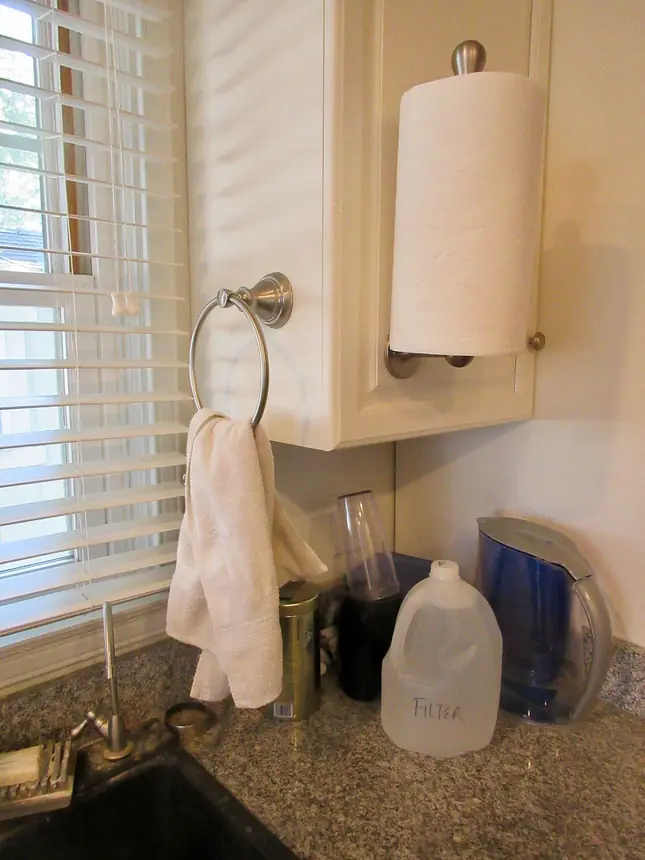
Ants get into a dishwasher for the same two things they want everywhere else in a kitchen: food and water. A dishwasher holds both for days at a time. Scraps settle in the filter, a film of grease and sugar coats the door gasket, and the sump at the bottom stays damp between loads. To a foraging ant that has found a gap behind the toe kick, it is a pantry with a built-in drinking fountain.
That covers most cases, and it is good news, because a foraging problem is fixable with cleaning and bait. The less common case is a colony using the moisture around the appliance, a slow leak at a hose or a soaked subfloor, as a reason to nest close by. Telling the two apart takes about ten minutes, and it changes what you should do next.
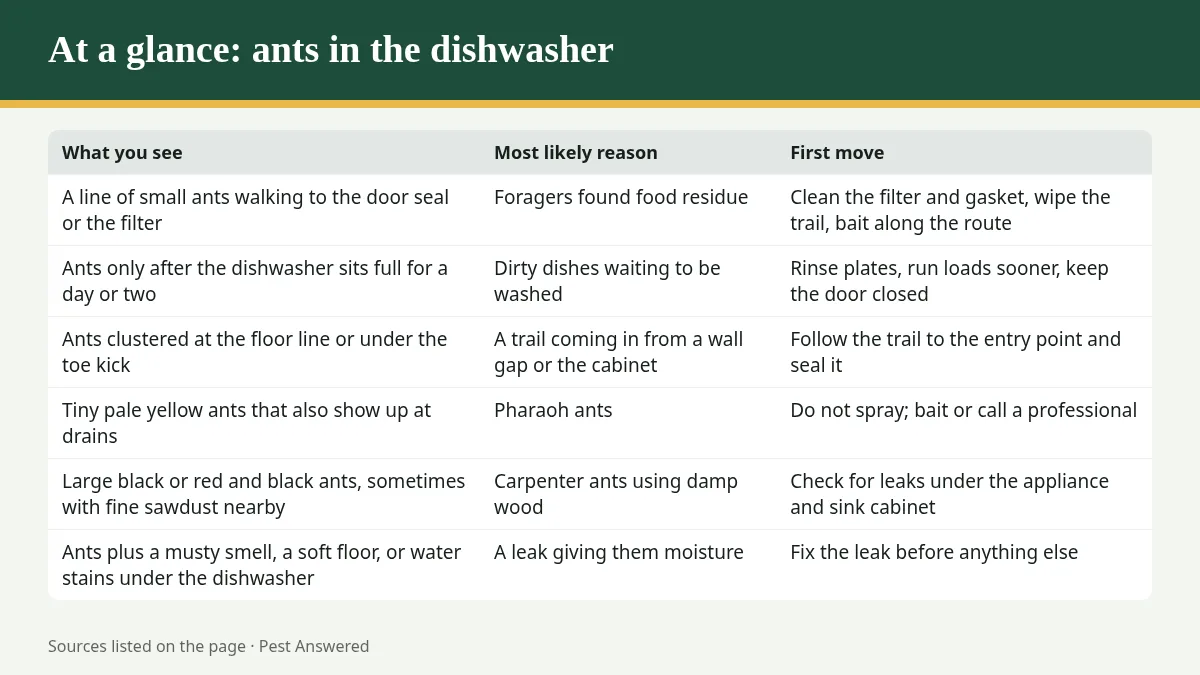 Graphic: summary of this guide, made by our team from the cited sources.
What you see, and where it points
| What you see | Most likely reason | First move |
|---|---|---|
| A line of small ants walking to the door seal or the filter | Foragers found food residue | Clean the filter and gasket, wipe the trail, bait along the route |
| Ants only after the dishwasher sits full for a day or two | Dirty dishes waiting to be washed | Rinse plates, run loads sooner, keep the door closed |
| Ants clustered at the floor line or under the toe kick | A trail coming in from a wall gap or the cabinet | Follow the trail to the entry point and seal it |
| Tiny pale yellow ants that also show up at drains | Pharaoh ants | Do not spray; bait or call a professional |
| Large black or red and black ants, sometimes with fine sawdust nearby | Carpenter ants using damp wood | Check for leaks under the appliance and sink cabinet |
| Ants plus a musty smell, a soft floor, or water stains under the dishwasher | A leak giving them moisture | Fix the leak before anything else |
Reason 1: the filter and gasket are feeding them
Every dishwasher catches food somewhere. Whirlpool's filter guide explains that the filter's job is to trap food particles and debris during wash cycles, and that manual clean filters collect the larger bits that can cause clogs. If nobody pulls that filter out and rinses it, the trapped scraps sit in a warm, wet cup at the bottom of the tub.
Whirlpool's general rule is to clean the filter once a month, and every two weeks if you have a large household or run the dishwasher daily. Its warning signs are the same ones ant-prone homes tend to have: dishes coming out dirty, unpleasant odors from the appliance, and visible soil on the filter.
The door gasket and the lower edge of the door are the other buffet. Syrup, juice, sauce and egg drip down the inside of the door as you load it, and some of that dries in the folds of the rubber seal where the spray arms never reach. Odorous house ants, one of the most common kitchen invaders, are drawn to exactly that. Penn State Extension says they mostly prefer sweets but will also feed on dead insects and grease.
What to do: Pull the filter and rinse it under running water. Whirlpool says a soft brush helps with stuck soil or hard water deposits, and to avoid wire brushes and scouring pads. Then wipe the gasket, the door edge and the bottom of the door frame with warm soapy water, which also handles the next problem.
Reason 2: the scent trail keeps leading them back
Ants find food, then mark the way home. The University of Kentucky's ant guide explains that ants lay invisible odor trails that the workers follow between food and the nest, and that the trail can often be followed back to where the ants are entering from outdoors. Once that trail runs to your dishwasher, new workers will keep arriving even after the food is gone, until the scent is cleaned off.
UC IPM's ant page recommends cleaning up invading ants with a sponge and soapy water as soon as they come in, to remove the scent trail. The National Pesticide Information Center gives the same advice. Plain soap and water does the job; you do not need vinegar or anything stronger on the trail.
Before you wipe, take two minutes to watch where the line goes. Kentucky points out that ants like to travel along lines and edges, so look along the toe kick, the seam where the countertop meets the wall, the cabinet frame beside the dishwasher, and the gap where the water and drain lines pass through the cabinet wall. That last spot is where many dishwasher trails start.
Reason 3: water, the part most people miss
Food gets the blame, but water is often the bigger draw. UC IPM says ants enter buildings seeking food and water, warmth and shelter, or refuge from dry, hot weather or flooded conditions, and it lists fixing leaky faucets among its prevention steps because water can attract ants.
A dishwasher has water in several places most people never look:
- the sump under the filter, which holds a little water between cycles by design
- the drain hose, which runs from the appliance into the sink drain or disposal
- the supply line connection behind the toe kick
- the floor under the unit, if a fitting has been weeping for months
That is also why ant trouble around a dishwasher often shows up during hot, dry weather. When the soil outside dries out, a damp kitchen cabinet looks very attractive.
What to do: With a flashlight, look under the sink at the drain hose and its clamp, and at the floor of the sink cabinet for stains or swelling. Then pull the toe kick panel if it comes off easily and look at the supply connection. A drip you find now is cheaper than the subfloor repair you would find later.
Reason 4: some ants nest near the moisture
This is the case that matters most for your house, not just your dishes.
Carpenter ants need damp wood. Ohio State's carpenter ant fact sheet says the parent nest is tied to wood with a moisture content above 15 percent, often caused by rain, leaks or condensation, and it lists dishwashers alongside window frames, crawl spaces and porch columns as places carpenter ant nests turn up. The University of Maine's carpenter ant bulletin is even more specific: kitchens and bathrooms are vulnerable because a leak in a water pipe, dishwasher hose or water heating system provides the moisture the ants require.
UC IPM describes carpenter ant workers as large, from 1/4 to 1/2 inch, black or red and black, and notes that they push sawdust-like material out of their nests. If you see big ants around the dishwasher and find fine shavings on the floor of the sink cabinet or under the appliance, treat it as a moisture and structure problem. Maine adds that worker carpenter ants wandering on kitchen counters and around sinks during the day are often coming in from an outdoor nest, so one large ant is not proof of a nest in the wall. Shavings plus a leak is a stronger signal.
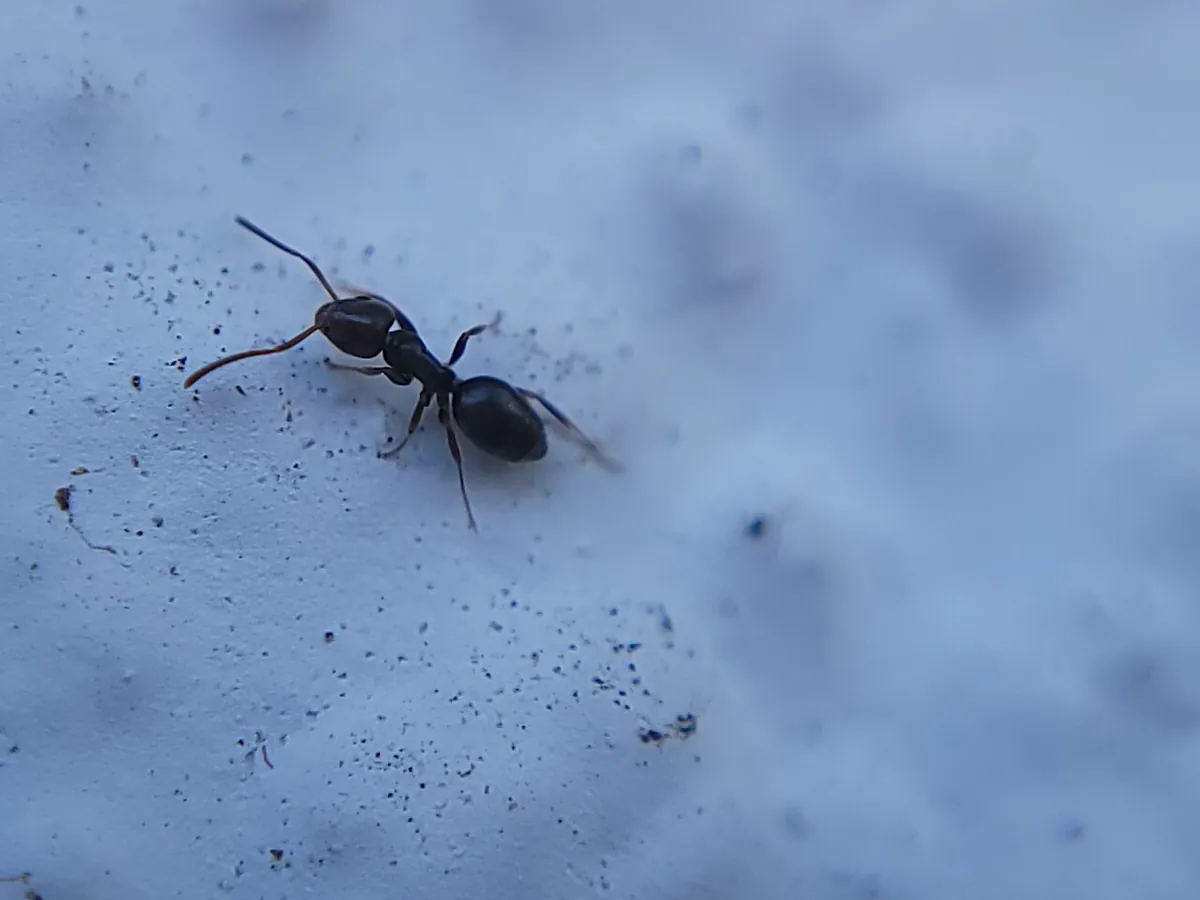
Odorous house ants can also move in close. Penn State says they nest indoors near sources of moisture and warmth, in voids. A dishwasher is warm after every cycle and sits in a hollow cabinet bay next to the sink plumbing, which is about as good as it gets for them.
Which ant is it? A quick ID for kitchen ants
You do not need a microscope for a first guess. Size, color, and one smell test sort most kitchen ants.
| Ant | Size and color | Kitchen clue | Source |
|---|---|---|---|
| Odorous house ant | 1/16 to 1/8 inch, dark brown to black | Rotten smell when crushed; loves sweets | Penn State, UC IPM |
| Argentine ant | 1/8 inch, dull brown | Long, busy trails; sweets, sometimes protein | UC IPM |
| Pharaoh ant | About 1/16 inch, light yellow to reddish brown | Shows up at drains, sinks and warm pipes | Ohio State |
| Carpenter ant | 1/4 to 1/2 inch, black or red and black | Sawdust-like shavings near damp wood | UC IPM, Ohio State |
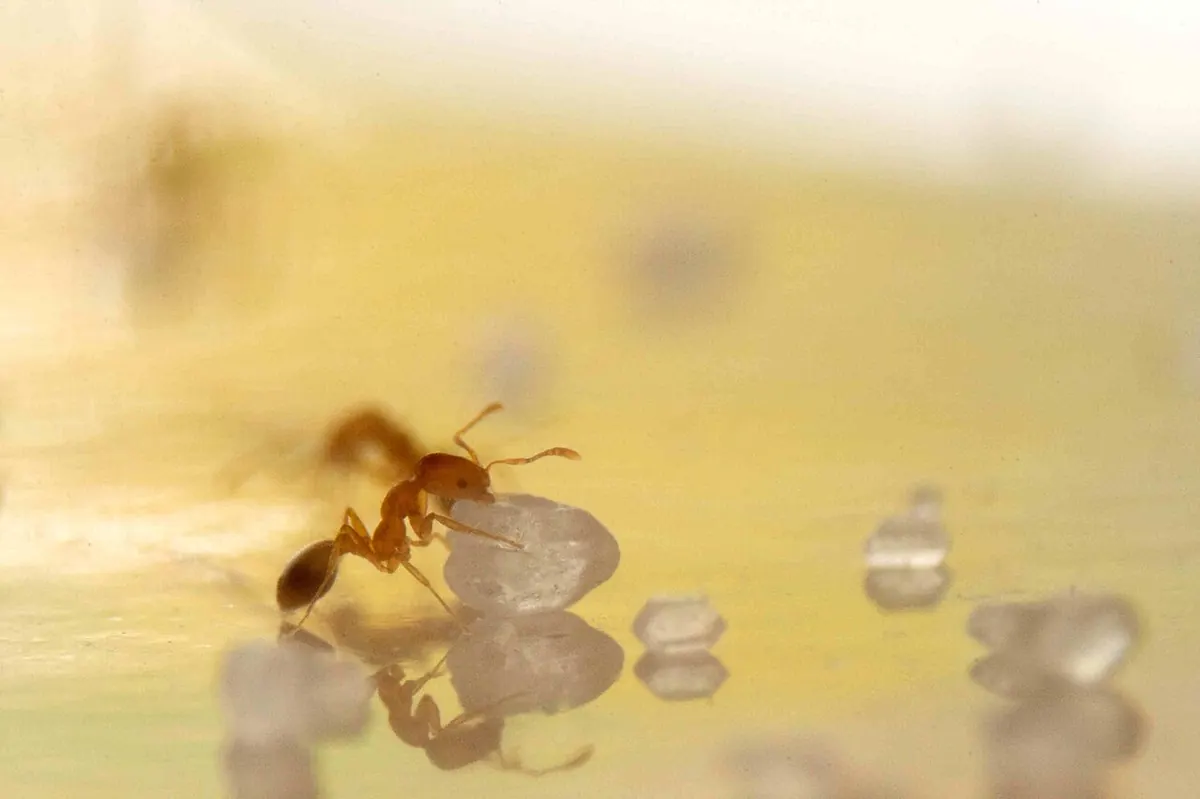
The Pharaoh ant row deserves a second look. Ohio State's Pharaoh ant fact sheet says these ants prefer dark, warm areas near hot water pipes and in kitchens, forage in drains and washbasins, and feed on greases, jellies and peanut butter among many other foods. A dishwasher plumbed into the hot water line and draining into the sink fits that description closely.
Why spraying the dishwasher backfires
The urge is to grab a can and soak the door. Every extension source we checked advises against that approach.
Kentucky says the mistake most people make is spraying only the ants they see. UC IPM says sprays give only temporary control, may not be safe to use indoors, and will not prevent more ants from entering. For Pharaoh ants it is worse: Ohio State says repellent pesticides can cause the colony to split, a habit called budding, and that repellent products such as pyrethrins may spread infestations to new areas of the building. You could start with ants in one appliance and end with ants in three rooms.
There is also the obvious problem of putting insecticide on the surfaces that touch your plates and cups. Running a cycle with vinegar or other home remedies will clean the tub, which helps, but it does nothing to the colony that sent the ants.
What works: clean, block, then bait outside the tub
This order matters. Baits work best when the ants have nothing better to eat.
1. Run the cleanup in one go. Clean the filter, wipe the gasket and door, rinse dishes before loading, and stop leaving a full load sitting for days. Wipe the ant trail on the floor and cabinet edges with soapy water. Store sweet foods nearby in sealed containers; UC IPM recommends clean, sealed containers rather than plastic bags or open packaging.
2. Fix the water. Repair any drip at the drain hose, supply line or sink trap. If you found swollen or soft wood under the sink or the dishwasher, get it dried out and repaired, because Ohio State calls eliminating high moisture an essential part of carpenter ant management.
3. Seal the way in. UC IPM and NPIC both recommend caulking cracks and openings ants use to enter. Look at the holes where the hoses and cable pass through the cabinet side, the gap at the back of the cabinet floor, and the baseboard line behind the toe kick.
4. Bait along the trail, not inside the dishwasher. Kentucky explains that bait combines a food attractant with a slow-acting insecticide, which foragers carry back and feed to the queens and the rest of the colony. Place bait stations or gel on the floor beside the trail, in the sink cabinet or behind the toe kick, where children and pets cannot reach them, as Penn State advises. Kentucky suggests putting gel on a strip of masking tape or wax paper to protect the surface, and warns not to spray other insecticides or cleaners around the bait, because that can keep the ants away from it.
For more on what to expect once the bait is down, see our guide on how long ant baits take to work.
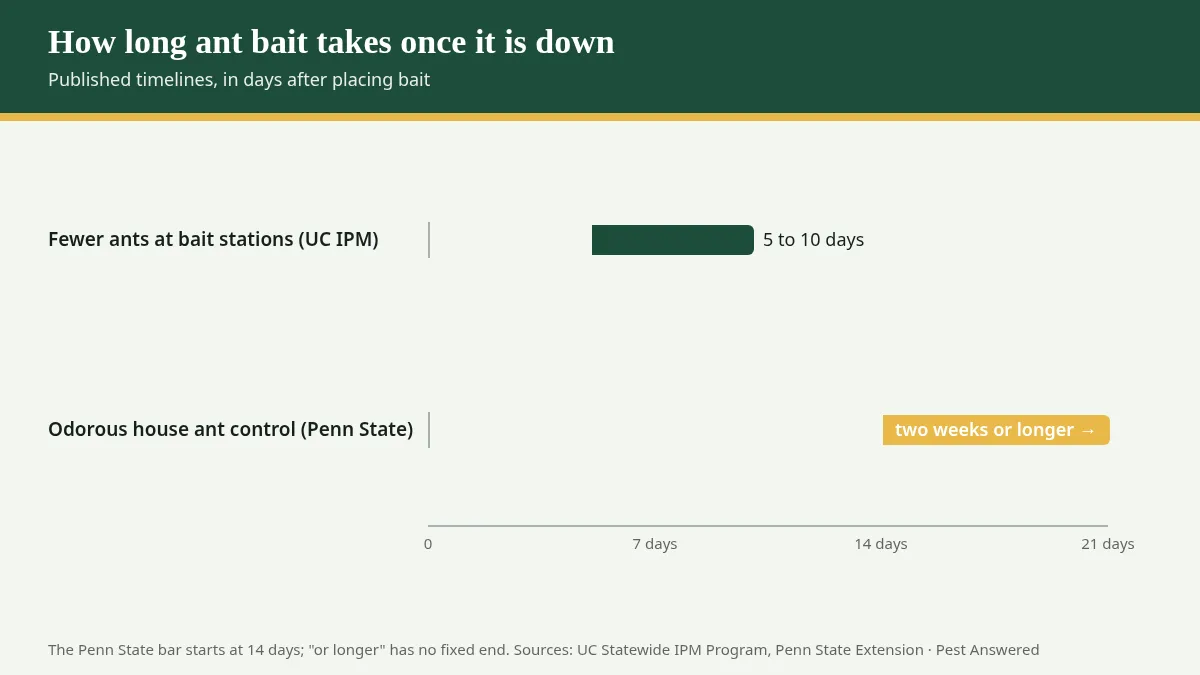 Graphic: made by our team from UC IPM and Penn State Extension figures (linked on this page).
Expect more ants at the bait for the first day or two. Kentucky says an increase around the bait is normal at first and tells readers not to spray them. UC IPM says it can take 5 to 10 days to see fewer ants, and Penn State says odorous house ant control may take two weeks or longer.
When to call a professional
Some dishwasher ant problems are worth handing off:
- Pharaoh ants. Ohio State says their treatment is best left to commercial applicators who have the right baits and understand baiting.
- Carpenter ants with shavings or damaged wood. You need both the nest found and the moisture source fixed, and the nest may be inside a wall or under the floor.
- Ants that come back after two or three weeks of steady baiting. UC IPM suggests asking a pest control company to use baits and spot treatments rather than monthly sprays.
A plumber may be the better first call if you found a leak. Ants that are there for water usually lose interest once the water is gone.
How to keep ants out of the dishwasher for good
Prevention is mostly routine:
- Clean the filter monthly, or every two weeks with daily use, following your model's manual.
- Scrape plates before loading and run the dishwasher instead of letting it sit full.
- Wipe the gasket and the bottom of the door every week or two.
- Leave the door closed between loads so the tub is not an open invitation.
- Check under the sink for drips every few months.
- Keep the outside of the house in mind too. UC IPM notes that outdoor nests are often near buildings and along sidewalks, so ants in the kitchen frequently start in the yard.
If you are also seeing ants in other rooms, our guide to why there are so many ants in the house covers how colonies decide to move in. If they turn up next to the tub or shower as well, read why ants show up only in the bathroom; the water story there is similar.
The short version
Ants in a dishwasher are almost always foragers after food in the filter and gasket, plus the water that sits in and around the appliance. Clean those, wipe the trail, seal the gaps around the hoses, and bait on the floor nearby instead of spraying the tub. Look harder if the ants are large carpenter ants or tiny pale Pharaoh ants, or if you find any sign of a leak. In those cases the dishwasher is only where you noticed them, and the real problem is somewhere in the cabinet, wall or floor.
Frequently asked questions
Can ants survive a dishwasher cycle?
Whether or not the ants caught in a cycle die, it does not help much. The University of Kentucky notes that the ants you see foraging are only a small part of the colony, so the nest keeps sending new workers along the same scent trail.
Should I spray bug spray inside the dishwasher?
No. UC IPM says sprays give only temporary control and may not be safe to use indoors, and Ohio State warns that repellent sprays can make Pharaoh ant colonies split and spread. A dish appliance is the last place you want pesticide residue.
Do ants in the dishwasher mean they are nesting inside it?
Usually not. Most ants in a kitchen are foragers walking in from a nest elsewhere. The exception is carpenter ants: Ohio State lists dishwashers among their indoor nest sites, and UMaine says a leaking dishwasher hose can supply the moisture they need.
How often should I clean the dishwasher filter to keep ants away?
Whirlpool's general rule is once a month, or every two weeks if you run the dishwasher daily or have a large household. A filter with food stuck in it is one of the easiest ant meals in the kitchen.
Sources
- Ants, UC Statewide IPM Program
- Odorous House Ant, Penn State Extension
- Pharaoh Ant (HYG-2136), Ohio State University Extension
- Carpenter Ants (HYG-2063), Ohio State University Extension
- Carpenter Ants (Bulletin 5007), University of Maine Cooperative Extension
- Ant Control for Householders (ENTFACT-619), University of Kentucky Entomology
- Ants, National Pesticide Information Center (NPIC)
- How to Clean the Dishwasher Filters, Whirlpool Product Help
Spotted an error? See our corrections policy or email contact@pestanswered.com.

Pest Answered Editorial Team
Our editors research each guide from the listed sources and check every claim before publishing. Editorial policy
Emanuel Jaramillo
Expert Contributor, Pest Control
Emanuel Jaramillo has 12 years of hands-on pest control experience and is bilingual in English and Spanish. He contributes field tips and reviews our practical guides on pest signs, identification, prevention and…
Related guides
-
 Ants
Why Are There So Many Ants in My House? What a Big Ant Crowd Really Means
Hundreds of ants usually means one colony found food, water or shelter and recruited its workers by scent trail. Why the numbers jump, which ant you have, and what stops them.
-
 Ants
How Long Do Ant Traps Take to Work? Real Timelines From Extension Experts
Most ant bait stations cut ant numbers in about 5 to 10 days, but some ants take two weeks or more and fire ant baits can take weeks to months. Timelines, why you see more ants first, and fixes.
-
 Ants
Why Are There Ants Only in My Bathroom? What It Usually Means
Ants that show up only in a bathroom are usually after water, warmth or the pipe runs they travel along. How to tell which ant it is, what to check, and when winged ones mean termites.
-
 Ants
Ants in Your Bed but No Food? Why They Come and How to Stop Them
Ants in a bed with no food are usually after water, warmth or a nest site, or are scouts from a colony in the wall. How to tell which ant you have and stop them, with UC IPM, NPIC and Penn State sources.