How Long Do Ant Traps Take to Work? Real Timelines From Extension Experts
 ✓ Reviewed by Emanuel Jaramillo
Published · Last reviewed · 6 min read
Most store-bought ant traps (bait stations) start cutting down a household ant problem in about 5 to 10 days. That is the window UC IPM gives for seeing fewer ants. Some kinds take longer: Penn State says odorous house ants can need two weeks or longer, and outdoor fire ant baits range from a few days to a couple of months depending on the active ingredient. If you see more ants in the first day or two, the bait is usually working.
The slowness is the point. A good bait does not kill the ant that finds it. That worker carries it home and shares it, so the poison reaches the ants you never see, including the queens. A bait that killed instantly would leave the nest untouched.
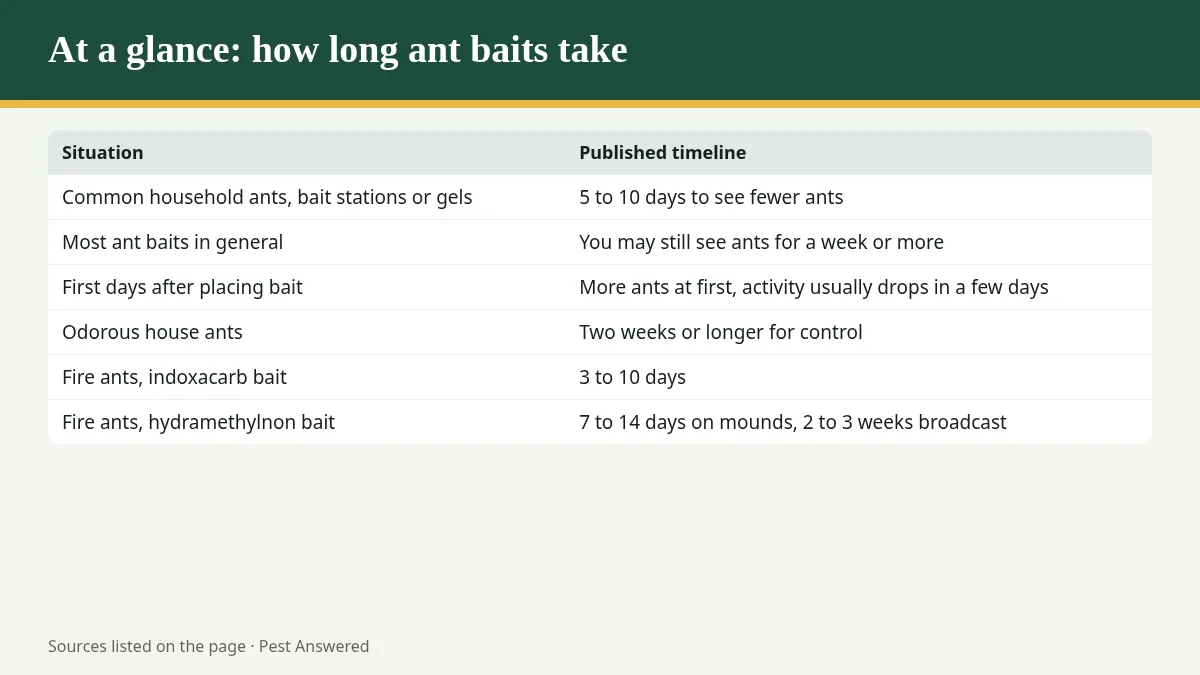 Graphic: summary of this guide, made by our team from the cited sources.
Ant bait timelines, by source
| Situation | Published timeline | Source |
|---|---|---|
| Common household ants, bait stations or gels | 5 to 10 days to see fewer ants | UC IPM |
| Most ant baits in general | You may still see ants for a week or more | NC State Extension |
| First days after placing bait | More ants at first, activity usually drops in a few days | University of Kentucky |
| Odorous house ants | Two weeks or longer for control | Penn State Extension |
| Fire ants, indoxacarb bait | 3 to 10 days | Texas A&M AgriLife |
| Fire ants, hydramethylnon bait | 7 to 14 days on mounds, 2 to 3 weeks broadcast | Texas A&M AgriLife |
| Fire ants, insect growth regulator baits | 1 to 2 months in spring, 6 months in fall | Texas A&M AgriLife |
| Fire ant baits, maximum control | 2 to 6 weeks depending on bait | Mississippi State Extension |
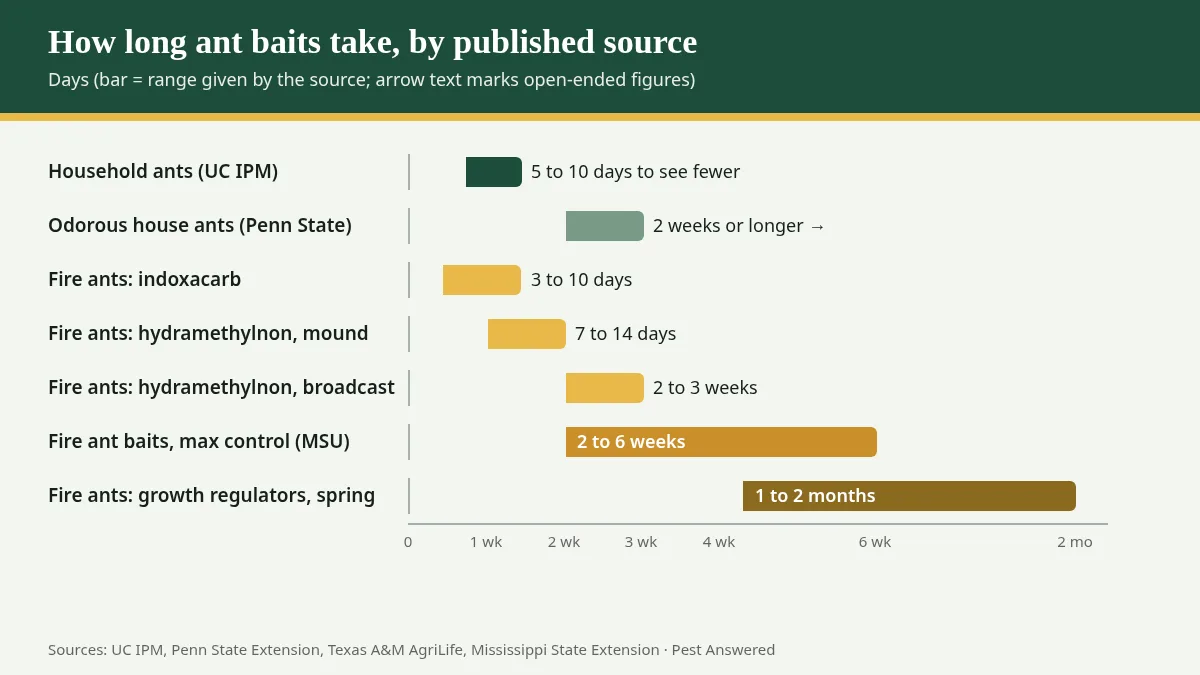 Graphic: made by our team from UC IPM, Penn State, Texas A&M AgriLife and Mississippi State Extension figures (linked on this page).
None of these are guarantees. Colony size, how many queens the colony has, the weather and whether the ants have other food all change the clock.
What normal looks like in the first two weeks
Day 1 to 3: more ants, not fewer. The University of Kentucky's ant control guide says you should at first see an increase in ants around the bait, and stresses: do not spray them. It means they are feeding and carrying the bait back to the nest.
Day 3 to 10: traffic thins out. Kentucky says activity usually subsides in a few days as the colony declines. UC IPM's 5 to 10 day window for seeing fewer ants falls here.
Week 2 and beyond: stragglers. NC State Extension notes most baits are slow-acting, so you may keep seeing some ants for a week or more. Large colonies may need baits in several spots.
When to stop. NC State says to leave bait in place for 3 to 4 days after you see no more ants feeding on it.
Why your ant traps are not working yet
If two weeks have passed and nothing has changed, one of these is usually the reason.
- The ants are not eating it. NC State suggests putting bait where ants are walking and watching for a few minutes. If they show no interest, try a different bait until you find one they readily eat.
- Wrong food type. UC IPM says Argentine ants find sweet baits attractive year-round and protein baits mainly in spring, while thief ants and Pharaoh ants prefer protein or greasy baits. Ant preferences can also change through the year, so offering more than one type helps.
- The bait ran out. NC State says to check bait daily. If ants carry it all away before you refill it, they may leave and forage somewhere else before the colony is gone. Penn State gives the same advice for odorous house ants: keep replacing used baits.
- Something else is on the menu. Baits work best when ants have no other food. Wipe up crumbs and spills, keep food sealed and wipe ant trails with soapy water, as NPIC suggests.
- Someone sprayed. UC IPM says not to use insecticide sprays while you are using baits, and Kentucky warns sprays and cleaners near bait placements can keep ants away from it.
- Old bait. UC IPM notes baits can dry up or go rancid and stop attracting ants, so refresh stations regularly.
- A product that only looks like bait. UC IPM warns against granules containing cyfluthrin or permethrin. They can be mistaken for baits but are contact insecticides that kill foragers quickly and do not control the colony.
If ants seem to come out of nowhere in one room, our guide to why ants show up only in the bathroom explains how pipes, water and warmth draw them in.
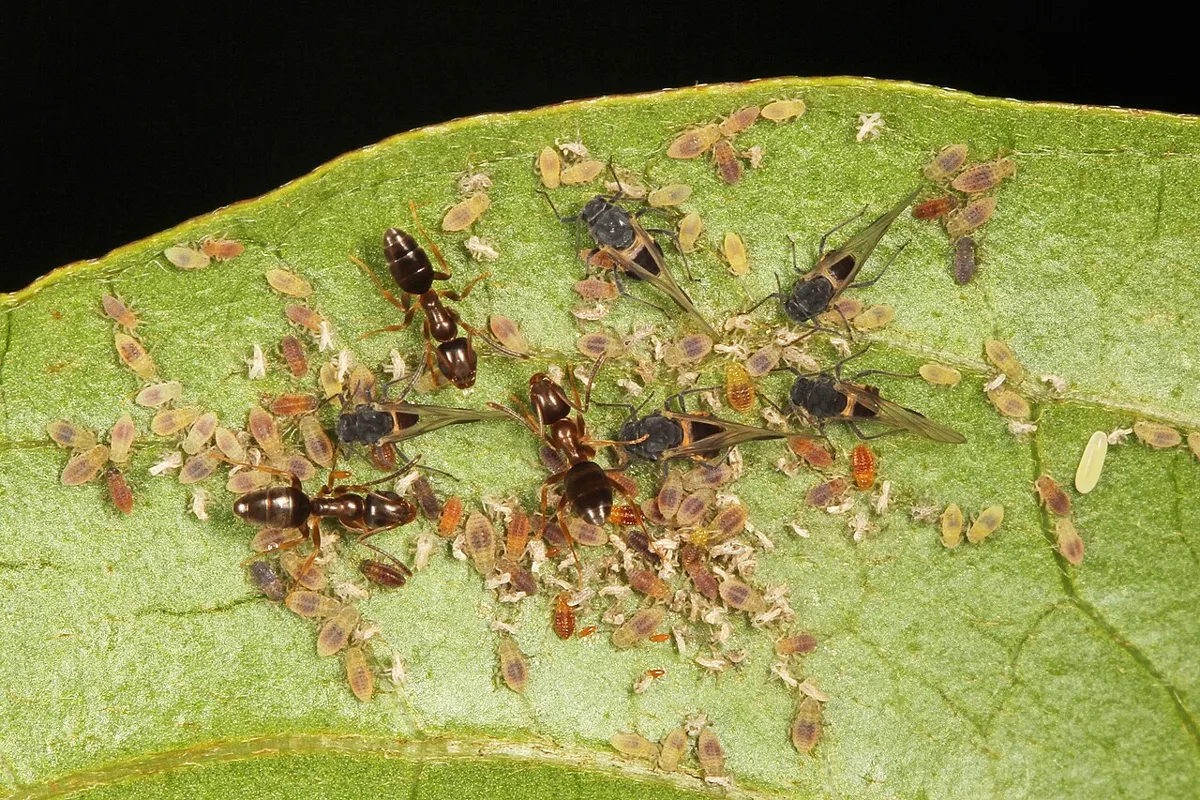
Odorous house ants: plan on two weeks or more
Kentucky calls the odorous house ant the most common and difficult ant to control in Kentucky and much of the Midwest. Penn State says the baits that work are slow-acting, so workers share them before they die, and that it may take two weeks or longer to get control. Keep replacing used baits so the colony always has enough. UC IPM lists this ant as preferring sweets, sometimes proteins. Its nests can sit in wall voids and around water pipes or heaters, so the ants you see are often a small part of the colony.
Carpenter ants: slower, and baits are not always enough
For carpenter ants, UC IPM explains why baits take time: only about 10 percent of the ants are out foraging at any one time, so the bait has to be carried back and shared. Carpenter ants are also finicky. UC IPM suggests first attracting them with a nontoxic food such as sugar milk, diced crickets or mealworms, then switching to a bait once they are feeding. Only use a product whose label lists carpenter ants.
Because carpenter ants nest in wood, often wood that has been wet, a slow result can also mean the nest needs to be found and treated directly. That is a job for a pest professional.
Fire ant baits in the yard: days to months
Outdoor fire ant baits are granules spread on mounds or over the whole yard, and their timing depends on the active ingredient. Texas A&M AgriLife lists:
- Indoxacarb: works in 3 to 10 days.
- Hydramethylnon: 7 to 14 days on individual mounds, 2 to 3 weeks when broadcast.
- Spinosad: several weeks.
- Insect growth regulators (abamectin, fenoxycarb, methoprene, pyriproxyfen): 1 to 2 months when applied in spring and 6 months when applied in fall. Texas A&M says these slower products last longer, while the faster ones may need re-applying more often.
Mississippi State Extension puts it simply: depending on the bait, it can take 2 to 6 weeks to get maximum control. Its guide also explains why baits must be slow: adult workers cannot eat solid food, so they carry the bait to the larvae, which digest it and pass it back.
UC IPM adds that baiting in late winter and early spring, when ant populations are just starting to grow, gives the most effective control.
Keep it safe while you wait
- Read the label first. It is the law. UC IPM says to make sure ants are listed as a target pest, and the label tells you where the product may be used.
- Place it out of reach. NC State says keep bait away from children, pets and wildlife, and never put it directly on countertops where food is prepared.
- No sprays near baits, and no bug bombs for Pharaoh ants. Ohio State says total release aerosols do not work on them, and repellent sprays can make Pharaoh ant colonies split and spread.
- No home mixes or dosing. Use only products sold and labeled for ants, as directed.
If ants are turning up in bedrooms with no food around, see why ants get into a bed when there is no food.
When to call a pest professional
- Two to three weeks of steady baiting, with fresh bait the ants are actually eating, has not cut the numbers.
- Tiny yellowish ants around drains, kitchens or bathrooms. Ohio State says Pharaoh ant control is best left to commercial applicators who understand baiting.
- Large black ants with sawdust-like debris near wood, which UC IPM lists as a sign of carpenter ant nests.
- Fire ants close to where children or pets play, or anyone in the home is allergic to stings.
Frequently asked questions
How long does it take for ant traps to work?
For common house ants, expect fewer ants in about 5 to 10 days, according to UC IPM. NC State says you may still see some ants for a week or more because baits are slow on purpose. Odorous house ants can take two weeks or longer (Penn State), and outdoor fire ant baits take from days to months depending on the active ingredient (Texas A&M).
Why are there more ants after I put out ant traps?
That is usually a good sign. The University of Kentucky says you should at first see more ants around the bait, which means they are feeding and carrying it back to the nest. Do not spray them. Activity usually drops within a few days as the colony shrinks.
How long should I leave ant bait stations out?
Keep them stocked until the ants stop coming. NC State says to check bait daily so it never runs out, and to leave it in place for 3 to 4 days after you see no more ants feeding on it.
How long does ant bait take to work on carpenter ants?
Longer than for small sugar ants, and results vary. UC IPM says only about 10 percent of carpenter ants are out foraging at any one time and they are finicky eaters, so baits work slowly. A professional can find and treat the nest directly if baiting does not settle things.
What if the ants ignore the bait?
Try a different kind. UC IPM says Argentine ants like sweet baits year-round, while thief ants and Pharaoh ants prefer protein or greasy baits. NC State suggests watching for a few minutes after placing bait; if the ants show no interest, switch until you find one they readily eat.
Sources
- Ants, UC Statewide IPM Program
- Carpenter Ants, UC Statewide IPM Program
- Tips for Effective Ant Baiting, NC State Extension
- Ant Control for Householders (ENTFACT-619), University of Kentucky Entomology
- Odorous House Ant, Penn State Extension
- Pharaoh Ant (HYG-2136), Ohio State University Extension
- Fire Ant Control Methods, Texas A&M AgriLife Extension
- Control Fire Ants in Your Yard, Mississippi State University Extension
- Ants, National Pesticide Information Center (NPIC)
Spotted an error? See our corrections policy or email contact@pestanswered.com.

Pest Answered Editorial Team
Our editors research each guide from the listed sources and check every claim before publishing. Editorial policy
Emanuel Jaramillo
Expert Contributor, Pest Control
Emanuel Jaramillo has 12 years of hands-on pest control experience and is bilingual in English and Spanish. He contributes field tips and reviews our practical guides on pest signs, identification, prevention and…
Related guides
-
 Ants
Why Are There Ants Only in My Bathroom? What It Usually Means
Ants that show up only in a bathroom are usually after water, warmth or the pipe runs they travel along. How to tell which ant it is, what to check, and when winged ones mean termites.
-
 Ants
Ants in Your Bed but No Food? Why They Come and How to Stop Them
Ants in a bed with no food are usually after water, warmth or a nest site, or are scouts from a colony in the wall. How to tell which ant you have and stop them, with UC IPM, NPIC and Penn State sources.
-
 Mice & Rats
When Do Mice Come Out? Night, Dusk and Before Dawn, and What a Daytime Mouse Means
House mice are most active at night, with feeding peaks at dusk and just before dawn. Why you sometimes see them in daylight, what time of year they move indoors, and when to set traps.
-
 Cockroaches
How Fast Do Cockroaches Multiply? Real Numbers by Species
German cockroaches can go from one female to thousands in under a year. Sourced per-year numbers for German, American, brownbanded and oriental roaches, plus a day-by-day timeline and how to slow it down.