When Do Mice Come Out? Night, Dusk and Before Dawn, and What a Daytime Mouse Means
 ✓ Reviewed by Emanuel Jaramillo
Published · Last reviewed · 5 min read
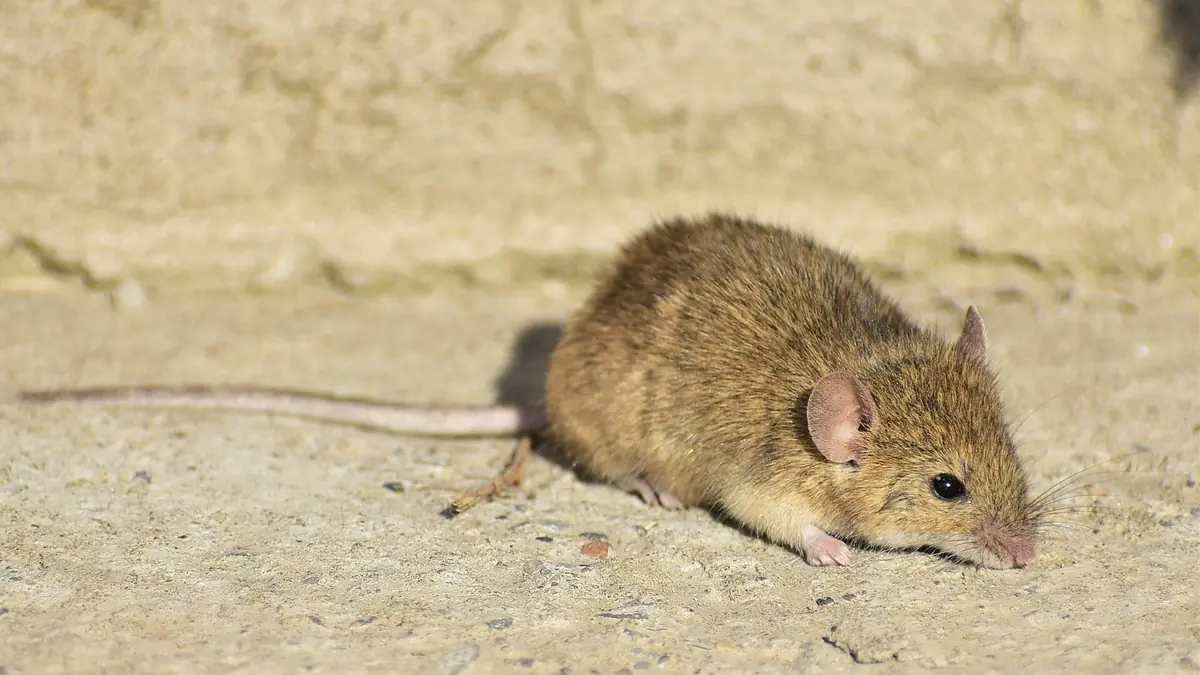
Mice come out mostly at night. The University of Arizona describes two main feeding periods for house mice, one at dusk and one just before dawn, with smaller snacks in between (University of Arizona). UC IPM adds that mice are active whenever food is available, so you may see one in daylight too (UC IPM).
The useful takeaways: set and check traps around those hours, and treat regular daytime sightings as a warning sign.
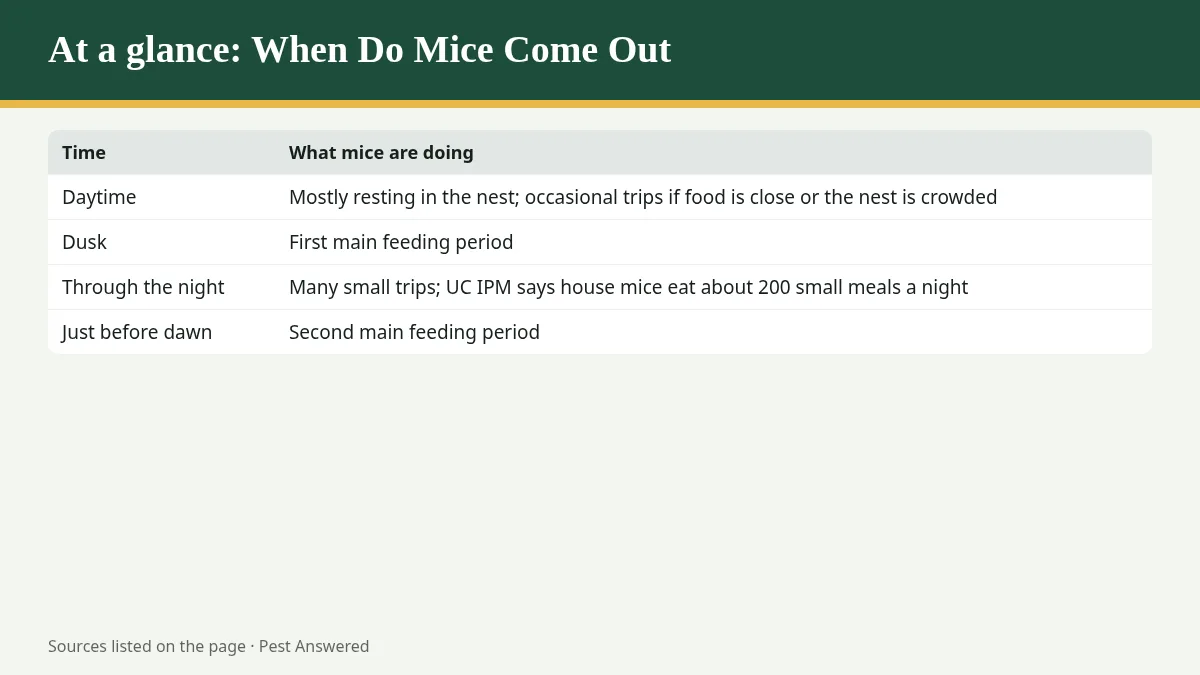 Graphic: summary of this guide, made by our team from the cited sources.
A mouse's day
| Time | What mice are doing |
|---|---|
| Daytime | Mostly resting in the nest; occasional trips if food is close or the nest is crowded |
| Dusk | First main feeding period |
| Through the night | Many small trips; UC IPM says house mice eat about 200 small meals a night |
| Just before dawn | Second main feeding period |
Sources: feeding periods from University of Arizona; 200 small meals from UC IPM.
All those small meals add up. UC IPM says house mice eat up to 20% of their body weight a day, and they either eat at the food source or carry food away to a hidden spot (UC IPM). This is why you find droppings and crumbs in drawers, not just near the food.
Why mice prefer the dark
Mice are built for low light. NC State says they have poor eyesight with little to no color vision and rely on hearing, smell, taste and touch (NC State). A review of mouse vision found their retinas are dominated by rods, which work in dim light, and that they are sensitive to movement but have poor visual sharpness (Latham and Mason 2004). Moving at night along walls, where whiskers can guide them, keeps them away from predators and people.
Seeing a mouse in the daytime
UC IPM says house mice are seen occasionally during daylight (UC IPM). One daytime sighting near a food source isn't unusual. Daytime activity that you see again and again usually points to one of these:
- A large population. More mice compete for food and some forage at less safe times.
- Easy food. Pet food, birdseed or an open pantry shelf near the nest.
- A disturbed nest. Renovation, moving boxes or a cleaning push can flush them out.
How far a mouse goes at night
Not far. House mice seldom travel more than 30 feet from their nest and food (UC IPM). A mouse nesting behind your stove may spend every night in the kitchen and never visit the bedroom. That is why UC IPM tells you to space traps no more than about 10 feet apart where mice are active (UC IPM).
Mice are also curious. The University of Arizona says that if something changes position or is out of place, mice will explore it and adjust their travel routes (University of Arizona). Utah State says mice investigate new objects in their home range every day (USU). Unlike rats, they do not usually avoid a new trap for days, so a well-placed trap often works the first night.
Signs of night activity when you never see a mouse
Most people never see the mouse. They see what it did overnight:
- Droppings 1/8 to 1/4 inch long, rod-shaped with pointed ends (University of Arizona). NC State says one mouse can leave 50 to 75 a day (NC State).
- Gnaw marks on wood, cardboard and soft plastic, and chewed food boxes (University of Arizona).
- Rub marks: dirty streaks along baseboards and walls (University of Arizona).
- Sounds. Scratching in walls after dark. NC State says mice also make soft chittering and squeaking noises that people can hear (NC State).
Do mice come out more in certain seasons?
Indoors, mice can stay active all year. UC IPM says house mice with steady food and shelter can breed year-round (UC IPM). A female can have 5 to 10 litters a year (NC State). Outdoors, the big change is autumn, when mice move into buildings as nights turn cold (see below).
Do lights, noise or sound devices keep them in hiding?
Not reliably. UC IPM says high-frequency electronic devices aren't effective against house mice (UC IPM). Mice also hear well into the ultrasonic range (NC State), but hearing a sound is not the same as being driven off by it. Leaving lights on may make a mouse more cautious, but it will still come out for food when it is hungry. Removing food and sealing entry points works better than trying to scare mice.
When they come inside
Season matters as much as time of day. UC IPM says outdoor house mice frequently enter homes in autumn when nighttime temperatures become colder (UC IPM). Fall is the time to check door sweeps and gaps around pipes. A mouse can squeeze under a 1/4-inch gap, and our page on how mice get up walls covers how they reach higher openings.
House mouse or deer mouse?
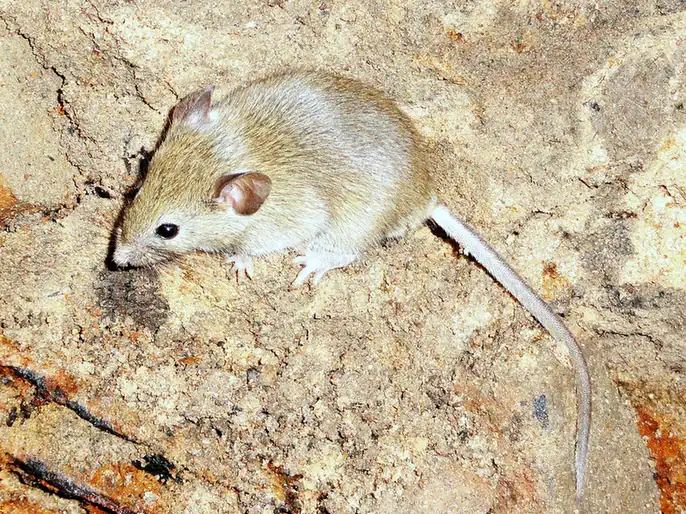
The timing advice here is for the house mouse, the gray-brown mouse that lives in buildings. NC State says house mice are more used to living around people than deer mice and field mice, and some spend their whole lives inside a building (NC State).
Deer mice matter for a different reason. The CDC says the most common hantavirus that causes hantavirus pulmonary syndrome in the U.S. is spread by the deer mouse, and that people usually get it from contact with rodent urine, droppings and saliva (CDC). Symptoms usually start 1 to 8 weeks after contact (CDC). If you find mice in a cabin, shed or garage, especially in rural areas, follow the CDC cleanup steps below and do not sweep up droppings.
Using their schedule against them
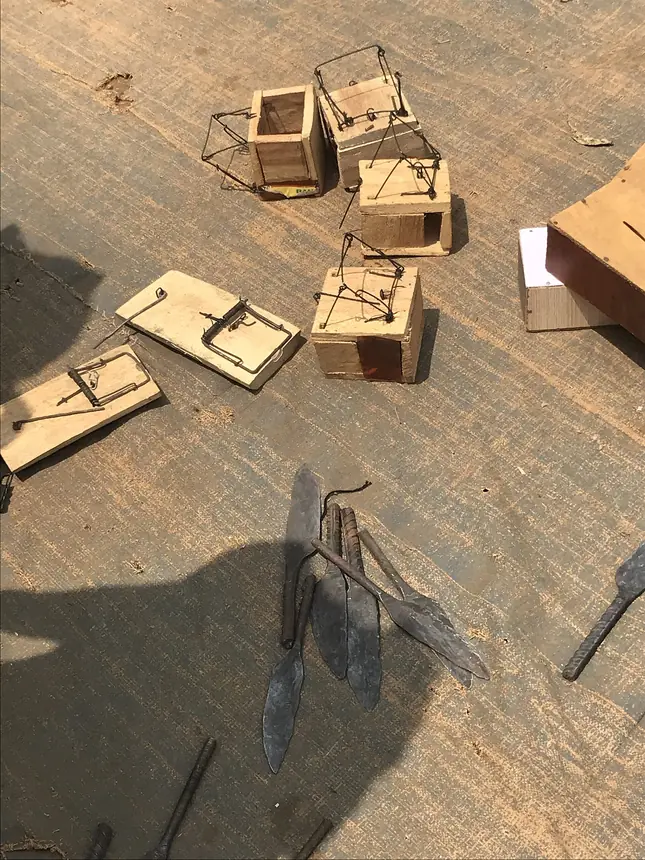
- Set traps in the late afternoon, before the dusk feeding period, along walls where you find droppings.
- Check them first thing in the morning, after the pre-dawn feeding.
- Remove food overnight. Put pet food away and seal pantry items in hard containers so the traps are the easiest meal around.
- Listen at night. Scratching inside walls after dark tells you where the nest is.
- Clean up the right way. Mice spread Salmonella in their droppings (University of Arizona). The CDC says to wear gloves, spray droppings with disinfectant until wet, wait 5 minutes and wipe with paper towels. Do not sweep or vacuum (CDC).
If the noise is coming from inside a wall, our guide to a mouse in the wall explains how to trap at the exits. If you are not sure whether you're dealing with mice at all, compare the droppings with our guide to what mouse poop looks like.
Frequently asked questions
What time do mice come out at night?
There is no exact clock time. The University of Arizona says house mice have two main feeding periods, at dusk and just before dawn, and nibble at other times through the night.
Is it bad if I see a mouse during the day?
It can be a sign of a bigger problem. UC IPM says mice are active when food is available, and are seen occasionally in daylight; regular daytime sightings usually mean many mice or a disturbed nest.
Do lights keep mice away?
Not reliably. Mice see poorly and rely on smell, hearing and touch. Leaving lights on may make them more cautious, but it does not stop them feeding.
What time of year do mice come inside?
UC IPM says outdoor house mice frequently enter homes in autumn when nighttime temperatures get colder.
Sources
- Pest Notes: House Mouse, UC Statewide IPM Program
- House Mice, University of Arizona Cooperative Extension
- Biology and Behavior of Common Structure-Invading Mice, NC State Extension
- Laboratory mice: vision (Latham and Mason, 2004), Applied Animal Behaviour Science
- Surveillance and Management of Common Structure-Invading Mice, NC State Extension
- Rats and Mice IPM manual, Utah State University Extension
- Cleaning Up After Rodents, CDC
- About Hantavirus, CDC
Spotted an error? See our corrections policy or email contact@pestanswered.com.

Pest Answered Editorial Team
Our editors research each guide from the listed sources and check every claim before publishing. Editorial policy
Emanuel Jaramillo
Expert Contributor, Pest Control
Emanuel Jaramillo has 12 years of hands-on pest control experience and is bilingual in English and Spanish. He contributes field tips and reviews our practical guides on pest signs, identification, prevention and…
Related guides
-
 Mice & Rats
Hearing Mice in the Walls but No Droppings? What It Could Be and How to Check
Noise in the walls with no droppings in sight usually means mice that stay in the wall void, or a different animal. How to check for mice, squirrels and other causes before you treat.
-
 Mice & Rats
Do Mice and Rats Live Together? Rarely Side by Side, but You Can Have Both
Rats prey on mice and compete with them, so they rarely share space closely, but one building can have both. How to tell if you do, and why getting rid of rats can bring out mice.
-
 Mice & Rats
Do Mice Turn Into Rats? No. How to Tell a Young Rat From an Adult Mouse
Mice never grow into rats: they are different species with different chromosome counts. How to tell a young rat from an adult mouse by head, feet, droppings and gnaw marks.
-
 Mice & Rats
Mouse in the Wall? How to Confirm It and Get It Out Without Opening the Wall
Scratching in the wall at night is often mice. How to confirm it, why poison is a bad idea inside walls, and how to trap mice at the wall's exits and then seal the gaps.