Do Mice Turn Into Rats? No. How to Tell a Young Rat From an Adult Mouse
 ✓ Reviewed by Emanuel Jaramillo
Published · Last reviewed · 4 min read
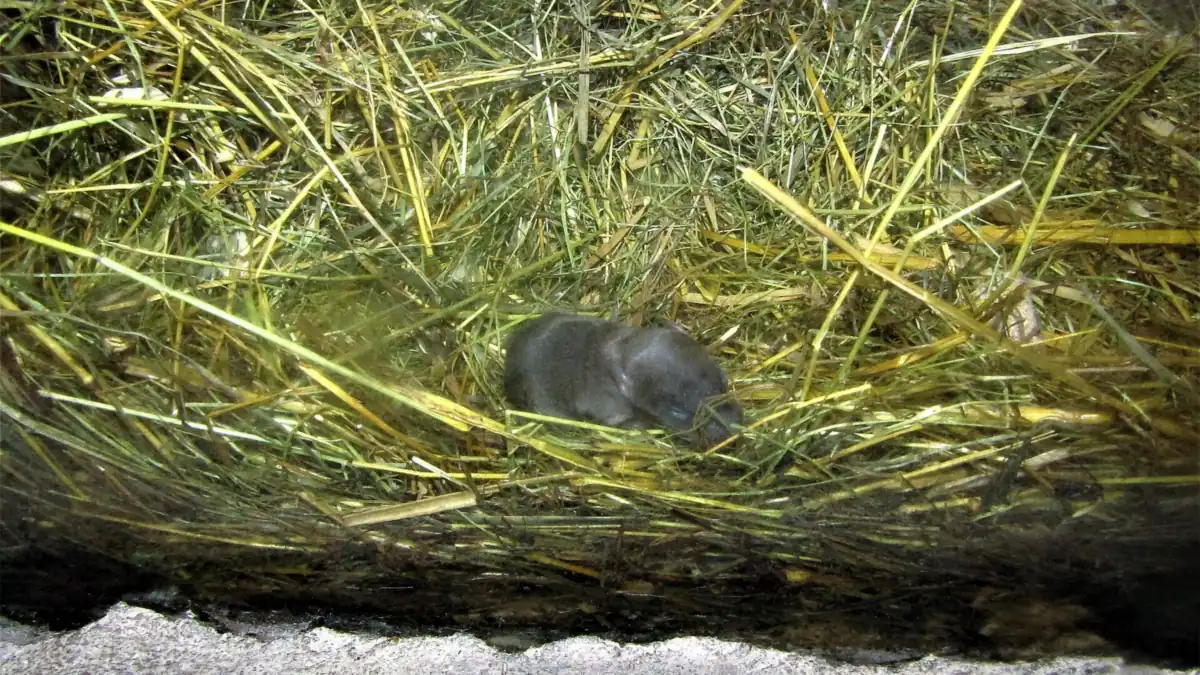
No. Mice do not turn into rats. The house mouse (Mus musculus) and the two common pest rats, the Norway rat (Rattus norvegicus) and the roof rat (Rattus rattus), are different species. Mice have 40 chromosomes and rats have 42, and the two do not breed with each other (WSU). A mouse stays a mouse its whole life.
The myth survives because a young rat really can look like a mouse. UC IPM says outright that "a young rat can be confused with a mouse" (UC IPM Rats). The rest of this page is about telling them apart, because that decides which traps and repairs will work.
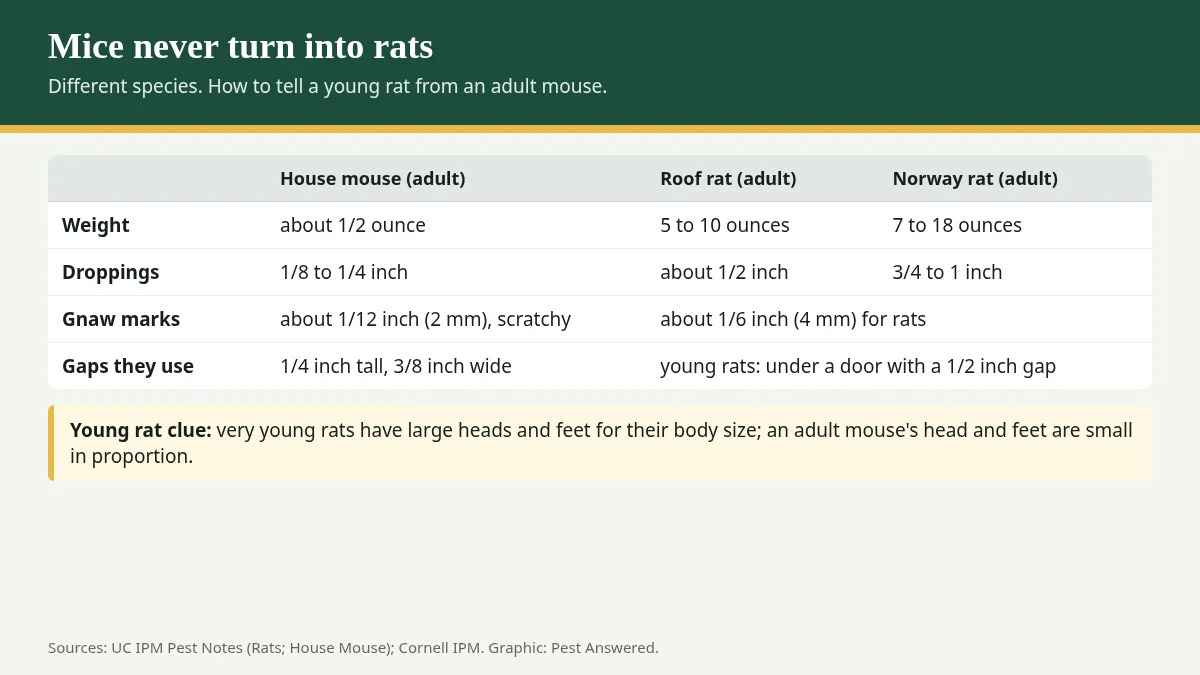 Graphic: summary of this guide, made by our team from the cited sources.
Why people think mice grow into rats
Most people see a rodent for a second, in poor light, running along a wall. A half-grown rat and a full-grown mouse can be close in size. If you saw a "mouse" in spring and a much bigger animal in the same spot in summer, it is tempting to think the first one grew. What usually happened is that you had rats all along, or you have both. Utah State's school IPM manual notes that rats prey on mice and compete with them for food and shelter, so removing rats often makes mice more visible (USU).
How big each one gets

| House mouse | Roof rat | Norway rat | |
|---|---|---|---|
| Adult weight | about 1/2 ounce | 5 to 10 ounces | 7 to 18 ounces |
| Size and build | 5 to 7 inches including a 3- to 4-inch tail | tail longer than head and body | larger and stockier than the roof rat |
| Droppings | 1/8 to 1/4 inch | about 1/2 inch | 3/4 to 1 inch |
Sources: weights and lengths from UC IPM House Mouse and UC IPM Rats; dropping sizes from Cornell IPM.
By our arithmetic from those figures, an adult rat weighs 10 to 36 times as much as an adult mouse. That gap closes only when the rat is young.
Young rat or adult mouse: the four checks
1. Head and feet
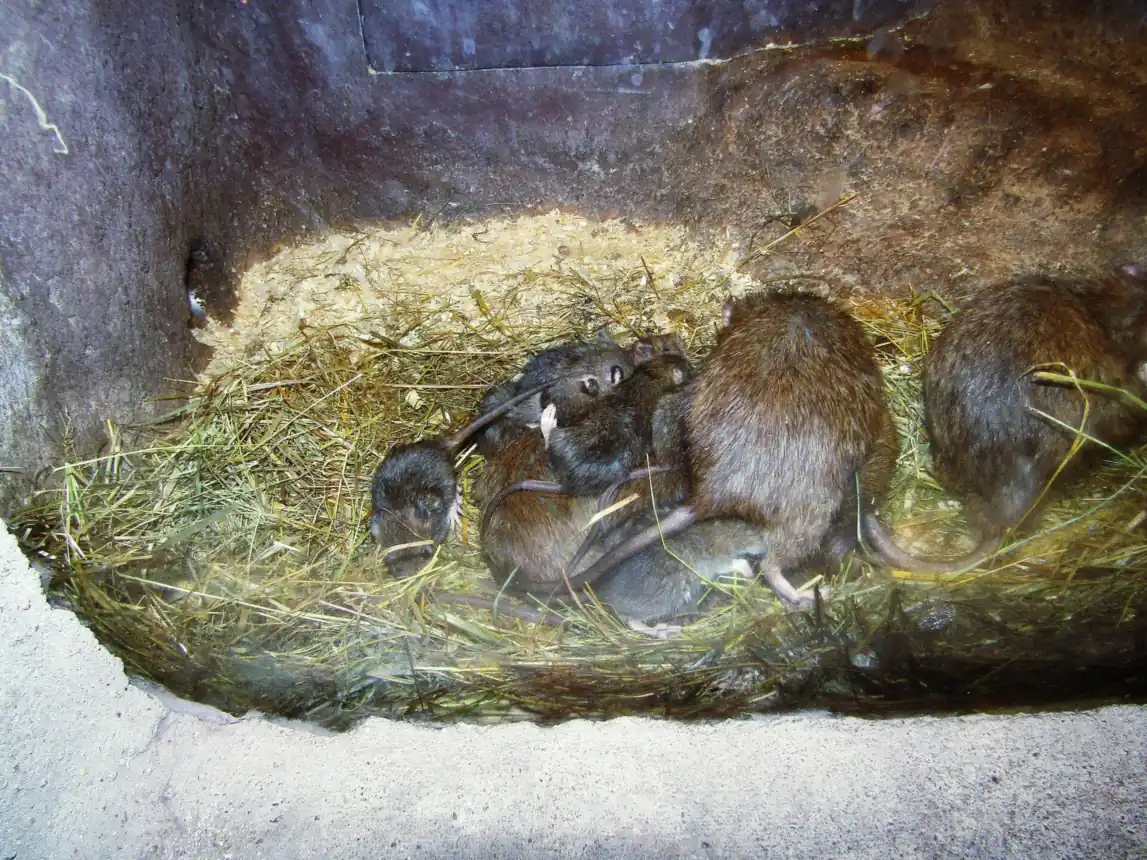
This is the most reliable field check. UC IPM says very young rats have large heads and feet in proportion to their bodies, while those of adult mice are proportionately much smaller (UC IPM Rats). A young rat looks "oversized at the ends", like a puppy with big paws.
2. Ears, eyes and nose
Cornell IPM describes adult mice, compared with juvenile rats, as having large ears and eyes and a pointier nose (Cornell IPM). A Norway rat of any age has a blunter snout and smaller ears for its head.
3. Gnaw marks
UC IPM gives a measurement you can check with a ruler: rats leave tooth marks about 1/6 inch (4 mm) wide, while mice leave "scratchy marks" of about 1/12 inch (2 mm) (UC IPM Rats). Look at chewed corners of food boxes, baseboards and the edges of entry holes.
4. Droppings
Droppings are often the easiest evidence to find. Mouse droppings are 1/8 to 1/4 inch long; roof rat droppings are about 1/2 inch and Norway rat droppings 3/4 to 1 inch (Cornell IPM). Young rats leave smaller droppings than adults, so if you find a mix of sizes in one area, suspect rats. Our mouse vs rat identification guide has more side-by-side signs.
How fast each one grows up
Speed of growth is part of the confusion. A house mouse is sexually mature at about 35 days and usually lives about a year (University of Arizona). A young mouse reaches adult size quickly and then stops. A young rat keeps growing for months. So a rodent that keeps getting bigger over a season was a rat from the start.
Why the answer changes what you do
Traps. UC IPM warns that mice and small juvenile rats often won't trigger a rat snap trap (UC IPM Rats). If you set rat traps and catch nothing, the culprit may be too light to spring them. If you set mouse traps for a rat, it may take the bait and walk away.
Patience. Rats quickly detect and tend to avoid new objects and foods, so they often avoid traps and baits for the first several days, sometimes weeks (UC IPM Rats). Mice are more curious and will usually check out a new trap sooner.
Sealing. House mice can squeeze under gaps 1/4 inch tall and through openings 3/8 inch wide (UC IPM House Mouse). Young rats can get under a door with a 1/2-inch gap, and may gnaw a wooden door to widen it (UC IPM Rats). Sealing every opening larger than 1/4 inch covers both. If you are not sure how they are getting up high, see what mice can and can't climb.
A quick check you can do today
- Find the busiest spot: along a kitchen wall, behind the stove, under the sink.
- Lay a ruler next to the droppings and take a photo.
- Check nearby gnaw marks against the 2 mm vs 4 mm widths above.
- If you catch or see the animal clearly, compare the size of its head and hind feet to its body.
- If the droppings are 1/2 inch or longer, or the gnaw marks are wide, treat it as a rat problem and use rat-sized traps.
When you clean up droppings, wet them with disinfectant first and don't sweep or vacuum them dry; the CDC explains why in its rodent cleanup guidance.
Frequently asked questions
Can a mouse grow into a rat?
No. The house mouse and the Norway and roof rats are separate species. A mouse stops growing at mouse size, about half an ounce, and a rat starts life as a rat pup.
Can mice and rats breed together?
No. Mice have 40 chromosomes and rats have 42, and the two do not breed with each other naturally.
Is a small rodent in my kitchen a baby rat or a mouse?
Look at the head and feet. UC IPM says very young rats have large heads and feet for their body size, while an adult mouse's head and feet are small in proportion.
Why does it matter which one I have?
Traps and sealing work differently. Mice and small young rats often won't set off a rat-sized snap trap, rats avoid new objects for days, and the gap sizes you need to seal are different.
Sources
- Pest Notes: Rats, UC Statewide IPM Program
- Pest Notes: House Mouse, UC Statewide IPM Program
- Overview of the Reproduction of Laboratory Mice and Rats, Washington State University (Skinner lab)
- Mouse and Rat Biology and Behavior, Cornell University IPM
- IPM for Rats and Mice (School IPM manual, 2012), Utah State University Extension
- House Mice, University of Arizona Cooperative Extension
- How to Clean Up After Rodents, CDC Healthy Pets, Healthy People
Spotted an error? See our corrections policy or email contact@pestanswered.com.

Pest Answered Editorial Team
Our editors research each guide from the listed sources and check every claim before publishing. Editorial policy
Emanuel Jaramillo
Expert Contributor, Pest Control
Emanuel Jaramillo has 12 years of hands-on pest control experience and is bilingual in English and Spanish. He contributes field tips and reviews our practical guides on pest signs, identification, prevention and…
Related guides
-
 Mice & Rats
Mouse in the Wall? How to Confirm It and Get It Out Without Opening the Wall
Scratching in the wall at night is often mice. How to confirm it, why poison is a bad idea inside walls, and how to trap mice at the wall's exits and then seal the gaps.
-
 Mice & Rats
Can Mice Climb Walls? Yes. Here's What They Can and Can't Climb
Yes, house mice climb any rough wall: brick, wood, concrete, siding. See what they can't grip, how high they jump, and how to block their routes.
-
 Mice & Rats
Dead Mouse Smell: How Long It Lasts and How to Get Rid of It
A dead mouse smell usually fades once the body dries out, in about a few weeks. How to find the source, clean up safely per CDC, and what not to do.
-
 Mice & Rats
Mouse vs Rat: How to Tell the Difference (Size, Droppings, Signs)
Mice are small (about 3 in plus tail) with big ears; rats are much bigger with blunter snouts. Compare size, droppings, gnaw marks and why it matters.