Dead Mouse Smell: How Long It Lasts and How to Get Rid of It
 ✓ Reviewed by Emanuel Jaramillo
Published · Last reviewed · 5 min read
✓ Reviewed by Emanuel Jaramillo
Published · Last reviewed · 5 min read
A dead mouse smell usually lasts until the body dries out, which McGill University's Office for Science and Society puts at "a few weeks" (McGill OSS). The fastest fix is to find and remove the body, then disinfect the spot the way the CDC recommends.
If you can't reach it, you can only wait and reduce the smell. This guide covers both cases.
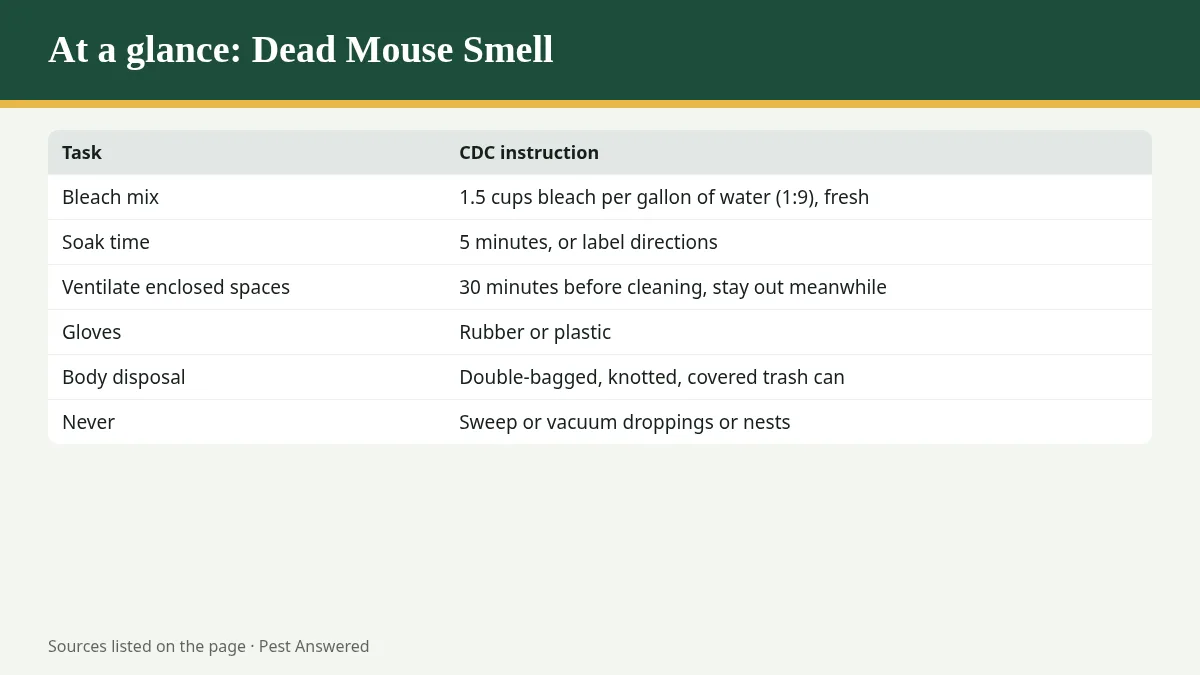 Graphic: summary of this guide, made by our team from the cited sources.
Why it smells so bad
As a body decomposes, microbes produce a mix of compounds including putrescine, cadaverine and various sulfur compounds. McGill notes these can "turn the human stomach." Once the carcass dehydrates, the microbes that make the smell die off and the smell goes away (McGill OSS).
Our sources don't give an exact number of days, and it will vary with the size of the animal and how warm, humid and enclosed the space is. Treat "a few weeks" as a rough guide, not a promise. A rat is much larger than a mouse (UC IPM), so expect a dead rat to take longer.
Step 1: Find the source
Most dead-mouse smells come from a wall void, ceiling, under a cabinet, behind an appliance, in a crawlspace or attic, or inside a heating duct.
Narrow it down:
- Follow your nose at different heights. Sniff near outlets, baseboards and cabinet bases. The smell is usually strongest closest to the body.
- Check where mice were active. UC IPM says house mice seldom go more than 30 feet from their nest and food (UC IPM). Start where you saw droppings or set traps or bait.
- Watch for flies. Small flies gathering at one spot on a wall or ceiling can point to the body.
- Look for stains. A damp or discolored spot on drywall or a ceiling can show where fluids leaked.
- Check easy places first: under and behind the fridge, stove and dishwasher (the kick plate often comes off), inside lower cabinets, under the bathtub access panel, in the garage and attic.
If you used poison bait: UC IPM warns that because house mice stay within about 30 feet of their nest, rodenticides "will often result in house mice dying inside the structure" and that trapping avoids these odor problems (UC IPM). Expect more than one body if bait was used.
If the smell comes from vents: the CDC says to contact a professional rodent service when rodents have gotten into heating and cooling systems (CDC).
Step 2: Remove it safely (CDC steps)
The CDC's guidance for dead rodents and nests is specific. In short (CDC):
- Ventilate first. For an enclosed area such as a shed, garage or other closed-up space, open doors and windows for 30 minutes before cleaning and leave the area during that time.
- Protect yourself. Wear rubber or plastic gloves. Fleas are common on rodents, so the CDC suggests an EPA-registered insect repellent (such as DEET) on clothing, shoes and hands.
- Soak it. Spray the dead rodent, nest and surrounding area with disinfectant. Let it soak for 5 minutes, or as the label directs.
- Bag it twice. Put the body (and any used trap you're throwing away) in a plastic bag, knot it, then put that bag in a second bag and knot it.
- Throw it out in a covered garbage can that's emptied regularly.
- Wash up. Wash gloved hands with soap and water or disinfectant before taking gloves off, then wash bare hands with soap and warm water.
Bleach solution: the CDC recipe is 1.5 cups of household bleach per 1 gallon of water (1 part bleach to 9 parts water), made fresh before use. You can also use a household product labeled "disinfectant" (CDC).
Don't sweep or vacuum droppings, urine or nesting material. The CDC says this can put tiny droplets containing viruses into the air (CDC).
| Task | CDC instruction |
|---|---|
| Bleach mix | 1.5 cups bleach per gallon of water (1:9), fresh |
| Soak time | 5 minutes, or label directions |
| Ventilate enclosed spaces | 30 minutes before cleaning, stay out meanwhile |
| Gloves | Rubber or plastic |
| Body disposal | Double-bagged, knotted, covered trash can |
| Never | Sweep or vacuum droppings or nests |
Source for every row: CDC.
Step 3: Clean the area
Once the body is out, the smell often drops quickly, but fluids may have soaked into nearby materials.
- Hard surfaces (floors, counters, cabinets, drawers): mop or wipe with disinfectant (CDC).
- Bedding, clothing, stuffed toys: wash in hot water with detergent and machine-dry on high or air-dry in the sun (CDC).
- Carpets and upholstery: shampoo with a commercial disinfectant or a commercial-grade steam cleaner or shampoo (CDC).
- Insulation: if it's soaked with urine or droppings, bag it for removal (CDC).
- Cardboard: throw out boxes contaminated with urine or droppings (CDC).
- Drywall or wood with a stain: porous materials can hold odor. If disinfecting doesn't clear it, the piece may need to be cut out and replaced.
If you can't reach the body
McGill's answer is honest: if the carcass can't be found or reached, there's "unfortunately not much" you can do except wait for it to dry out (McGill OSS). While you wait:
- Ventilate. Open windows and run exhaust fans where you can.
- Close off the room if the smell is in one area.
- Air fresheners only mask the smell. McGill says they can cover it in the meantime, nothing more (McGill OSS).
- Odor absorbers such as activated charcoal or baking soda placed near the spot are harmless to try. We found no lab testing on how well they work for this, so keep expectations modest.
Should you cut a hole? A small inspection hole in drywall, low on the wall where the smell is strongest, is often cheaper than weeks of smell, and drywall patches are easy. Turn off power to that area and check for wires and pipes first. If you're not comfortable doing it, a pest professional or handyman can.
About ozone generators
McGill notes that an ozone generator can be rented to break down the smelly compounds, but ozone "can also harm human lungs," so no one should stay in the space while it runs (McGill OSS). That includes pets. We don't recommend it as a first step. Remove the source, clean, and ventilate first.
Why careful cleanup matters
The smell is the part you notice, but disease risk comes from what the mouse left behind. UC IPM says house mice can carry leptospirosis, salmonella and lymphocytic choriomeningitis (LCM), and that LCM is caught from exposure to fresh urine, droppings, saliva or nesting material of infected mice. It estimates that 5% of house mice in the United States carry it (UC IPM). The CDC says rodent diseases spread to people mainly when they breathe in contaminated air, which is why it warns against sweeping or vacuuming (CDC).
For a heavy infestation, the CDC lists extra protection: coveralls, rubber boots or shoe covers, gloves, goggles and a respirator with a HEPA filter (CDC). At that point a professional cleanup is worth considering.
Preventing the next one
A dead mouse in the wall usually means mice got in. To stop a repeat:
- Trap instead of poisoning indoors. UC IPM says trapping lets you remove the bodies and avoid dead-mouse odors (UC IPM).
- Seal entry points. UC IPM recommends closing gaps larger than ¼ inch with metal or concrete; foam, rubber and plastic don't stop mice (UC IPM). Remember that mice climb, so check higher openings too. See can mice climb walls.
- Confirm what you're dealing with. Bigger droppings may mean rats. See mouse vs rat.
Frequently asked questions
How long does a dead mouse smell last?
McGill's Office for Science and Society says the carcass will likely dry out in a few weeks, and the smell goes away when it does. Removing the body ends it much sooner.
Is it safe to breathe dead mouse smell?
The smell itself is unpleasant. The bigger health concern is handling the body and droppings; CDC says to wear gloves, disinfect first, and never sweep or vacuum droppings.
Should I use an ozone generator?
McGill notes ozone can break down the smelly compounds but can also harm lungs, so no one should be in the space while it runs. Removing the source is better.
Will air freshener get rid of dead mouse smell?
No. It only masks the smell until the source is removed or dries out.
Sources
- Can you remove 'dead mouse smell' without putting holes in your walls?, McGill Office for Science and Society (2017)
- How to Clean Up After Rodents, CDC Healthy Pets, Healthy People
- Pest Notes: House Mouse, UC Statewide IPM Program
- Pest Notes: Rats, UC Statewide IPM Program
Spotted an error? See our corrections policy or email contact@pestanswered.com.

Pest Answered Editorial Team
Our editors research each guide from the listed sources and check every claim before publishing. Editorial policy
Emanuel Jaramillo
Expert Contributor, Pest Control
Emanuel Jaramillo has 12 years of hands-on pest control experience and is bilingual in English and Spanish. He contributes field tips and reviews our practical guides on pest signs, identification, prevention and…
Related guides
-
 Mice & Rats
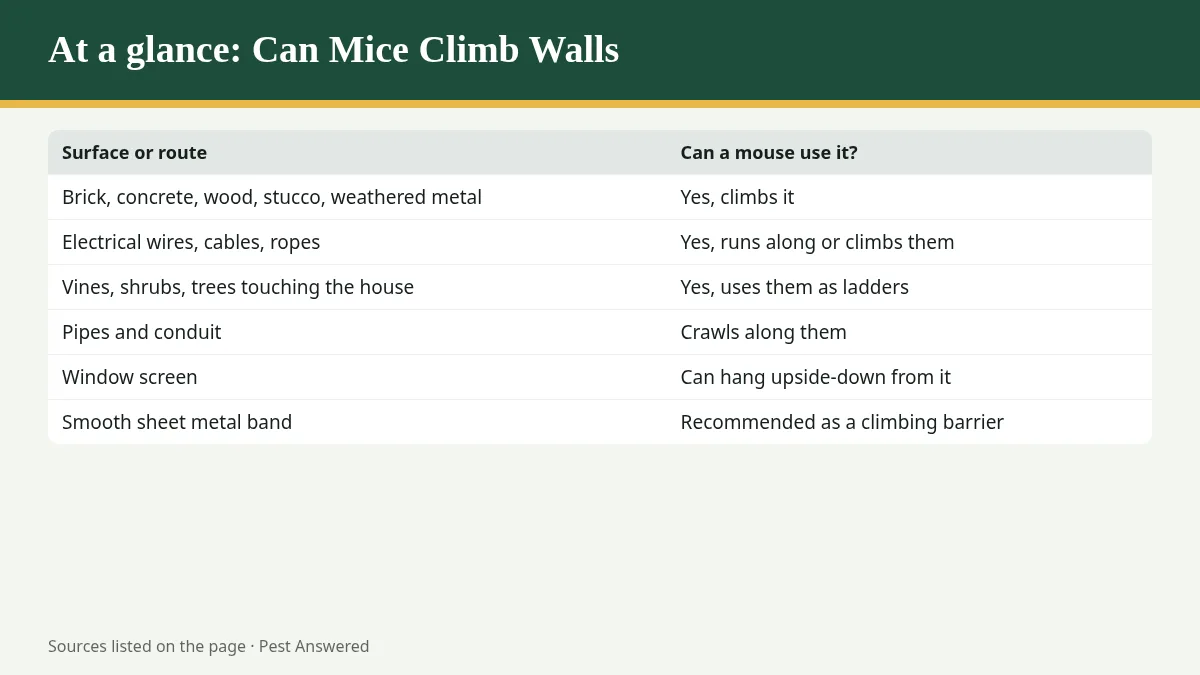
 Can Mice Climb Walls? Yes. Here's What They Can and Can't Climb
Yes, house mice climb any rough wall: brick, wood, concrete, siding. See what they can't grip, how high they jump, and how to block their routes.
-
 Mice & Rats
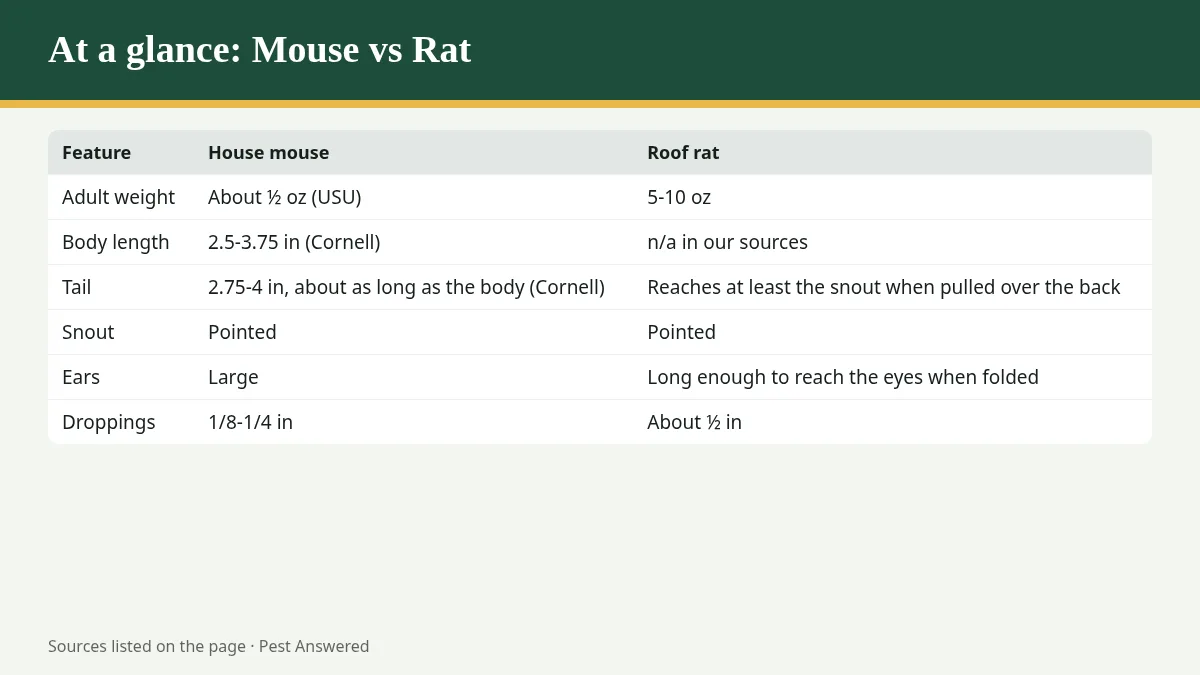
 Mouse vs Rat: How to Tell the Difference (Size, Droppings, Signs)
Mice are small (about 3 in plus tail) with big ears; rats are much bigger with blunter snouts. Compare size, droppings, gnaw marks and why it matters.
-
 Cockroaches
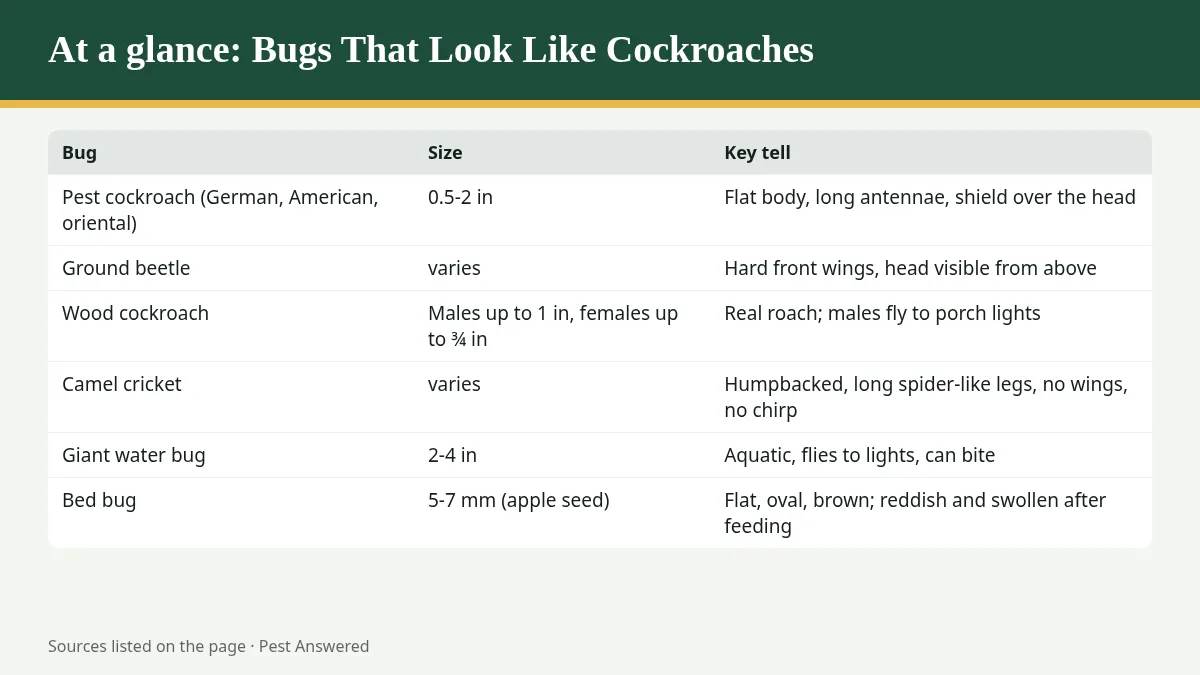
 Bugs That Look Like Cockroaches (and How to Tell Them Apart)
Ground beetles, wood roaches, camel crickets, water bugs and bed bugs get mistaken for cockroaches. Here's how to tell each one apart in under a minute.
-
 Wasps & Bees
 Do Wasps Come Out at Night? Most Don't. Here Are the Exceptions
Most wasps stay in the nest at night. European hornets and some parasitic wasps do fly after dark and come to porch lights. What it means for you.