Mouse vs Rat: How to Tell the Difference (Size, Droppings, Signs)
 ✓ Reviewed by Emanuel Jaramillo
Published · Last reviewed · 5 min read
✓ Reviewed by Emanuel Jaramillo
Published · Last reviewed · 5 min read
The fastest way to tell a mouse from a rat is size. An adult house mouse is about 2.5 to 3.75 inches long plus a tail of similar length, while an adult Norway rat can reach 11 inches plus a slightly shorter tail, about 16 inches total (Cornell IPM).
If you didn't get a good look, droppings are the next best clue: mouse droppings are 1/8 to 1/4 inch long, rat droppings are about ½ inch to 1 inch. The tricky case is a young rat, which can be close to mouse size. That's covered below.
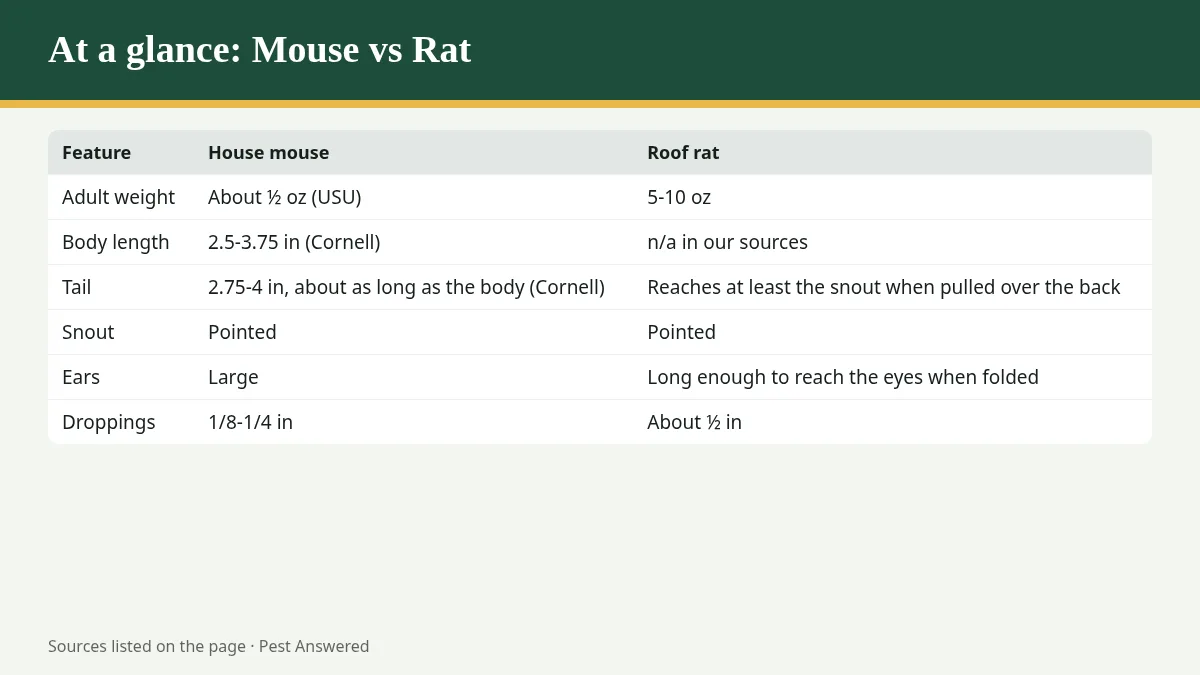 Graphic: summary of this guide, made by our team from the cited sources.
Side-by-side comparison
| Feature | House mouse | Roof rat | Norway rat |
|---|---|---|---|
| Adult weight | About ½ oz (USU) | 5-10 oz (UC IPM) | 7-18 oz (UC IPM) |
| Body length | 2.5-3.75 in (Cornell) | n/a in our sources | Up to 11 in (Cornell) |
| Tail | 2.75-4 in, about as long as the body (Cornell) | Reaches at least the snout when pulled over the back (UC IPM) | Reaches about mid-skull when pulled over the back (UC IPM) |
| Snout | Pointed | Pointed | Blunt (UC IPM) |
| Ears | Large | Long enough to reach the eyes when folded | Don't reach the eyes (UC IPM) |
| Droppings | 1/8-1/4 in | About ½ in | ¾-1 in (Cornell) |
| Food per day | About 1/10 oz | ½-1 oz | About 1 oz (USU) |
| Where indoors | Anywhere; walls, cabinets, drawers | Attics, walls, false ceilings, cabinets | Basements, ground floors (UC IPM) |
Mouse snout and ear details: Cornell IPM, USU.
Body shape and face
Mice have a pointy nose and large ears and eyes for their size. Cornell IPM says house mice are uniformly greyish-brown on back and belly, with a semi-naked tail about as long as the body (Cornell IPM).
Norway rats are stocky with a blunt muzzle and small ears and eyes, and they tend to have two-tone fur, brown to gray (Cornell IPM). UC IPM calls them stocky burrowers that usually stay in basements and on ground floors (UC IPM).
Roof rats are sleek and agile with a pointed muzzle and a tail longer than the head and body (UC IPM). Cornell notes a field test used where both rats live: pull the tail toward the head. If it reaches past the snout, it's a roof rat; if not, a Norway rat (Cornell IPM). Do this only on a dead rodent, with gloves.
Other small rodents people confuse with house mice
Not every small mouse indoors is a house mouse. Cornell IPM notes that white-footed mice and deer mice are about the same size and shape as house mice but have white fur on the belly. They spend most of their time outdoors and come into buildings from fall through spring, so "finding these mice indoors means there is an opening they use to enter the structure" (Cornell IPM). UC IPM adds that the deer mouse has larger eyes and a sharp line between its dark back and white underside, while the house mouse has an overall gray coat (UC IPM).
Young rat or adult mouse?
This is where most mix-ups happen. A young rat can be about the size of a large mouse.
Check the proportions. Utah State's comparison drawing shows a young rat with a large head and large feet for its body, while a house mouse has a small head and small feet (USU). Cornell adds that, compared to young rats, mice have large ears and eyes and a pointier nose (Cornell IPM).
Rule of thumb: big feet and a chunky head on a small body means young rat. Dainty feet, big ears and a pointed face mean mouse.
Signs that tell you which one you have
You often never see the animal. These signs help.
Droppings
Cornell IPM says rodent droppings have no lines on them (American cockroach droppings have vertical ridges). Mouse droppings are typically 1/8 to 1/4 inch long, Norway rat droppings 3/4 to 1 inch, and roof rat droppings about ½ inch (Cornell IPM). Utah State describes mouse droppings as rod-shaped and pointed, and rat droppings as capsule-shaped (USU).
Lay a ruler or coin next to a dropping and take a photo before you clean up. Then clean following CDC steps (spray with disinfectant or bleach solution first; don't sweep or vacuum). Our dead mouse smell guide covers those steps.
Gnaw marks
For the pair of grooves left by the front teeth, Cornell IPM gives adult mouse gnaw marks as 1 to 2 mm wide and adult rat gnaw marks as 3.5 to 4 mm wide (Cornell IPM).
Footprints
In dust or dirt, mouse footprints often look like a collection of dots, 3/8 to 3/4 inch long. Rat prints look like an actual foot, 3/4 to 1¼ inches long, and adult rats may leave a wavy tail drag between prints (Cornell IPM). A thin layer of flour or talc on the floor overnight can show you prints.
Where you find them
- Droppings in an attic, upper cabinets, or on top of walls: roof rats or mice. Roof rats favor attics, wall voids and cabinets (UC IPM). Mice climb too; see can mice climb walls.
- Burrows along the foundation, under trash piles or woodpiles: Norway rats (UC IPM).
- Rats running along utility lines or fence tops at dusk: roof rats (UC IPM).
- Droppings in drawers and around stored food: often mice. UC IPM says mice nest in sheltered places using finely shredded paper or fiber (UC IPM).
Why the difference matters
Entry gaps
Mice need only slightly more than a ¼-inch gap; rats need slightly more than ½ inch (UNL). UC IPM notes that rats, especially young ones, can squeeze under a door with a ½-inch gap (UC IPM). If you have mice, you need to seal smaller holes.
Trap size and setup
Mouse traps won't reliably hold a rat. UC IPM recommends spacing mouse traps no more than about 10 feet apart because mice rarely go more than 30 feet from their nest (UC IPM), while rat traps go about 10 to 20 feet apart (UC IPM).
Behavior around traps
Rats quickly detect and avoid new objects and foods, so they often avoid traps and baits for the first several days, maybe weeks. UC IPM says this fear of new objects is thought to be stronger in roof rats (UC IPM). To reduce "trap shyness," UC IPM suggests leaving rat traps baited but unset until the bait has been taken several times, then setting them all (UC IPM).
How far they travel
Mice stay close to home: UC IPM says house mice seldom go more than 30 feet from their nest and food (UC IPM). Roof rats range much farther. UC IPM says they "routinely travel up to 300 feet or more for food" and may live in one yard while feeding on fruit trees in another (UC IPM). With roof rats, the source can be a neighbor's tree or woodpile, so trimming branches near your roof and sealing openings matters as much as trapping.
Water
Norway rats need to drink standing water every day; mice can get enough moisture from most foods (Cornell IPM). Fixing leaks and condensation matters more for rats.
Common myths
"Mice grow into rats." No. House mice (Mus musculus) and rats (Rattus species) are different species (USU). Even the two common rat species can't interbreed (UC IPM).
"Ultrasonic plug-ins drive them out." UC IPM says there is little evidence that sound, magnetic or vibration devices drive established mice or rats from buildings (UC IPM).
Frequently asked questions
Is it a baby rat or a mouse?
Look at the head and feet. A young rat has a large head and large feet for its body; a mouse has a small head and small feet, with big ears and eyes and a pointier nose.
Do mice turn into rats?
No. House mice and rats are different species. A mouse stays a mouse; it does not grow into a rat.
How big are mouse droppings compared to rat droppings?
Cornell IPM lists mouse droppings at 1/8 to 1/4 inch, roof rat droppings at about 1/2 inch, and Norway rat droppings at 3/4 to 1 inch.
Are rats worse than mice?
They cause different problems. Rats need bigger gaps and bigger traps, and they avoid new objects for days. Mice fit through smaller gaps.
Sources
- Mouse and Rat Biology and Behavior, Cornell IPM
- Pest Notes: Rats, UC Statewide IPM Program
- Pest Notes: House Mouse, UC Statewide IPM Program
- Rats and Mice, IPM manual chapter (2012), Utah State University Extension
- Rodent-Proof Construction: Structural (NebGuide G1530), University of Nebraska-Lincoln
Spotted an error? See our corrections policy or email contact@pestanswered.com.

Pest Answered Editorial Team
Our editors research each guide from the listed sources and check every claim before publishing. Editorial policy
Emanuel Jaramillo
Expert Contributor, Pest Control
Emanuel Jaramillo has 12 years of hands-on pest control experience and is bilingual in English and Spanish. He contributes field tips and reviews our practical guides on pest signs, identification, prevention and…
Related guides
-
 Mice & Rats
 Can Mice Climb Walls? Yes. Here's What They Can and Can't Climb
Yes, house mice climb any rough wall: brick, wood, concrete, siding. See what they can't grip, how high they jump, and how to block their routes.
-
 Mice & Rats
 Dead Mouse Smell: How Long It Lasts and How to Get Rid of It
A dead mouse smell usually fades once the body dries out, in about a few weeks. How to find the source, clean up safely per CDC, and what not to do.
-
 Cockroaches
 Bugs That Look Like Cockroaches (and How to Tell Them Apart)
Ground beetles, wood roaches, camel crickets, water bugs and bed bugs get mistaken for cockroaches. Here's how to tell each one apart in under a minute.
-
 Wasps & Bees
 Do Wasps Come Out at Night? Most Don't. Here Are the Exceptions
Most wasps stay in the nest at night. European hornets and some parasitic wasps do fly after dark and come to porch lights. What it means for you.