Bugs That Look Like Cockroaches (and How to Tell Them Apart)
 ✓ Reviewed by Emanuel Jaramillo
Published · Last reviewed · 6 min read
✓ Reviewed by Emanuel Jaramillo
Published · Last reviewed · 6 min read
The bugs most often mistaken for cockroaches are ground beetles, wood cockroaches (real roaches that don't infest homes), camel crickets, giant water bugs and, for tiny roach nymphs, bed bugs. You can tell most of them apart by checking three things: the wings, whether you can see the head from above, and the legs.
This guide covers each look-alike, what it means if it's in your house, and when you're actually looking at a pest roach.
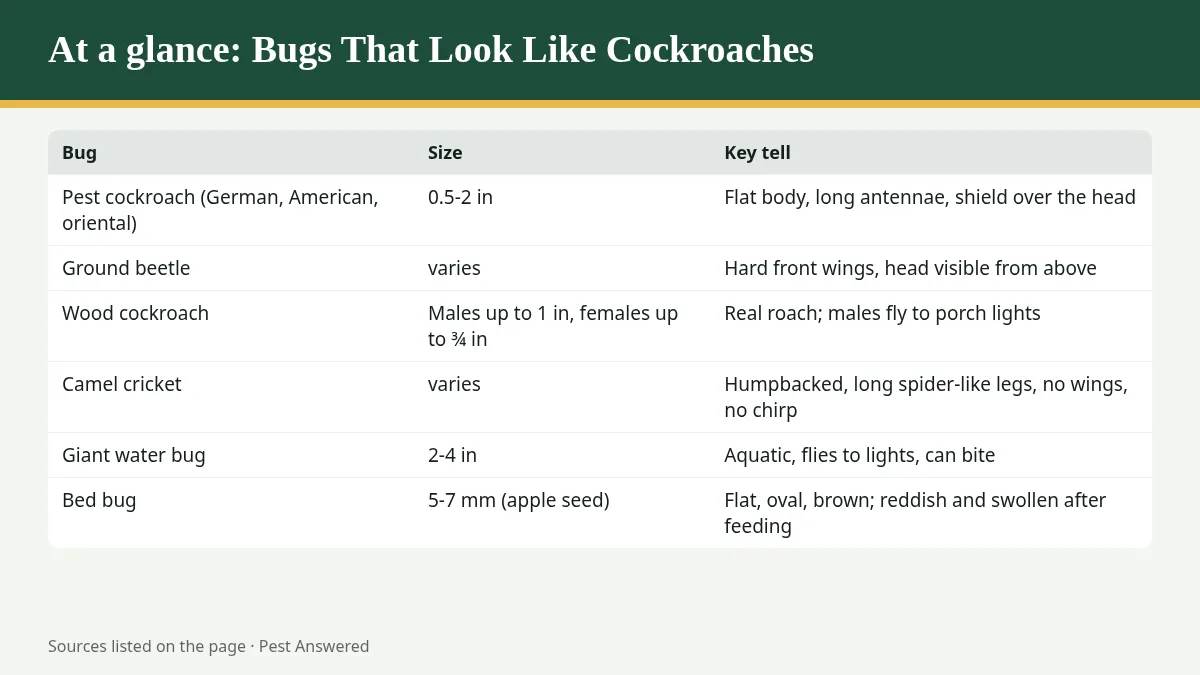 Graphic: summary of this guide, made by our team from the cited sources.
Quick ID table
| Bug | Size | Key tell | Problem indoors? | Source |
|---|---|---|---|---|
| Pest cockroach (German, American, oriental) | 0.5-2 in | Flat body, long antennae, shield over the head | Yes | UC IPM |
| Ground beetle | varies | Hard front wings, head visible from above | No, accidental | Univ. of Kentucky |
| Wood cockroach | Males up to 1 in, females up to ¾ in | Real roach; males fly to porch lights | No, dies in days | Penn State |
| Camel cricket | varies | Humpbacked, long spider-like legs, no wings, no chirp | Nuisance in damp areas | NC State |
| Giant water bug | 2-4 in | Aquatic, flies to lights, can bite | No, accidental | UMaine |
| Bed bug | 5-7 mm (apple seed) | Flat, oval, brown; reddish and swollen after feeding | Yes, different treatment | EPA |
First, what a real cockroach looks like
UC IPM describes cockroaches as broad, flattened insects with long antennae and "a prominent, shield-shaped section behind the head called the pronotum" (UC IPM). Look at one from above and that shield mostly hides the head. Their wings are thin and membranous, not hard.
The common pest species:
- German: about 0.5 inch, light brown, 2 dark stripes on the shield behind the head. Lives and breeds indoors (UC IPM).
- Brownbanded: about 0.5 inch with light bands across the body. Indoors (UC IPM).
- Oriental: about 1.25 inches and almost black. Lives outdoors and in damp areas and can't climb smooth vertical surfaces (UC IPM).
- American: about 2 inches, reddish brown, with light edges on the shield (UC IPM).
If what you have matches one of these, read why roaches come out at night next.
Ground beetles
Ground beetles are the most common "roach" people find on a basement floor or near a door. The University of Kentucky says they may be confused with cockroaches such as the oriental roach because both are shiny and very dark. The difference: "beetles have hardened front wings where roaches either have leathery wings or no wings. Roaches also have a hood that conceals their head from above" (Univ. of Kentucky).
UC IPM makes the same point: adult cockroaches "lack the thick, hardened forewings of beetles" (UC IPM).
How to check: look from above. On a beetle you'll see the head sticking out in front and two hard wing covers meeting in a straight line down the middle of the back, like a shell. On a roach the head tucks under a shield and the wings overlap or are missing.
What it means: ground beetles live and hunt outdoors. One indoors usually wandered in. Sealing door gaps helps.
Wood cockroaches
These are true cockroaches, which is why they cause so much worry. Penn State describes them as having the classic roach shape: flattened, spiny legs, long antennae, and a head concealed from above. Adult males grow up to 1 inch long with long wings; females reach up to ¾ inch and have short wings that leave the end of the body exposed (Penn State).
The good news is in the same fact sheet. Wood cockroaches live in forest leaf litter and under logs. They come indoors by accident through foundation cracks, around windows and doors, on firewood, or after being attracted to porch lights. Indoors "they quickly die within a few days due to dehydration and do not feed or reproduce indoors" (Penn State).
How to tell: a winged roach about an inch long that showed up near a porch light, a door, or a firewood stack, in a house near woods, is a strong candidate. German cockroaches are about half that size and stay near kitchens and bathrooms.
What to do: Penn State says the best control is keeping them out: bring in only as much firewood as you'll burn in a few hours, and move firewood piles away from the house (Penn State).
Camel crickets
NC State says they're named for their slightly humpbacked shape, their long legs give them a spider-like look, adults have no wings, and unlike most crickets they don't chirp (NC State).
They like cool, damp places and often invade crawlspaces, basements, garages, bathrooms and laundry rooms, especially after very wet weather or long hot, dry spells. A sign of a heavy infestation is dark fecal smears on surfaces such as floor joists. They're mostly a nuisance but can damage stored garments and linens in boxes (NC State).
How to tell: the hump and the very long back legs. Roaches have flat backs and run; camel crickets jump.
What to do: NC State recommends sealing gaps around windows, doors, the foundation, dryer vents, crawlspace doors and utility lines, adding door sweeps, and keeping stored boxes off the floor (NC State). Reducing dampness helps too.
Giant water bugs
Here's where the name "water bug" gets confusing. UC IPM notes that the oriental cockroach is sometimes called a "water bug" (UC IPM). But there's also a real insect called the giant water bug.
The University of Maine describes the giant water bug as 2 to 4 inches long and aquatic, also known as water roach, toe-biter ("they can inflict a painful bite") and electric-light bug, because adults fly to lights at night and are often found in parking lots and near porch lights (UMaine).
How to tell: size and setting. If you find a very large "roach" under a porch light in summer near a pond or lake, it may be a giant water bug.
What to do: don't pick it up by hand. It doesn't infest homes.
Bed bugs (vs. baby cockroaches)
Small roach nymphs and bed bugs both are brown, small and flat, so they get confused. The EPA describes adult bed bugs as about the size of an apple seed (5-7 mm, or 3/16 to 1/4 inch), brown, with a flat, oval body when unfed, and reddish and more elongated after feeding (EPA).
How to tell: roach nymphs have the same long antennae as adult roaches (UC IPM), and German roaches cluster near food and water in kitchens and bathrooms. Bed bugs have an oval, apple-seed shape and turn reddish after feeding. Where you found it also helps: a bug in the seams of a mattress is a bed bug suspect; a bug under the sink is a roach suspect. This matters a lot because treatments differ. The EPA calls correct identification a critical first step to avoid costly treatment for the wrong bug (EPA).
A one-minute ID check
- Catch it. Trap it under a clear cup or on a sticky trap. UC IPM notes sticky traps are useful for catching roaches for identification (UC IPM).
- Look from above. Head visible with hard wing covers = beetle. Head hidden under a shield = roach.
- Check the back. Humped with long jumping legs = camel cricket.
- Check the size and place. Tiny and near a bed = check for bed bugs. About 1 inch, near a light or firewood, house near woods = likely wood roach. 2-4 inches, under an outdoor light near water = possibly a giant water bug.
- Photograph it next to a coin or ruler. Your local extension office can identify it from a sample or photo.
When it is a roach
If it's a German or brownbanded roach indoors, one sighting often means more are hiding nearby. Look for the signs in our guide to what a cockroach nest looks like. UC IPM recommends identifying the species before you treat, because the right control depends on the species (UC IPM).
Frequently asked questions
What bug looks like a cockroach but isn't?
The most common are ground beetles, camel crickets, giant water bugs and, for small nymphs, bed bugs. Wood cockroaches are real roaches but don't infest homes.
How do I tell a beetle from a cockroach?
Beetles have hard, shell-like front wings that meet in a straight line down the back. Roaches have leathery or no wings and a shield that hides the head from above.
Is a wood cockroach a problem indoors?
Penn State says wood cockroaches die within a few days indoors from dehydration and don't feed or reproduce inside.
What is a water bug?
The name is used for two different insects: the oriental cockroach and the giant water bug, a large aquatic true bug that can bite.
Sources
- Pest Notes: Cockroaches (UC ANR Pub. 7467), UC Statewide IPM Program
- ENTFACT-706: Ground Beetles, University of Kentucky Entomology
- Wood Cockroaches, Penn State Extension
- Camel Crickets, NC State Extension
- Giant Water Bug, University of Maine Cooperative Extension
- Bed Bugs Appearance and Life Cycle, US EPA
Spotted an error? See our corrections policy or email contact@pestanswered.com.

Pest Answered Editorial Team
Our editors research each guide from the listed sources and check every claim before publishing. Editorial policy
Emanuel Jaramillo
Expert Contributor, Pest Control
Emanuel Jaramillo has 12 years of hands-on pest control experience and is bilingual in English and Spanish. He contributes field tips and reviews our practical guides on pest signs, identification, prevention and…
Related guides
-
 Cockroaches
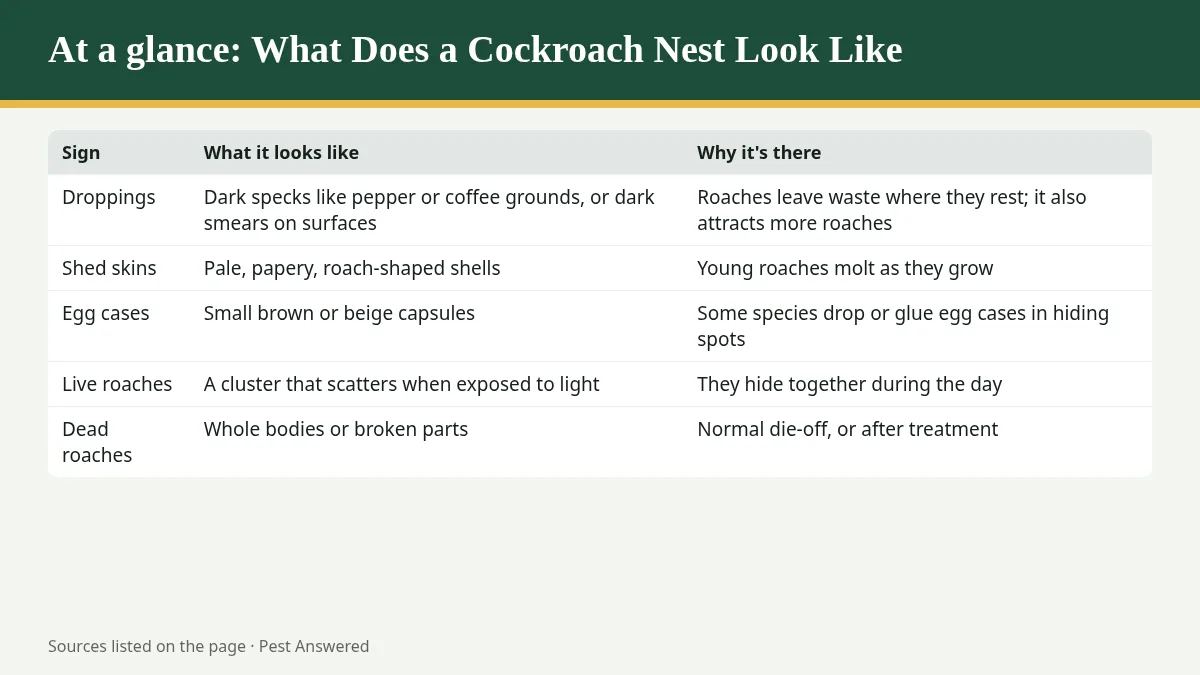
 What Does a Cockroach Nest Look Like? Signs, Egg Cases and Where to Look
A cockroach nest isn't built. It's a crack crowded with roaches, dark droppings, shed skins and egg cases. What each sign looks like and where to look.
-
 Cockroaches
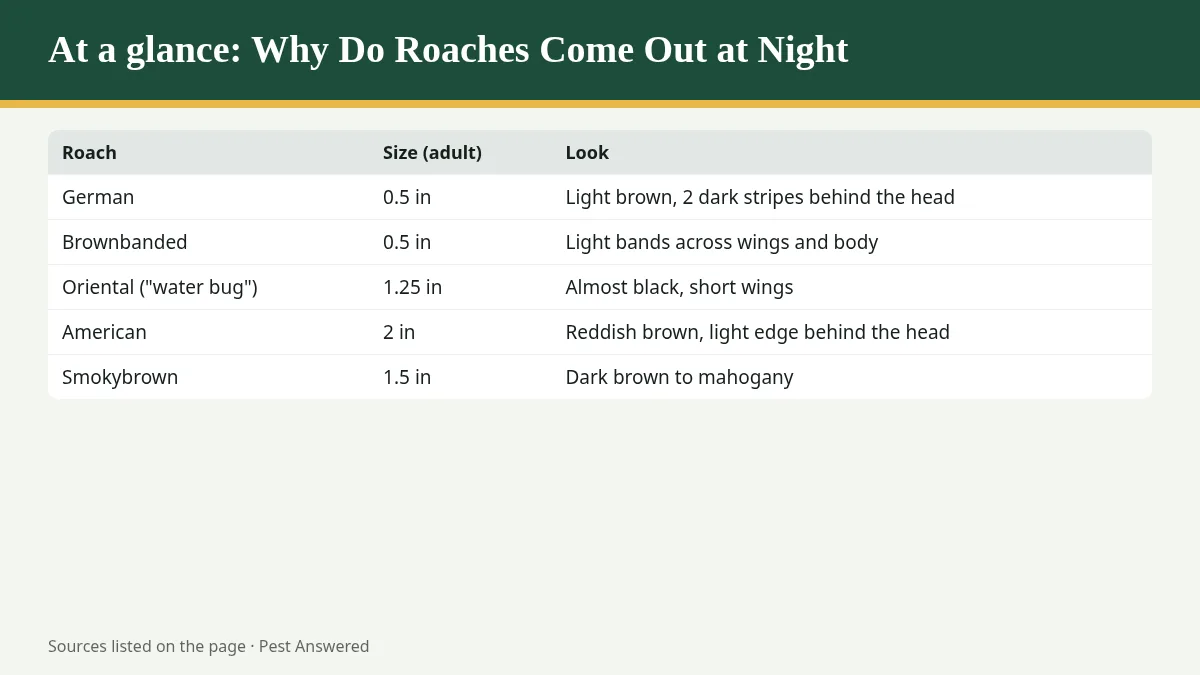
 Why Do Roaches Come Out at Night? (And What a Daytime Roach Means)
Roaches come out at night because they're nocturnal: they hide in dark cracks by day and forage after dark. Here's why, and what seeing one by day means.
-
 Mice & Rats
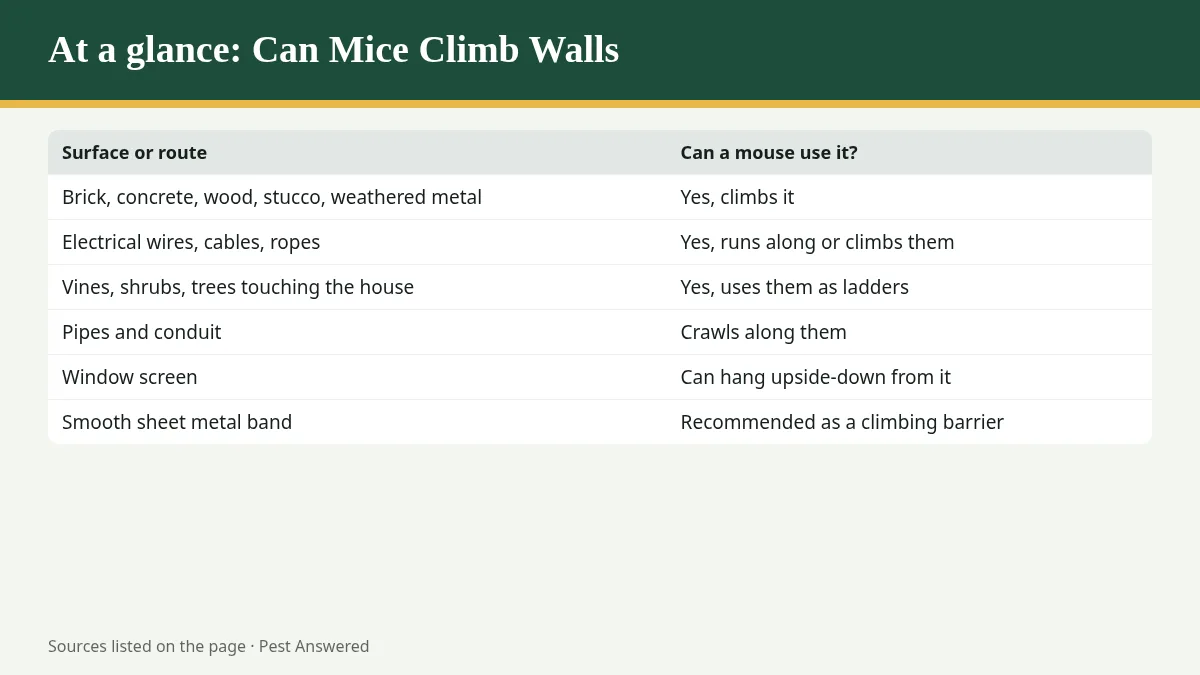
 Can Mice Climb Walls? Yes. Here's What They Can and Can't Climb
Yes, house mice climb any rough wall: brick, wood, concrete, siding. See what they can't grip, how high they jump, and how to block their routes.
-
 Mice & Rats
 Dead Mouse Smell: How Long It Lasts and How to Get Rid of It
A dead mouse smell usually fades once the body dries out, in about a few weeks. How to find the source, clean up safely per CDC, and what not to do.