Can Mice Climb Walls? Yes. Here's What They Can and Can't Climb
 ✓ Reviewed by Emanuel Jaramillo
Published · Last reviewed · 6 min read
✓ Reviewed by Emanuel Jaramillo
Published · Last reviewed · 6 min read
Yes, mice can climb walls. House mice run straight up any rough vertical surface, including brick, wood, concrete, stucco and weathered siding, and they also travel along pipes, wires and ropes (UC IPM; UNL Extension).
What they struggle with is smooth, hard surfaces. That difference is the key to keeping them off counters, out of upper floors and away from the gaps that let them inside.
 Graphic: summary of this guide, made by our team from the cited sources.
What mice can climb
The University of Nebraska-Lincoln rodent-proofing guide lists what rats and mice can do. They can climb almost any rough vertical surface, such as wood, brick, concrete and weathered sheet metal. They can run along or climb electrical wires, ropes, cables, vines, shrubs and trees to reach a building, and crawl sideways along pipes and conduit (UNL G1530). The same guide says house mice can hang upside-down from screen wire.
UC IPM, the University of California's pest program, describes house mice as "excellent climbers" that "can run up any rough vertical surface" and "will run horizontally along wire cables or ropes" (UC IPM).
In a lab study, researchers attached wire mesh to the wall of a test arena. The mice reared against the wall, then climbed straight up the mesh, reached the top, and later moved sideways along the upper edge. Their top climbing speeds were 32 to 64 cm per second (roughly 1 to 2 feet per second), and their sideways speed on the wall averaged only about 30% of their top vertical speed (Royal Society Open Science). In plain terms: going up is easy for them; crossing a wall sideways is harder.
| Surface or route | Can a mouse use it? | Source |
|---|---|---|
| Brick, concrete, wood, stucco, weathered metal | Yes, climbs it | UNL G1530 |
| Electrical wires, cables, ropes | Yes, runs along or climbs them | UNL G1530, UC IPM |
| Vines, shrubs, trees touching the house | Yes, uses them as ladders | UNL G1530, UC IPM |
| Pipes and conduit | Crawls along them | UNL G1530 |
| Window screen | Can hang upside-down from it | UNL G1530 |
| Smooth sheet metal band | Recommended as a climbing barrier | UNL G1530 |
What mice can't climb well
Every source above says "rough". Mice need texture for their claws. That is why the UNL guide recommends attaching 12- to 18-inch-wide aluminum sheet metal bands at least 36 inches above the ground, or at floor level, to stop rodents from climbing walls, especially in corners (UNL G1530).
Surfaces that tend to give mice little grip:
- Glass
- Smooth, hard sheet metal (not weathered or dented)
- Glossy tile and smooth plastic panels
Treat this as "hard for them", not "impossible". A smooth wall next to a rough door frame, a cable, or a stack of boxes gives them another way up. Corners are a weak spot because a mouse can brace against two surfaces, which is why the UNL guide calls out corners for metal guards.
How high can a mouse jump?
Two good sources give two numbers:
- UC IPM: up to 12 inches from the floor onto a flat surface (UC IPM).
- UNL Extension: up to 18 inches vertically (UNL G1530).
The difference likely comes from how the jump is measured (onto a landing surface versus straight up). For planning, use the higher number. Anything a mouse can reach by an 18-inch jump plus a short climb should be treated as reachable.
Can mice climb stairs, beds and counters?
Stairs: yes. Each step is a short hop well inside the jump heights above, and carpet or wood treads give grip.
Beds: a mouse can't scale a smooth metal bed leg easily, but a bedspread that touches the floor is a fabric ladder. A wood or upholstered headboard pushed against the wall is another route. If you have found droppings near a bed, pull bedding off the floor and move the bed a few inches from the wall.
Kitchen counters: cabinet faces, drawer pulls, the gap between the stove and counter, and appliance cords all give footholds. Counters are reachable for mice. Droppings on a counter usually mean food is reachable too.
Upper floors and attics: mice follow wiring and plumbing runs inside walls. UNL notes they crawl horizontally along pipes and conduit, so a mouse in the basement can show up in an upstairs bathroom without ever using the stairs.
Can rats climb walls too?
Yes, and some rats climb better than mice. UC IPM describes roof rats as "very agile climbers" that nest in attics, wall voids, ceiling voids and cabinets, and run along utility lines and fence tops at night. Norway rats are stockier burrowers that usually stay in basements and ground floors (UC IPM Rats).
The UNL guide adds that rats can climb the outside of vertical pipes up to 3 inches in diameter, climb the inside of 1½- to 4-inch pipes, and jump 36 inches straight up (UNL G1530). If you're not sure which rodent you have, see our guide on how to tell a mouse from a rat.
What this means for keeping mice out
Because mice climb, sealing only the ground-level gaps isn't enough. Openings higher up the wall count.
Entry size to look for. House mice can squeeze under gaps ¼ inch tall and through openings ⅜ inch wide (UC IPM). UNL says mice need "only slightly more than a ¼-inch gap" and that doors should sit less than ¼ inch above the threshold (UNL G1530).
What to seal with. UC IPM recommends wire screen or coarse steel wool for small openings, and metal or concrete around pipes, vents and utility cables. It warns that plastic screening, rubber, vinyl, expanding foam and wood are ineffective plugs because mice chew through them (UC IPM). UNL lists 24-gauge hardware cloth with ¼ × ¼-inch mesh to exclude mice, and notes that plain steel wool eventually rusts, while copper or stainless steel wool lasts longer (UNL G1530).
Cut the ladders. UC IPM says to thin or remove plants next to or climbing up buildings "since house mice are excellent climbers" (UC IPM).
A 20-minute outside check
Walk the outside of the house with a flashlight and a pencil. A standard pencil is roughly ¼ inch thick, so any gap it fits into is a mouse-sized gap.
- Ground line: gaps where siding meets the foundation, and under garage and exterior doors.
- Utility entries: where the AC line, gas line, cable, phone and water lines enter. Look for gaps around each pipe.
- Dryer and bath vents: missing or broken flaps and loose vent hoods.
- Higher openings: soffits, roof-to-wall joints, attic vents, and gaps around a chimney. These are the openings a climbing mouse uses.
- Ladders: vines, shrubs, tree limbs, fences and wires that touch or nearly touch the house.
Write down each spot, photograph it, and seal the ground-level ones first because they are easiest. For roof-line openings, use a ladder safely or hire help.
Inside the house
- Mice seldom go more than 30 feet from their nest and food, so look for droppings within that range of where you saw one (UC IPM).
- UC IPM recommends snap traps placed along walls, behind objects and in dark corners, close to the wall so a mouse runs over the trigger. Space them no more than about 10 feet apart where mice are active (UC IPM).
- Because mice climb, put a few traps where they travel off the floor too: on shelves, on top of cabinets, or along a ledge you've found droppings on. Keep traps away from children and pets.
- Skip ultrasonic devices. UC IPM says there is "little evidence" that sound, magnetic or vibration devices drive established mice out (UC IPM).
When to call a pro
Call a licensed pest professional if you find droppings on several floors, hear activity inside walls or ceilings, or can't reach the openings you've found. Climbing mice often use routes inside walls and attics that are hard to inspect from inside living space.
Frequently asked questions
Can mice climb smooth walls?
Not well. Extension sources say mice climb rough surfaces. Smooth sheet metal is recommended as a climbing barrier, and glossy, hard surfaces give them little to grip.
How high can a mouse jump?
UC IPM says up to 12 inches from the floor onto a flat surface. A University of Nebraska guide lists 18 inches vertically. Plan for the higher number.
Can mice climb into my bed?
They can if something rough connects the floor to the mattress, such as a bedspread touching the floor or a wood or fabric headboard against the wall.
Can mice climb stairs?
Yes. Each step is a short hop for a mouse, and wood or carpet gives them grip.
Do rats climb better than mice?
Roof rats are very agile climbers and often live in attics. Norway rats usually stay in basements and ground floors but can still climb.
Sources
- Pest Notes: House Mouse (UC ANR Pub. 7483), UC Statewide IPM Program
- Rodent-Proof Construction: Structural (NebGuide G1530), University of Nebraska-Lincoln Extension
- Pest Notes: Rats, UC Statewide IPM Program
- Vertical exploration and dimensional modularity in mice, Royal Society Open Science (2018)
Spotted an error? See our corrections policy or email contact@pestanswered.com.

Pest Answered Editorial Team
Our editors research each guide from the listed sources and check every claim before publishing. Editorial policy
Emanuel Jaramillo
Expert Contributor, Pest Control
Emanuel Jaramillo has 12 years of hands-on pest control experience and is bilingual in English and Spanish. He contributes field tips and reviews our practical guides on pest signs, identification, prevention and…
Related guides
-
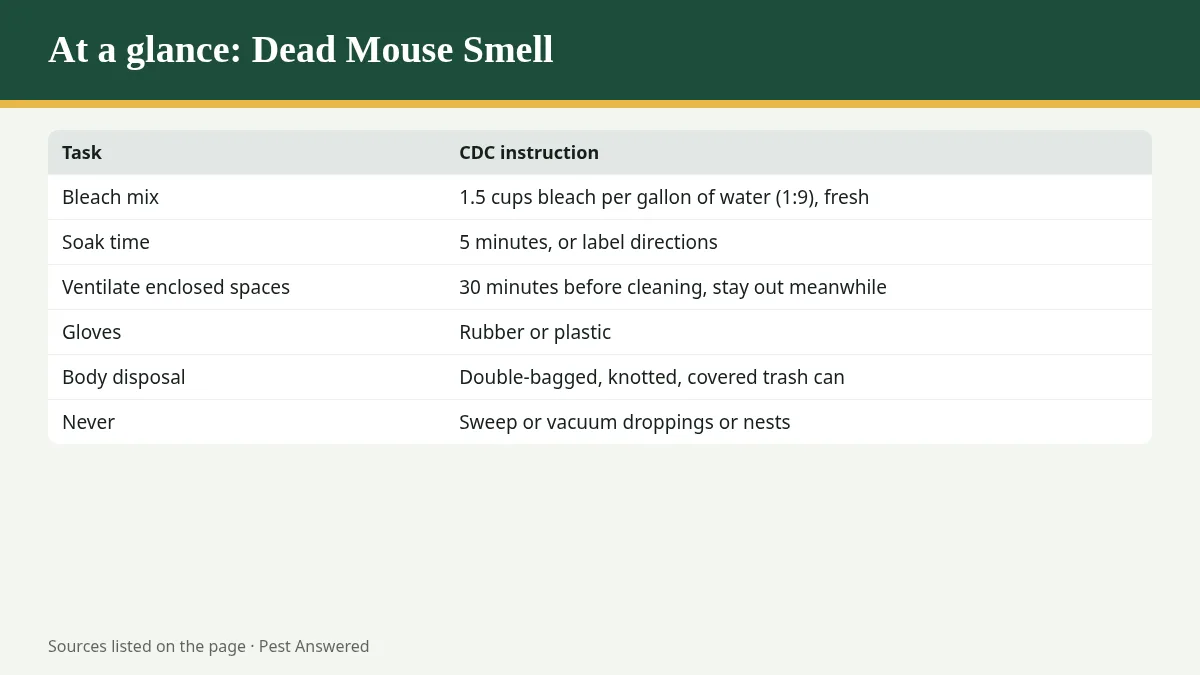 Mice & Rats
 Dead Mouse Smell: How Long It Lasts and How to Get Rid of It
A dead mouse smell usually fades once the body dries out, in about a few weeks. How to find the source, clean up safely per CDC, and what not to do.
-
 Mice & Rats
 Mouse vs Rat: How to Tell the Difference (Size, Droppings, Signs)
Mice are small (about 3 in plus tail) with big ears; rats are much bigger with blunter snouts. Compare size, droppings, gnaw marks and why it matters.
-
 Cockroaches
 Bugs That Look Like Cockroaches (and How to Tell Them Apart)
Ground beetles, wood roaches, camel crickets, water bugs and bed bugs get mistaken for cockroaches. Here's how to tell each one apart in under a minute.
-
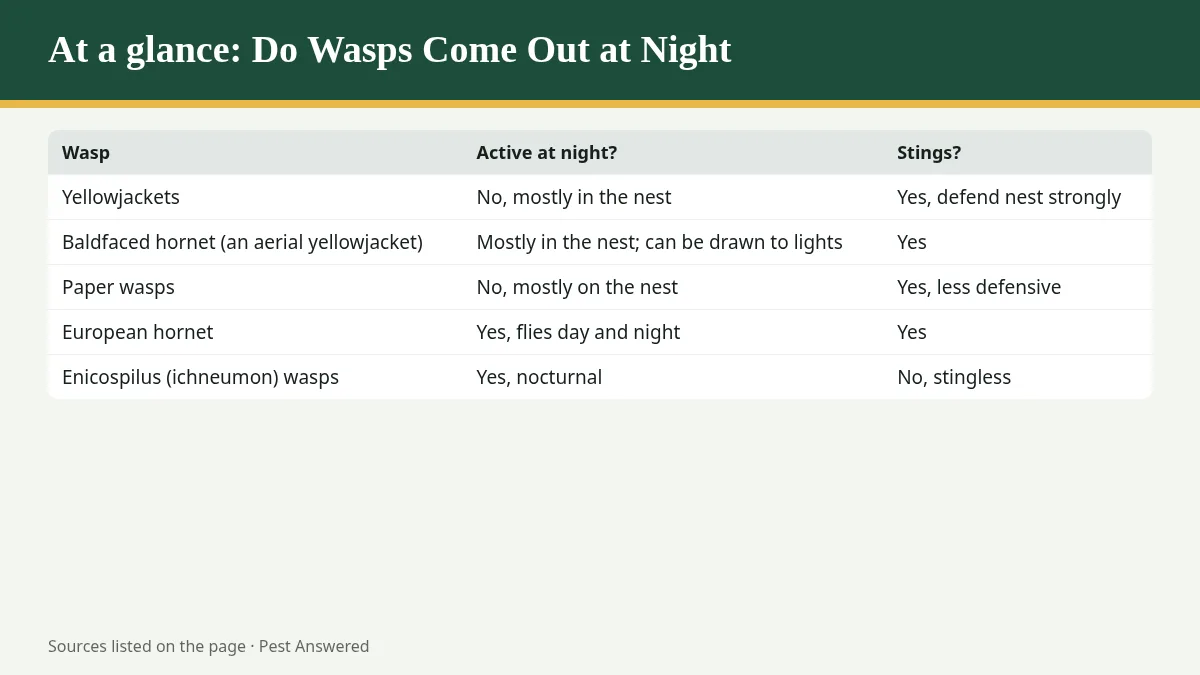 Wasps & Bees
 Do Wasps Come Out at Night? Most Don't. Here Are the Exceptions
Most wasps stay in the nest at night. European hornets and some parasitic wasps do fly after dark and come to porch lights. What it means for you.