Ants in Your Bed but No Food? Why They Come and How to Stop Them
 ✓ Reviewed by Emanuel Jaramillo
Published · Last reviewed · 7 min read
Ants in a bed with no food are usually there for water, warmth or a place to nest, or they are scouts from a colony living in the wall, the floor, a potted plant or right outside. UC IPM lists all of these reasons: ants come indoors for food and water, for warmth and shelter, and to escape hot dry weather or floods, and a few straggling ants are scouts searching for food or nest sites.
"No food" also rarely means no food at all. A crumb under the bed, a sticky soda can, a pet bowl or a plant covered in aphids is plenty for an ant colony. The fix is to work out which of these you have, clean up the trail so others can't follow it, and close the way in.
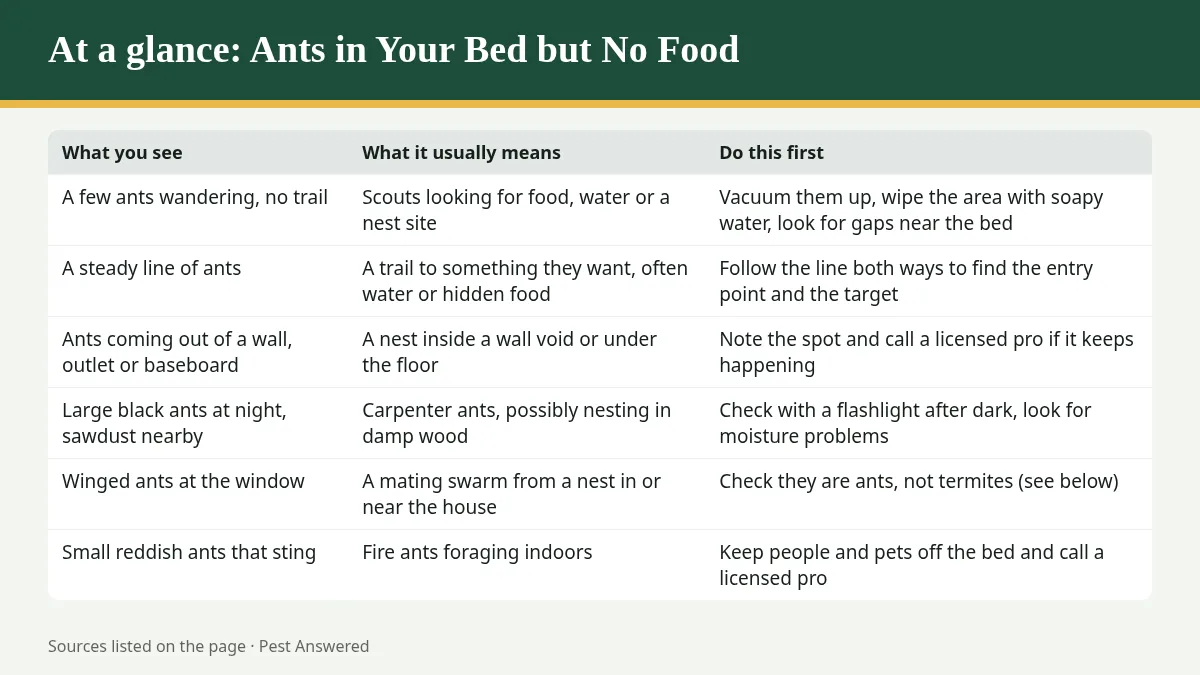 Graphic: summary of this guide, made by our team from the cited sources.
What you see, and what it usually means
| What you see | What it usually means | Do this first |
|---|---|---|
| A few ants wandering, no trail | Scouts looking for food, water or a nest site | Vacuum them up, wipe the area with soapy water, look for gaps near the bed |
| A steady line of ants | A trail to something they want, often water or hidden food | Follow the line both ways to find the entry point and the target |
| Ants coming out of a wall, outlet or baseboard | A nest inside a wall void or under the floor | Note the spot and call a licensed pro if it keeps happening |
| Large black ants at night, sawdust nearby | Carpenter ants, possibly nesting in damp wood | Check with a flashlight after dark, look for moisture problems |
| Winged ants at the window | A mating swarm from a nest in or near the house | Check they are ants, not termites (see below) |
| Small reddish ants that sting | Fire ants foraging indoors | Keep people and pets off the bed and call a licensed pro |
Source: our table, built from the UC IPM, Penn State and Texas A&M fact sheets linked in this guide.
Why ants come to a bed when there is no food
- Water. Bedrooms next to a bathroom, a leaky pipe, a sweating window or a damp wall attract ants. NPIC's prevention advice includes fixing leaky pipes and replacing moist or rotting wood.
- Warmth and shelter. Several house ants nest inside walls, near hot water pipes or heaters. A bed against an outside wall can sit right next to that nest.
- Weather. UC IPM notes ants may appear suddenly when other food sources become unavailable or the weather changes, and they come in to escape hot dry spells or flooding.
- Hidden food. Crumbs between the mattress and frame, a drink by the bed, pet food or a snack wrapper in a bag are enough. Ants also follow the sweet honeydew that aphids, scales and mealybugs leave on house plants.
- A nest in a potted plant. UC IPM tells readers to check potted plants as indoor nest sites.
- Scouts. One or two ants on the sheets may be scouts. If they find nothing, they leave. If they find something, a trail follows.
Which ant is in your bedroom?
The species matters, because each one nests in a different place and the wrong treatment can make things worse. NPIC puts identifying the ant first.
| Ant | Worker size | Where it nests indoors | Source |
|---|---|---|---|
| Odorous house ant | 1/16 to 1/8 inch, smells rotten when crushed | Voids near moisture and warmth, termite-damaged wood | Penn State: Odorous House Ant |
| Pharaoh ant | About 1/16 inch, light yellow to reddish brown | Wall voids, under floors, behind baseboards, linens, light fixtures; likes warm spots near hot water pipes | Ohio State: Pharaoh Ant |
| Pavement ant | 2.5 to 4 mm, dark brown to black | Under slabs and sidewalks; enters through cracks in slabs and foundation walls and leaves small sand piles | Penn State: Pavement Ant |
| Carpenter ant | 1/4 to 1/2 inch, dark brown to black | Hollow areas of ceilings and walls, under insulation, often near wood kept wet by leaks or condensation | Penn State: Carpenter Ants |
| Red imported fire ant | 1/16 to 3/16 inch, reddish or dark brown | Prefers to nest outdoors in soil, in mounds; workers forage indoors for food and water | Texas A&M: Managing Household Ants |
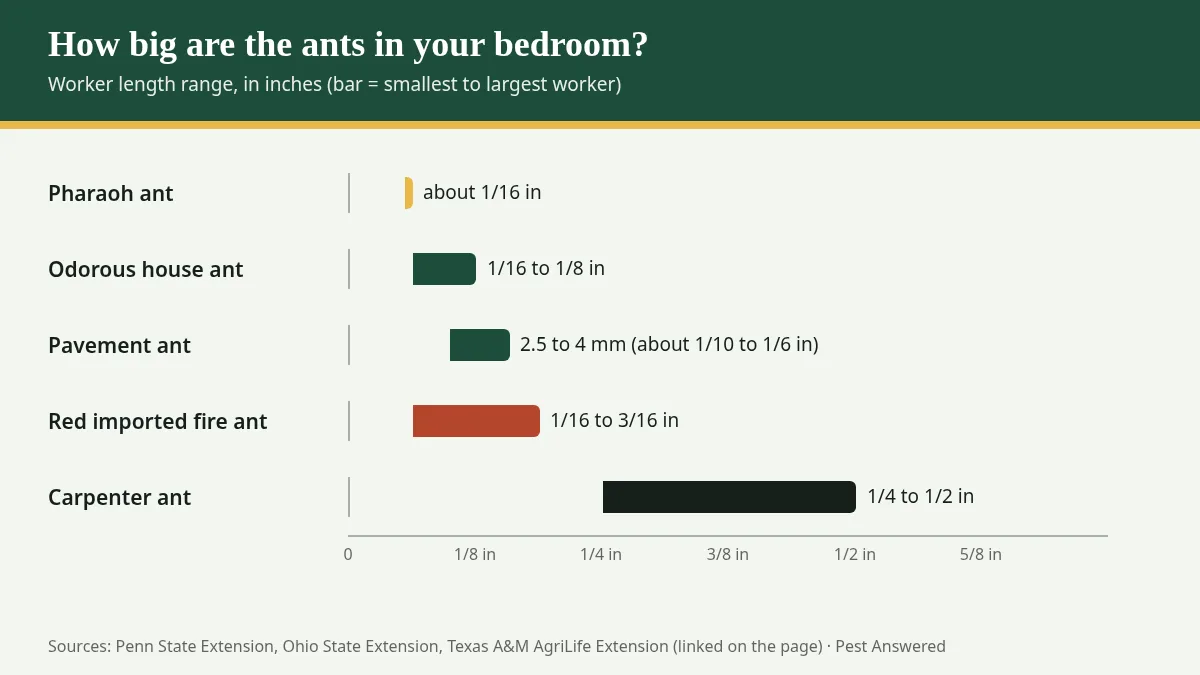 Chart: our team's chart of the worker size ranges in the table above (Penn State, Ohio State and Texas A&M). Pavement ant millimeters converted to inches.
How to get ants out of your bed, step by step
- Strip and wash the bedding, then vacuum the mattress seams, bed frame and floor around the bed. NPIC advises emptying the vacuum outdoors right away. You can find NPIC's full list in its ants fact sheet.
- Wipe the trail with soapy water. Ants follow a scent trail. Wiping it breaks the path that leads other ants to the bed.
- Follow the ants before you clean them all up. Watch where they come from: a baseboard gap, an outlet, a window frame, a crack in the floor. UC IPM lists bedrooms among the rooms ants invade and suggests inspecting along pipes.
- Seal the entry point with caulk. UC IPM suggests petroleum jelly as a quick plug until you can caulk.
- Remove the draw. Fix leaks, dry damp spots, keep drinks and snacks out of the bedroom, store food in sealed hard containers and rinse soda cans before they go in the bin.
- Check house plants. NPIC suggests a water moat around potted plants so ants can't climb in.
- Move the bed an inch or two away from the wall and keep sheets and blankets off the floor so ants can't climb straight up.
Do not spray the bed, sheets or mattress, and skip "natural" powders on bedding too. Any pest product, even a natural one, may only be used where its label allows. The label is the law.
Why spraying makes some ant problems worse
Spraying the ants you can see only kills the workers on the surface. Ohio State Extension says most of a Pharaoh ant colony stays hidden in the nest, and that a repellent pesticide can make the colony split and move to new spots, a habit called budding. Bug bombs don't reach the colony either.
Baits work differently. Workers carry the bait back to the nest and share it. UC IPM's ants guide says baits take 5 to 10 days to cut ant numbers and full control can take several weeks, and it recommends placing baits near ant trails and nest openings outdoors. It also warns that spraying ants indoors will not prevent more ants from coming in. Don't spray near baits, or the ants stop taking them. If you are working with a pro and see more ants for a few days, our guide on why you see more bugs after pest control explains what is normal.
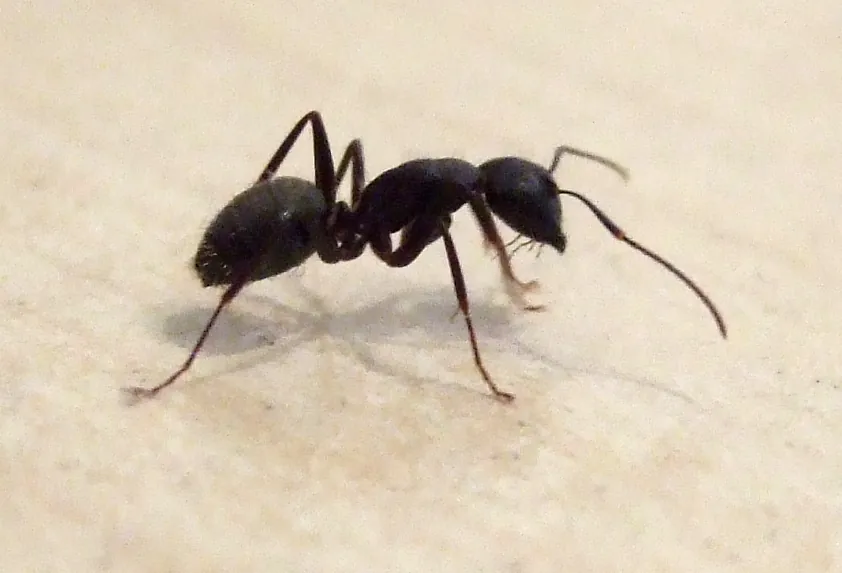
Large black ants at night: check for carpenter ants
Carpenter ants are the ones to take seriously. Penn State says the workers usually come out at night, the nest may actually be outside, and indoor nests are often in hollow areas of ceilings and walls near wood kept wet by leaking pipes, tubs or showers. UC IPM's carpenter ant guide suggests inspecting after sunset with a flashlight, following the trails, and watching for sawdust-like frass or a faint rustling in the walls.
Winged ants in the bedroom: ants or termites?
Winged ants near a bedroom window mean a nest in, under or very close to the house. Texas A&M's guide to swarming insects indoors says ant swarmers have pinched waists and elbowed antennae, while termite swarmers have straight-sided bodies and long wings of equal length. Swarming usually lasts only one or a few days, and if you see no other ants, no further control may be needed. Termite swarmers indoors are different: unless one clearly flew in through an open window, Texas A&M advises contacting a termite control professional.
Bites but no ants? Rule out bed bugs
If you wake up with bites and never actually see ants, the culprit may not be ants at all. The EPA's guide to finding bed bugs says to check the piping, seams and tags of the mattress and box spring for rusty or reddish stains, tiny dark spots and shed skins.
Fire ants indoors: a safety issue
Fire ants sting. Texas A&M's fire ant site warns that fire ants foraging indoors can threaten people who are asleep or bedridden, and pets, and that whole colonies occasionally nest in wall voids or move into buildings during floods. If fire ants are reaching a bed, especially a baby's crib or the bed of someone who can't get up easily, call a licensed pest professional rather than treating it yourself.
When to call a licensed professional
- Fire ants anywhere inside the home.
- Large black ants or sawdust that point to carpenter ants in the walls.
- Tiny yellow ants spreading through an apartment or multi-unit building, which may be Pharaoh ants.
- Winged insects that might be termites.
- Ants still coming back after a few weeks of cleanup, sealing and moisture fixes.
A licensed pro can identify the species, find the nest and pick a treatment the label allows for a bedroom.
Frequently asked questions
Why are there ants in my bed at night if I never eat there?
Ants come indoors for water, warmth and shelter as well as food, and a few wandering ants are often scouts looking for food or a nest site. Some species, like carpenter ants, are most active after dark, so you notice them at bedtime.
Can ants live in a mattress or bedding?
It is uncommon, but Ohio State Extension says a Pharaoh ant nest can be small enough to sit in clothing, laundry or linens. Most ants that reach a bed are nesting in a wall void, under the floor, in a potted plant or outside.
Do ants bite you in bed?
Most ants rarely bite, according to UC IPM. Fire ants sting, and carpenter ants can give a painful bite. If you wake up with bites and never see ants, check the mattress seams for bed bug signs.
Should I spray my bed or sheets for ants?
No. Wash the bedding, vacuum, and wipe ant trails with soapy water instead. Sprays will not stop more ants from coming in, and some ants scatter into new nests when sprayed. Any insecticide may only be used exactly as its label allows.
When should I call a pest professional for ants in my bedroom?
Call a licensed professional if you see fire ants indoors, large black ants or winged ants coming from a wall, ants that keep coming back after a few weeks of cleanup and sealing, or tiny yellow ants spreading through an apartment building.
Sources
- Ants, UC Statewide IPM Program
- Carpenter Ants, UC Statewide IPM Program
- Ants, National Pesticide Information Center (NPIC)
- Odorous House Ant, Penn State Extension
- Pavement Ant, Penn State Extension
- Carpenter Ants, Penn State Extension
- Pharaoh Ant (HYG-2136), Ohio State University Extension
- Managing Household Ants, Texas A&M AgriLife Extension
- Managing Fire Ants for Specific Sites, Texas A&M
- Swarming Insects Indoors, Texas A&M Insects in the City
- How to Find Bed Bugs, US EPA
Spotted an error? See our corrections policy or email contact@pestanswered.com.

Pest Answered Editorial Team
Our editors research each guide from the listed sources and check every claim before publishing. Editorial policy
Emanuel Jaramillo
Expert Contributor, Pest Control
Emanuel Jaramillo has 12 years of hands-on pest control experience and is bilingual in English and Spanish. He contributes field tips and reviews our practical guides on pest signs, identification, prevention and…
Related guides
-
 Mice & Rats
When Do Mice Come Out? Night, Dusk and Before Dawn, and What a Daytime Mouse Means
House mice are most active at night, with feeding peaks at dusk and just before dawn. Why you sometimes see them in daylight, what time of year they move indoors, and when to set traps.
-
 Cockroaches
How Fast Do Cockroaches Multiply? Real Numbers by Species
German cockroaches can go from one female to thousands in under a year. Sourced per-year numbers for German, American, brownbanded and oriental roaches, plus a day-by-day timeline and how to slow it down.
-
 Mice & Rats
Hearing Mice in the Walls but No Droppings? What It Could Be and How to Check
Noise in the walls with no droppings in sight usually means mice that stay in the wall void, or a different animal. How to check for mice, squirrels and other causes before you treat.
-
 Cockroaches
Do Cockroaches Die in the Winter? Indoor Roaches Don't. Here's What Changes
German cockroaches live indoors year-round and don't die off in winter. Outdoor species slow down or move inside. What cold does to each species, and what that means for control.