Why Are There Ants Only in My Bathroom? What It Usually Means
 ✓ Reviewed by Emanuel Jaramillo
Published · Last reviewed · 8 min read
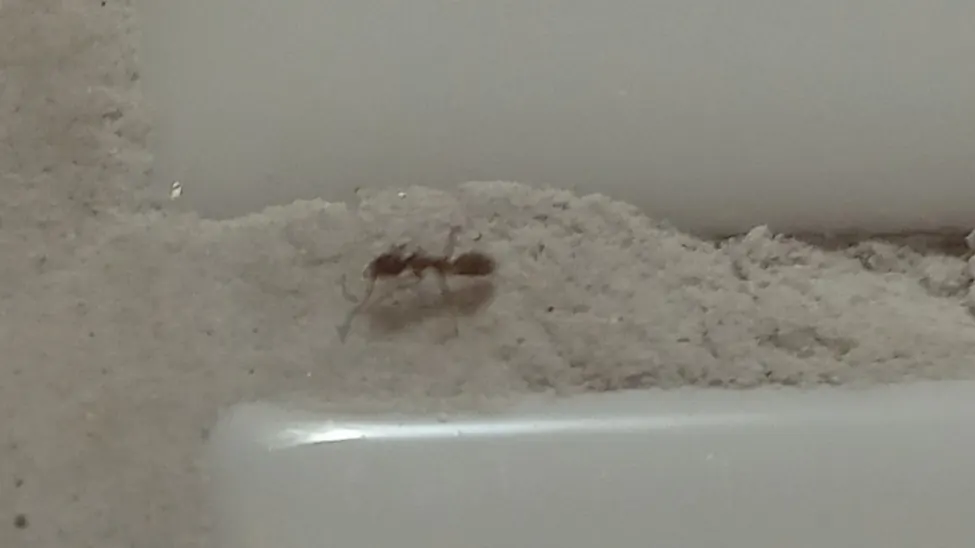
Ants that show up only in the bathroom are usually there for water, not food. A bathroom is the wettest, often warmest room in the house, and it is full of the pipes ants use as roads into and through walls. UC IPM's ant guide says ants come indoors for food and water, warmth and shelter, or to escape hot, dry weather, and it tells homeowners to inspect under sinks and along pipes and electrical wires.
So a few ants by the sink or tub usually mean a colony nearby has found a drip, damp grout or a gap around a pipe. Most of the time the fix is simple: dry the room, clean the trail and close the gap. Two cases are different and worth a closer look: tiny pale ants that keep spreading, and winged insects coming out of the wall or floor.
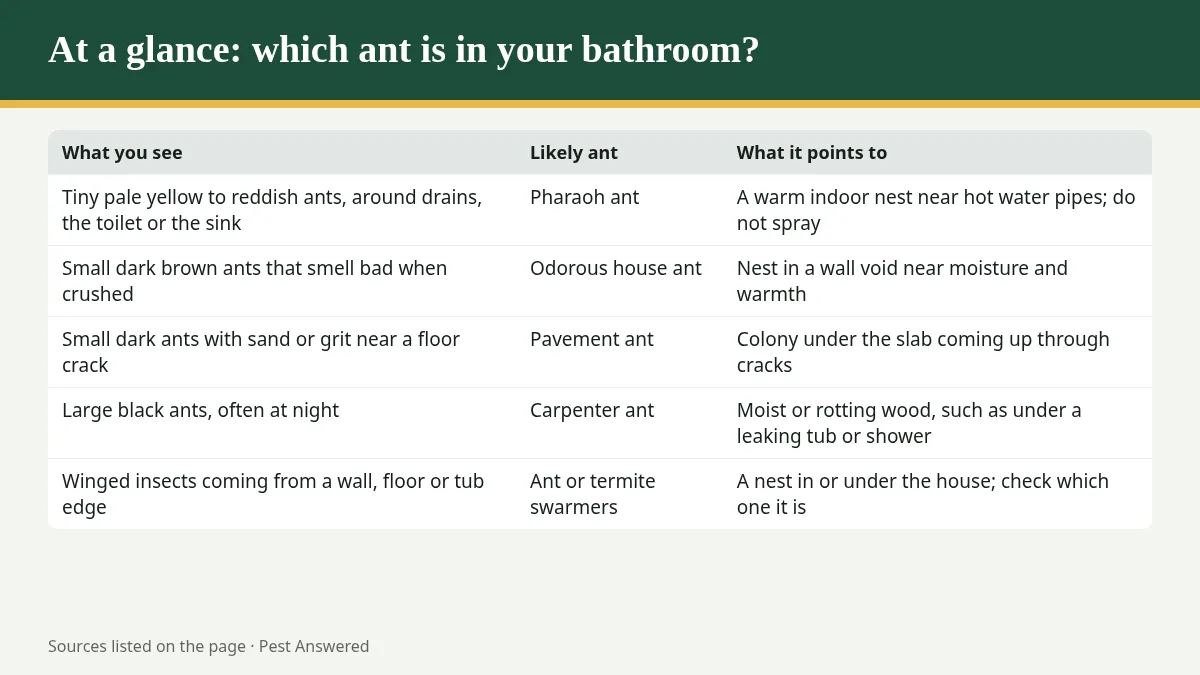 Graphic: summary of this guide, made by our team from the cited sources.
What the ants in your bathroom are telling you
| What you see | Likely ant | What it points to |
|---|---|---|
| Tiny pale yellow to reddish ants, around drains, the toilet or the sink | Pharaoh ant | A warm indoor nest near hot water pipes; do not spray |
| Small dark brown ants that smell bad when crushed | Odorous house ant | Nest in a wall void near moisture and warmth |
| Small dark ants with sand or grit near a floor crack | Pavement ant | Colony under the slab coming up through cracks |
| Large black ants, often at night | Carpenter ant | Moist or rotting wood, such as under a leaking tub or shower |
| Winged insects coming from a wall, floor or tub edge | Ant or termite swarmers | A nest in or under the house; check which one it is |
The rest of this guide goes through each case and what to do about it.
Why the bathroom and not the kitchen
Three things make a bathroom attractive even when the kitchen is spotless.
Water. UC IPM lists leaky faucets as something that attracts ants, and NPIC's ant page tells homeowners to fix leaky pipes. A slow drip under the sink, a wet bath mat or a shower that never fully dries can water a whole colony.
Warmth. Ohio State Extension says Pharaoh ants prefer dark, warm areas near hot water pipes, in bathrooms and kitchens, and Penn State says odorous house ants nest indoors near sources of moisture and warmth.
Pipes and gaps. The holes where supply and drain lines pass through walls and floors are often loosely sealed. UC IPM advises checking under sinks and along pipes and electrical wires when ants invade a bathroom or kitchen.
Size is the fastest clue
You don't need a microscope to narrow it down. Lay one ant next to a ruler or a grain of rice and compare it with the published sizes below.
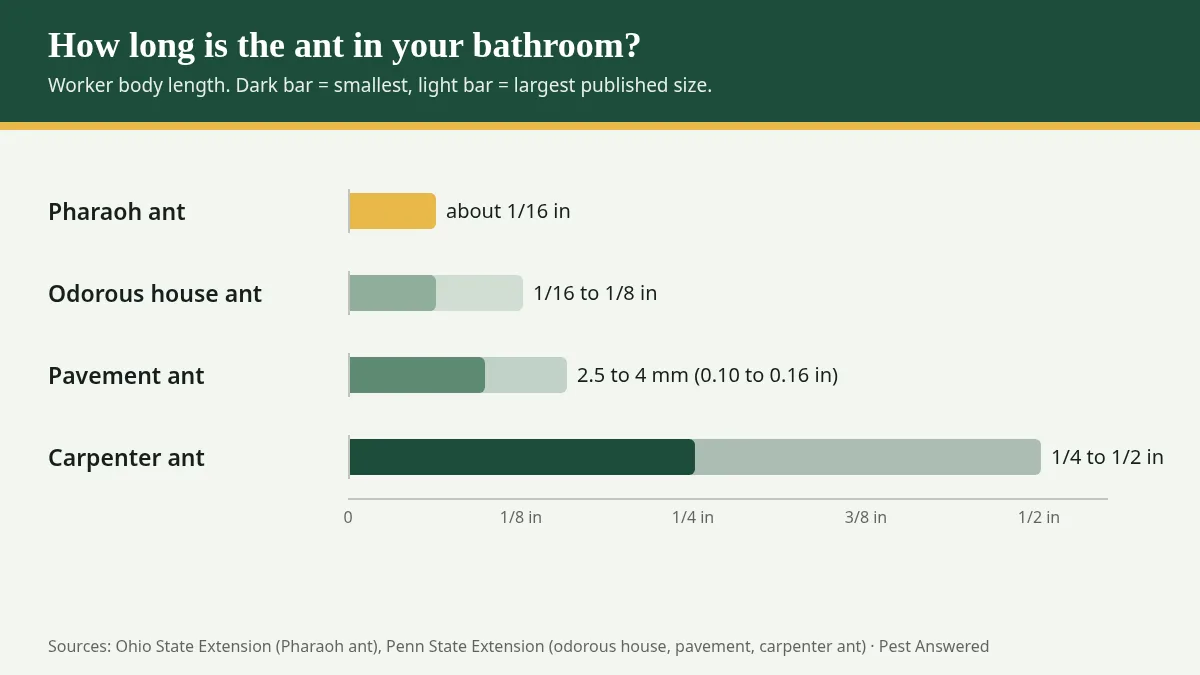 Chart: worker body lengths from Ohio State Extension (Pharaoh ant) and Penn State Extension (odorous house ant, pavement ant, carpenter ant). Made by our team.
Tiny pale ants around drains: think Pharaoh ant
Pharaoh ant workers are very small, about 1/16 inch long, and light yellow to reddish brown with a darker abdomen, according to Ohio State Extension's Pharaoh ant fact sheet. They are trail-making ants that forage in drains, toilets and washbasins, and colonies can grow to 300,000 or more members.
The detail that matters most: Ohio State says a colony can split into new nests, called budding, for several reasons, including the application of a repellent pesticide. Spraying a trail of Pharaoh ants can turn one nest into several. Ohio State also says bug bombs do not reach the colony and can push the ants to move it.
What to do instead: clean the trail, fix the moisture, and use a bait labeled for this ant, placed where the ants are feeding and out of reach of children and pets. Ohio State says treating these ants is best left to commercial applicators who understand baiting, so if they keep spreading, or you live in an apartment building, call a licensed professional.
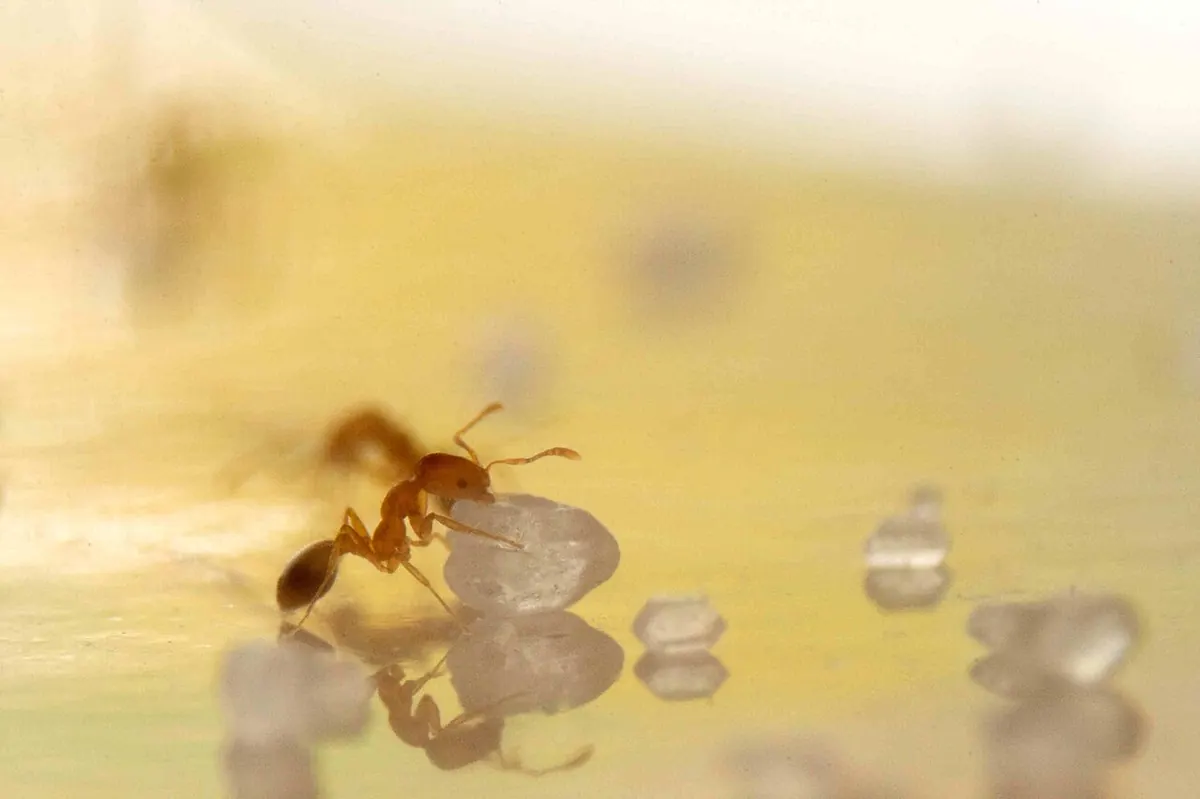
Small dark ants: odorous house ants and pavement ants
Odorous house ant workers are 1/16 to 1/8 inch long and give off a rotten odor when crushed, according to Penn State Extension's odorous house ant fact sheet. They nest indoors near moisture and warmth, in wall voids, so a bathroom wall is a natural spot.
Penn State's pavement ant fact sheet gives pavement ants as about 2.5 to 4 mm long and dark brown to black. Penn State says their colonies are usually under sidewalks, slabs and large rocks, and they come in through cracks in foundation walls and interior slabs, often leaving small piles of sand or soil next to the crack. If you find grit on the bathroom floor near a crack or along the tub, that is a strong hint.
For both, Penn State says baits work because workers carry the bait back to the nest. Choose a bait labeled for the ant you have and follow the label exactly.
Big black ants: check for wet wood
Carpenter ant workers are dark, shiny brown to black and 1/4 to 1/2 inch long, according to Penn State Extension's carpenter ant fact sheet. Penn State says they seldom tunnel into dry, sound wood but will excavate moist, rotting wood to build satellite nests, and it lists leaking bathtubs, showers and condensation from water pipes among the places to check. Wood that stays below about 15 percent moisture is usually left alone.
Large black ants in a bathroom, especially at night, can mean a soft subfloor or a wet wall behind the tub. Press around the tub edge and the toilet base for soft spots, look for piles of coarse, stringy wood bits sifting from cracks or behind trim, and check under the sink for old water stains. If you find damage, the leak needs fixing before any ant treatment will last. If you see both large ants and wood debris, have a licensed professional inspect it.
Winged insects in the bathroom: ant or termite?
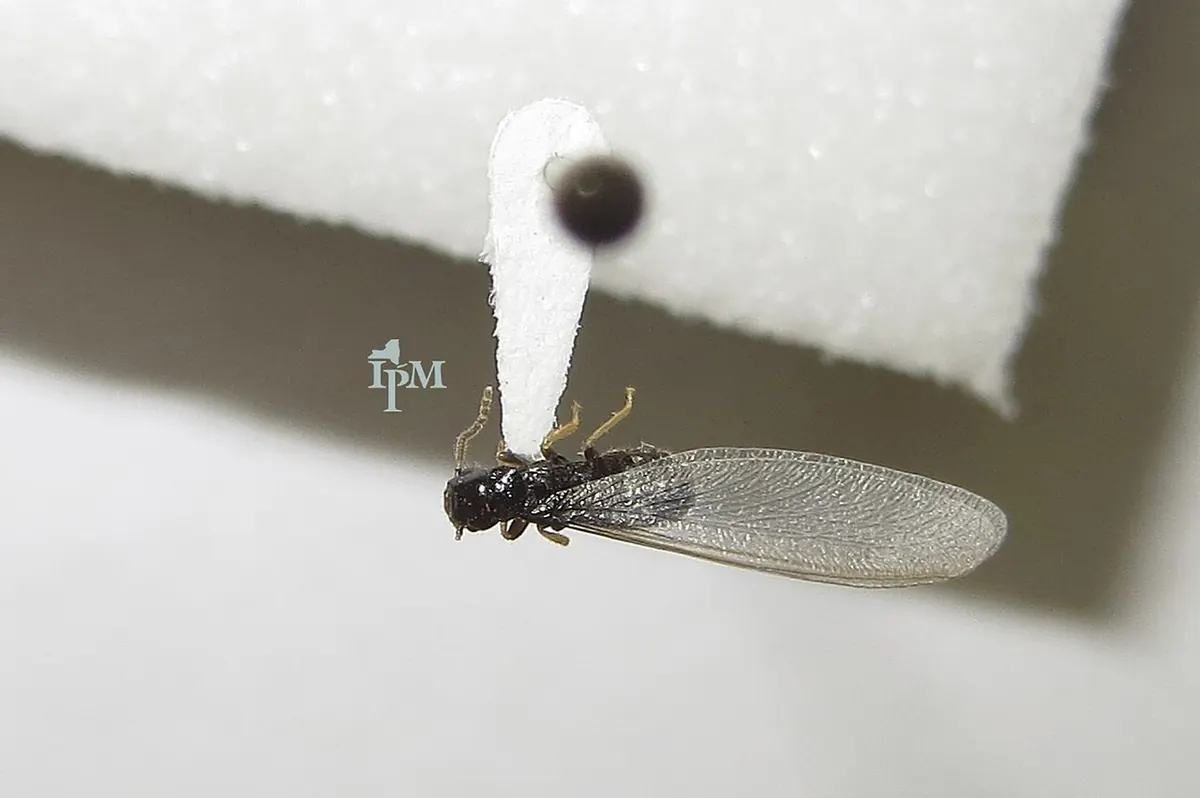
Winged insects coming out from around the tub, a floor crack or a wall are swarmers, the reproductive form that leaves a mature colony to mate. Texas A&M's Swarming Insects Indoors fact sheet says that when numerous ant swarmers appear indoors, there is an ant nest inside, underneath or very close to the home, while termites swarming indoors are an almost sure sign of a termite infestation. So the first job is telling them apart.
| Feature | Winged ant | Winged termite |
|---|---|---|
| Waist | Pinched, narrow | Thick, no narrow waist |
| Antennae | Elbowed | Straight |
| Wings | Front pair longer than back pair | All four about the same length |
Both ants and termites can lose their wings shortly after they swarm, so loose wings on a windowsill or in the tub are a clue too. Save a few insects in a sealed bag or jar to show a professional.
Bathrooms on a concrete slab have a specific weak point for termites. LSU AgCenter's bath trap page explains that a bath trap is an opening left in the slab where the tub plumbing comes through, and that wood forms around it can give termites a way in. Texas A&M AgriLife's subterranean termite guide recommends checking the plumbing closely in bathrooms on slab construction and installing a removable access panel if there is no access to the bath trap. If you have termite swarmers in a slab-home bathroom, a licensed professional will want to look at that spot. Our guide on how long termite treatment takes to work explains what happens next.
A 10-minute bathroom check
Work through the room once with a flashlight:
- Under the sink. Feel the supply lines, the shutoff valves and the drain trap for moisture. Look for water stains and for gaps where the pipes enter the wall.
- Around the toilet. Check the base and the supply line for seepage, and look for soft flooring.
- The tub and shower. Look at the caulk where the tub meets the wall and floor. Gaps, mold or crumbling grout let water and ants into the wall.
- Floor cracks and grout. Small piles of sand or soil point to pavement ants coming up from below.
- Follow a trail. Watch where ants go when they leave. A trail that disappears into a pipe hole, an outlet or a gap behind the baseboard shows you where to seal.
- Ventilation. If the room stays damp hours after a shower, run the fan longer or fix it.
What to do, and what not to do
Do:
- Wipe trails with soapy water. NPIC and UC IPM both recommend it because it removes the scent trail other ants follow.
- Fix drips and leaks, and dry wet mats and towels.
- Caulk gaps around pipes, fixtures and baseboards once you know where ants enter.
- Use ant baits only as their labels direct, placed out of reach of children and pets. UC IPM says baits take time to work and that indoor sprays aren't usually necessary.
Don't:
- Spray ants indoors. UC IPM says it will not prevent more ants from coming in, and Ohio State warns that repellent sprays can make Pharaoh ant colonies split.
- Set off a bug bomb. Ohio State says total release aerosols do not reach Pharaoh ant colonies.
- Mix or improvise your own pesticides. The label is the law, and any product may only be used exactly as its label allows.
If ants are also turning up where you sleep, see our guide to ants in your bed when there is no food around.
When to call a professional
Call a licensed pest professional if you see:
- Winged insects coming from a wall, floor or the edge of the tub, especially if they look like termites.
- Large black ants together with soft wood, wood debris or a known leak.
- Tiny pale ants that keep spreading to other rooms or apartments after a few weeks of cleaning and sealing.
- Ants that come back after you have fixed the moisture and sealed the gaps.
If you find an active leak, a plumber may be the first call, since ants and termites are both drawn to moisture.
Frequently asked questions
Why do ants come into the bathroom if there is no food there?
Water is often enough. UC IPM says ants come indoors for water as well as food, and that leaky faucets attract them. A bathroom also gives them warmth and pipes to travel along, and soap scum, hair products or a dead insect can supply a little food.
Are tiny yellow ants in the bathroom a bad sign?
They may be Pharaoh ants. Ohio State Extension says this ant is about 1/16 inch long, prefers warm areas near hot water pipes and in bathrooms, and forages in drains, toilets and washbasins. Do not spray them, because repellent pesticides can make the colony split into new nests.
Could the ants in my bathroom actually be termites?
If they have wings, check. Termites have straight antennae, a thick waist and four wings of equal length, while ants have elbowed antennae, a pinched waist and unequal wings. Texas A&M says termites swarming indoors almost surely mean an infestation, so call a licensed professional.
What is the best way to get rid of ants in a bathroom?
Wipe trails with soapy water, fix drips and leaks, caulk gaps around pipes and fixtures, and use ant baits only as their labels allow. UC IPM says spraying ants indoors will not stop more ants coming in.
Do big black ants in a bathroom mean water damage?
They can. Penn State Extension says carpenter ants nest in moist, rotting wood and lists leaking bathtubs and showers as places to check. Large black ants around a tub, especially at night or with wings, are worth a professional inspection.
Sources
- Ants, UC Statewide IPM Program
- Pharaoh Ant (HYG-2136), Ohio State University Extension
- Odorous House Ant, Penn State Extension
- Pavement Ant, Penn State Extension
- Carpenter Ants, Penn State Extension
- Swarming Insects Indoors, Texas A&M Insects in the City
- Subterranean Termites (ENTO-PU-036), Texas A&M AgriLife Extension
- Bath Traps, LSU AgCenter
- Ants, National Pesticide Information Center (NPIC)
Spotted an error? See our corrections policy or email contact@pestanswered.com.

Pest Answered Editorial Team
Our editors research each guide from the listed sources and check every claim before publishing. Editorial policy
Emanuel Jaramillo
Expert Contributor, Pest Control
Emanuel Jaramillo has 12 years of hands-on pest control experience and is bilingual in English and Spanish. He contributes field tips and reviews our practical guides on pest signs, identification, prevention and…
Related guides
-
 Ants
How Long Do Ant Traps Take to Work? Real Timelines From Extension Experts
Most ant bait stations cut ant numbers in about 5 to 10 days, but some ants take two weeks or more and fire ant baits can take weeks to months. Timelines, why you see more ants first, and fixes.
-
 Ants
Ants in Your Bed but No Food? Why They Come and How to Stop Them
Ants in a bed with no food are usually after water, warmth or a nest site, or are scouts from a colony in the wall. How to tell which ant you have and stop them, with UC IPM, NPIC and Penn State sources.
-
 Mice & Rats
When Do Mice Come Out? Night, Dusk and Before Dawn, and What a Daytime Mouse Means
House mice are most active at night, with feeding peaks at dusk and just before dawn. Why you sometimes see them in daylight, what time of year they move indoors, and when to set traps.
-
 Cockroaches
How Fast Do Cockroaches Multiply? Real Numbers by Species
German cockroaches can go from one female to thousands in under a year. Sourced per-year numbers for German, American, brownbanded and oriental roaches, plus a day-by-day timeline and how to slow it down.