How Long Does Termite Treatment Take to Work? Liquids vs Baits
It depends on the method. Purdue Extension puts it plainly: "With liquid termiticides, control is immediate; with baits, control may take from several months to a year" (Purdue).
"Immediate" means the treated soil starts working right away. It doesn't mean every termite dies that day. Modern liquid products are made to kill slowly so termites spread them to others (NC State). Below is what to expect with each method and what you may still see afterward.
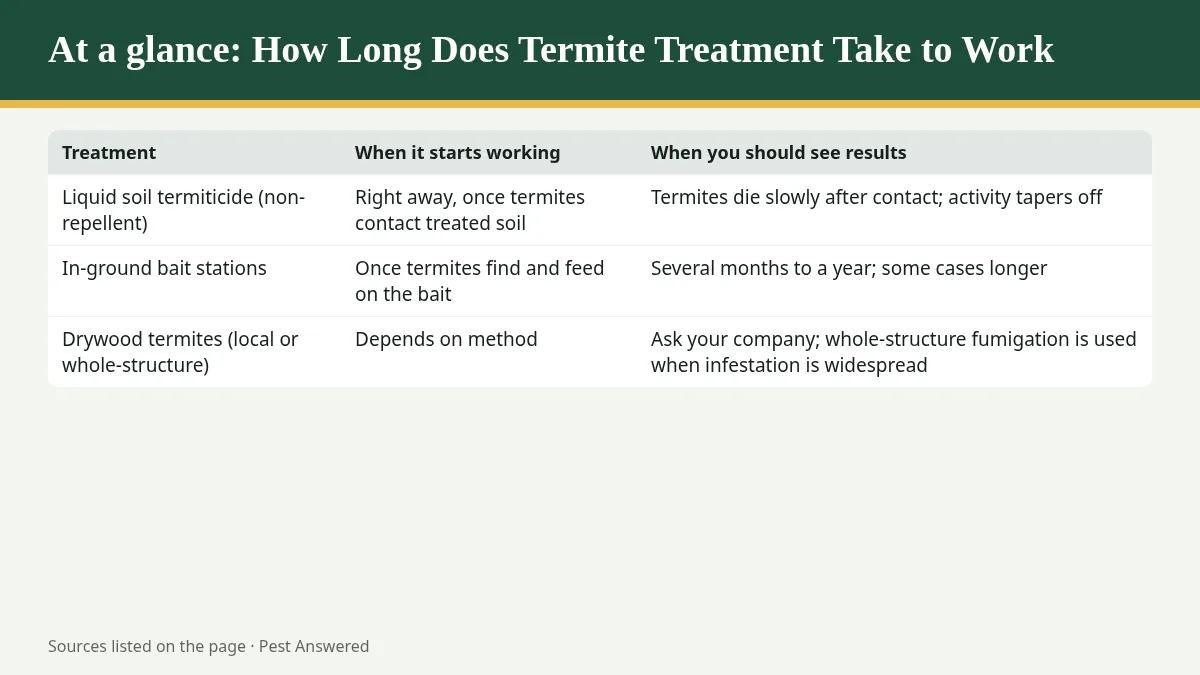 Graphic: summary of this guide, made by our team from the cited sources.
Timeline by treatment type
| Treatment | When it starts working | When you should see results | Source |
|---|---|---|---|
| Liquid soil termiticide (non-repellent) | Right away, once termites contact treated soil | Termites die slowly after contact; activity tapers off | Purdue, NC State |
| In-ground bait stations | Once termites find and feed on the bait | Several months to a year; some cases longer | Purdue, UC IPM |
| Drywood termites (local or whole-structure) | Depends on method | Ask your company; whole-structure fumigation is used when infestation is widespread | UC IPM |
Liquid termiticides: fast start, slow kill
Most homes are treated with a liquid termiticide applied to the soil around and under the foundation. NC State calls this "the most common method of termite treatment on a home" (NC State).
Why it's not instant. Older termiticides were often repellent. UC IPM explains that termites could detect repellent products (usually pyrethroids) and avoid them without getting a lethal dose, so those products were phased out. Newer active ingredients, including chlorantraniliprole, fipronil and imidacloprid, are non-repellent (UC IPM).
NC State says these products "kill termites more slowly when the insects come in contact with the treated soil," and studies indicate the contaminated termites may pass some of the chemical to other colony members (NC State). Slow is the point: a termite that dies instantly can't spread it.
What this means for you. Termites that were already inside your walls when the soil was treated may keep working for a while. Our sources don't give a fixed number of weeks for a liquid treatment to clear an active infestation, so ask your company what they expect for the product they used.
Bait stations: months, by design
Purdue describes the setup: stations go into the ground around the house every 10 to 20 feet and about 2 feet out from the foundation, and the professional rechecks them monthly (Purdue). NC State gives 2 to 4 feet from the foundation and no more than 20 feet apart (NC State).
Why it takes months. Baits use slow-acting insect growth regulators. NC State explains these don't affect the queen, king, soldiers or adult workers directly. They affect immature termites, which make up most of the colony, so "it may take several months before the entire colony is substantially reduced or even eliminated" (NC State). UC IPM says baits may take "several months or even years" and must be followed up with constant monitoring (UC IPM).
Things that slow it down:
- Termites have to find the stations first. NC State notes weather affects foraging; very cold winters can reduce termite activity (NC State).
- Purdue says the time to eliminate a colony depends on "several to many environmental factors that limit termite foraging" (Purdue).
- Feeding on bait may slow as temperatures drop after a fall installation (NC State).
Which termite you have changes the timeline
UC IPM says the right treatment depends on the type of termite and where it is (UC IPM):
- Subterranean termites nest in soil and reach wood that touches soil, or travel up through earthen shelter tubes. These are the termites that soil liquids and in-ground baits target.
- Drywood termites nest above ground in fairly dry wood such as lumber, fences, utility poles and dead tree limbs. They often push out fecal pellets that pile up on surfaces below, and UC IPM describes the pellets as having six flattened sides lengthwise. Treatments are local (into the wood) or, when the infestation is widespread, whole-structure fumigation.
- Dampwood termites nest in very moist wood and soil, mostly in cool, humid coastal areas.
UC IPM notes that methods suited to drywood termites, such as fumigation and heat, don't work on subterranean termites, because most of a subterranean colony lives in nests near or below ground (UC IPM). So the timelines above for liquids and baits apply to subterranean termites. For drywood work, ask the company directly how long their method takes and how they'll confirm it worked.
Is it even termites?
Winged ants are often mistaken for swarming termites, especially in spring. UC IPM lists three differences: ants have a thin, pinched waist while termites have a broad waist; an ant's hind wings are smaller than its front wings while a termite's are about equal; and ants have elbowed antennae while termites don't (UC IPM Ants). Both shed their wings soon after flying, so a pile of loose wings near a window doesn't settle it alone.
What you may still see after treatment
Swarmers in spring. NC State says if bait is installed in the fall against an active infestation, "you might still see activity, including swarming (winged) termites in the spring," and the same can happen with a liquid treatment done very late in the year or in winter (NC State).
Swarms outdoors. UC IPM notes that seeing swarms of flying termites does not always mean your home is infested (UC IPM). Swarms in the yard after treatment aren't proof the treatment failed. Swarms coming from inside the house are worth reporting.
Old mud tubes. Purdue says subterranean termite tubes are generally less than ¼ inch in diameter (Purdue). UC IPM recommends destroying shelter tubes between soil and wood (UC IPM). If you break a section and later find it rebuilt, termites are still active there. Tell your company.
More insects in general. If you're also seeing ants or roaches after a pest service, see why you might see more bugs after pest control.
How long the protection lasts
- Purdue says soil termiticides "should provide at least 5 years of protection in all but the harshest environments" (Purdue).
- NC State expects liquid termiticides to stay effective in the soil for at least five years, usually longer, but says that "does not guarantee that termites will not invade your house for 5 years. An annual inspection is the only way to maintain that level of protection" (NC State).
- Bait programs continue year-round as long as you keep the contract (NC State).
- UC IPM recommends regular inspections every 3 to 5 years to catch infestations early (UC IPM).
You have time to choose
If you've just found termite damage, Purdue says "there is no great hurry to apply control measures. Termites work slowly, and a few weeks or even months delay is of little consequence." It recommends getting bids, descriptions of the work, and guarantee details from at least two companies (Purdue).
UC IPM adds that do-it-yourself termite pesticides are generally not effective and recommends calling a professional (UC IPM).
Questions to ask before you sign
- Is this a liquid treatment, baits, or both? Which product?
- When should I expect to stop seeing activity, and what should I do if I don't?
- How often will you inspect or check stations? NC State says updates may come quarterly or annually (NC State).
- What does the guarantee cover: retreatment only, or repairs too?
- What happens if swarmers show up next spring?
Frequently asked questions
How long does it take for termite treatment to work?
Purdue says control with liquid termiticides is immediate, while baits may take several months to a year. Non-repellent liquids kill termites slowly after contact, so activity can taper off over weeks.
Why do I still see termites after treatment?
Slow-acting products need time, and NC State notes swarmers can still appear in spring after a late-year treatment. Ongoing activity months later is a reason to call the company back.
How long does termite treatment last?
Purdue says soil termiticides should provide at least 5 years of protection in most conditions; NC State expects at least five years but stresses that annual inspections are needed.
Can I treat termites myself?
UC IPM says do-it-yourself pesticides for termites are generally not effective. Purdue notes the soil termiticides it lists for pretreatment are restricted to professional applicators.
Sources
- Termite Control (E-4), Purdue Extension Entomology
- Termite Baiting Systems, NC State Extension
- Pest Notes: Subterranean and Other Termites (UC ANR Pub. 7415), UC Statewide IPM Program
- Pest Notes: Ants, UC Statewide IPM Program
Spotted an error? See our corrections policy or email contact@pestanswered.com.

Pest Answered Editorial Team
Our editors research each guide from the listed sources and check every claim before publishing. Editorial policy

Expert review in progress
This guide has not yet been reviewed by a pest control professional. We will add the reviewer’s name and the review date here once that is done.
Related guides
-
 Cockroaches
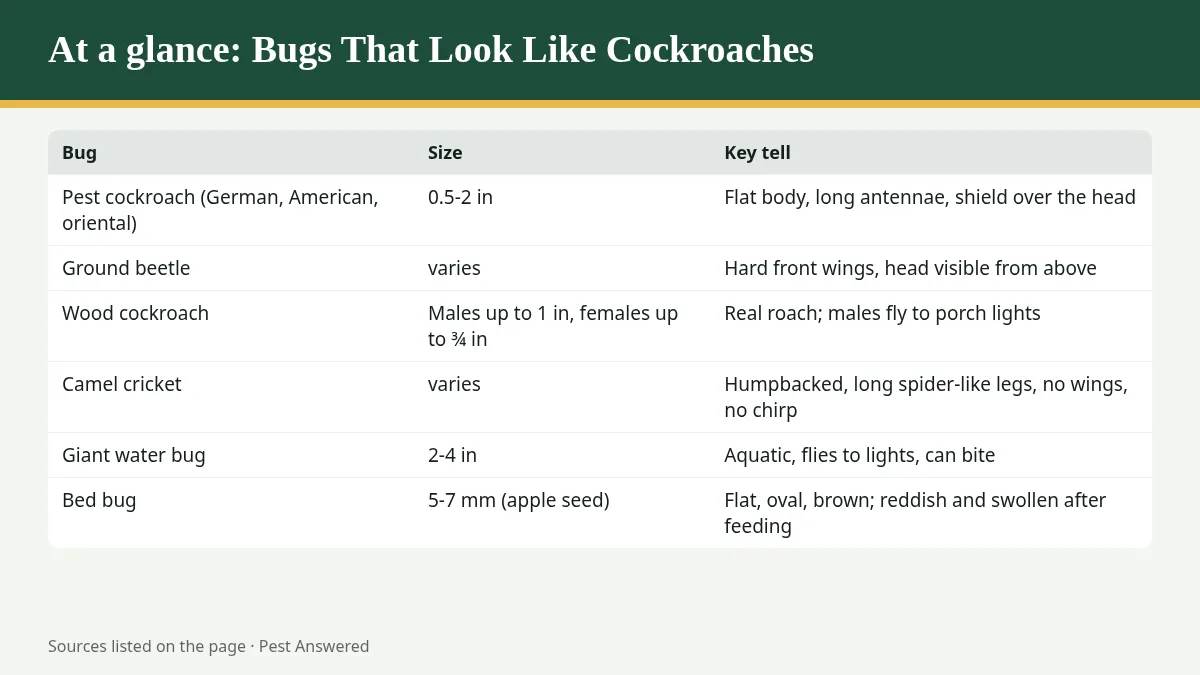
 Bugs That Look Like Cockroaches (and How to Tell Them Apart)
Ground beetles, wood roaches, camel crickets, water bugs and bed bugs get mistaken for cockroaches. Here's how to tell each one apart in under a minute.
-
 Mice & Rats
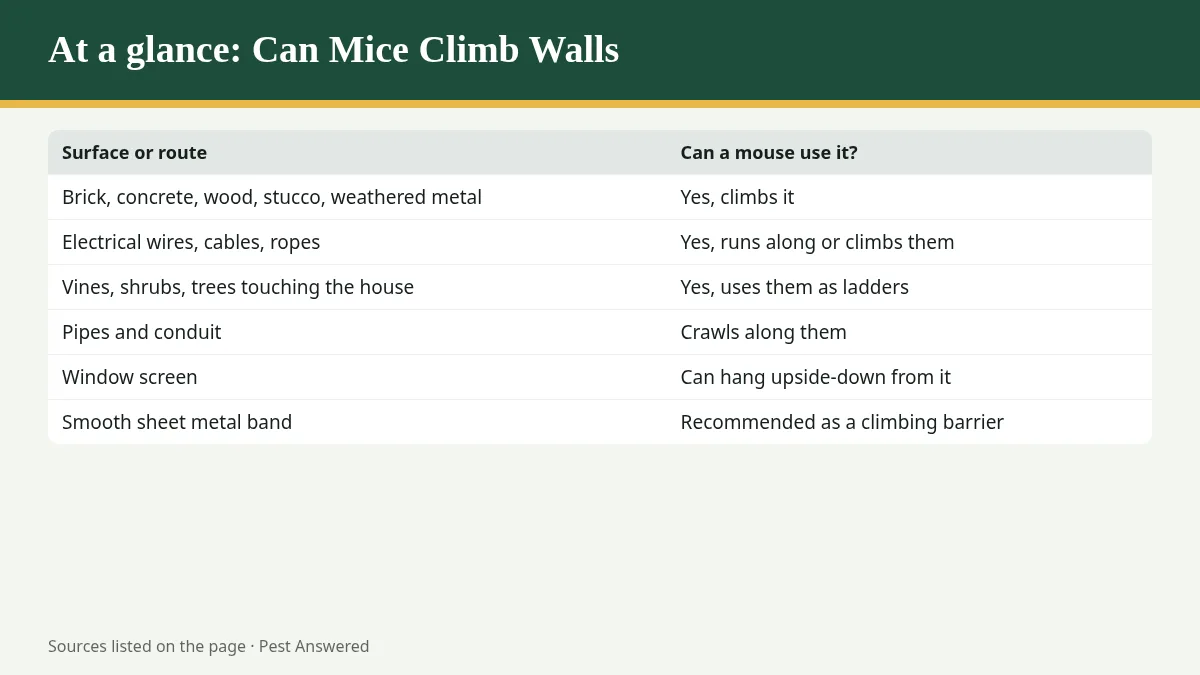
 Can Mice Climb Walls? Yes. Here's What They Can and Can't Climb
Yes, house mice climb any rough wall: brick, wood, concrete, siding. See what they can't grip, how high they jump, and how to block their routes.
-
 Mice & Rats
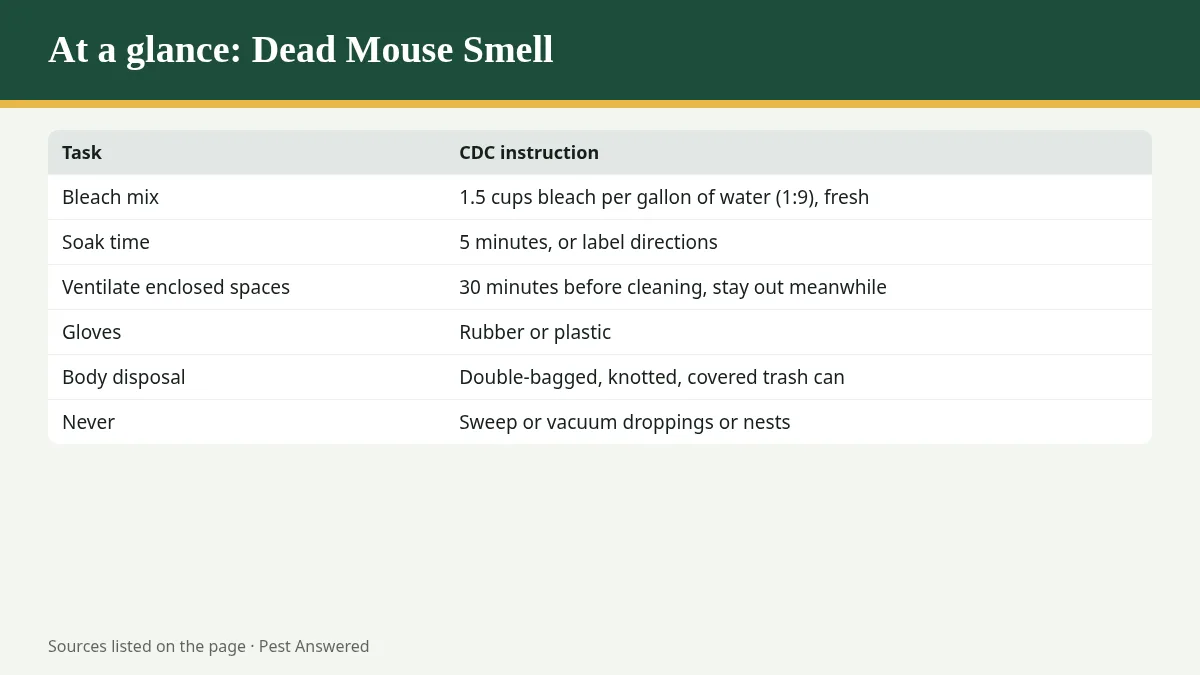
 Dead Mouse Smell: How Long It Lasts and How to Get Rid of It
A dead mouse smell usually fades once the body dries out, in about a few weeks. How to find the source, clean up safely per CDC, and what not to do.
-
 Wasps & Bees
 Do Wasps Come Out at Night? Most Don't. Here Are the Exceptions
Most wasps stay in the nest at night. European hornets and some parasitic wasps do fly after dark and come to porch lights. What it means for you.