Cockroach Eggs: What They Look Like, Where They Hide, and How to Get Rid of Them
Cockroach eggs come packed inside a small, hard capsule called an ootheca (egg case). It is brown, shaped like a bean or a tiny purse, and about 1/4 to 3/8 inch long depending on the species (UC IPM). You will rarely see individual eggs. If you find these cases in a cabinet, behind a fridge or in a basement, roaches are breeding nearby.
What happens next depends on which roach laid it. German cockroaches carry the case until it is almost ready to hatch, so you seldom find theirs. American, oriental and brownbanded roaches drop or glue their cases in hiding spots, where they can sit for weeks.
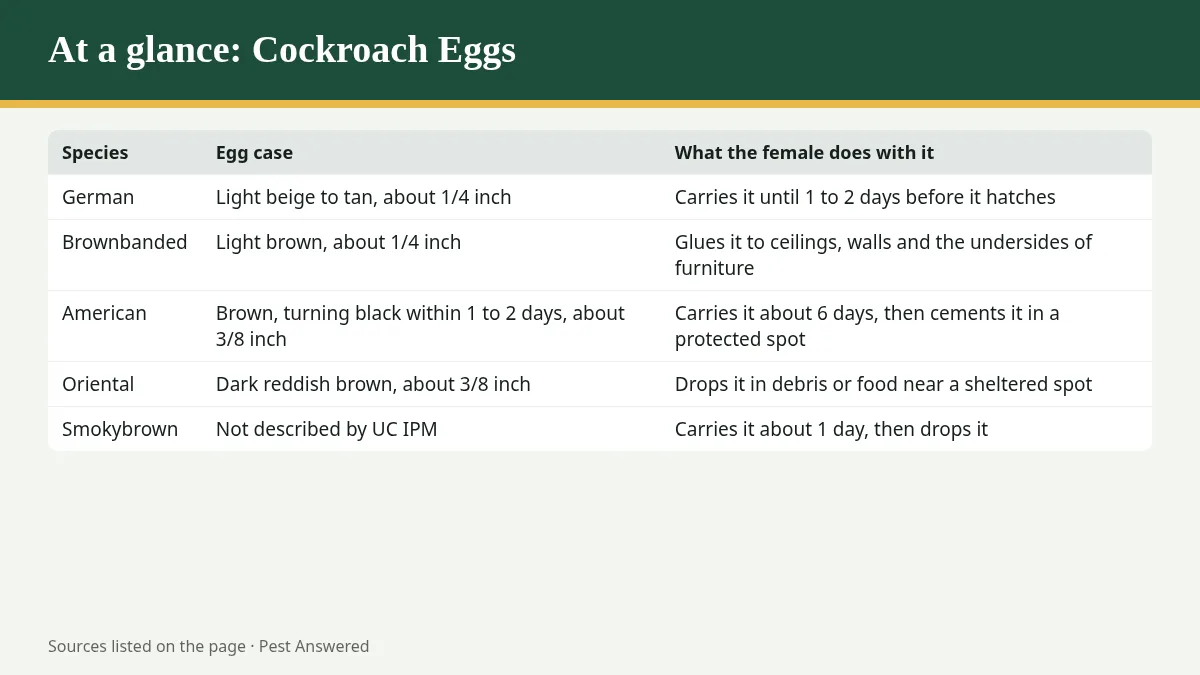 Graphic: summary of this guide, made by our team from the cited sources.
What each species' egg case looks like
| Species | Egg case | What the female does with it | Young per case |
|---|---|---|---|
| German | Light beige to tan, about 1/4 inch | Carries it until 1 to 2 days before it hatches | about 30 |
| Brownbanded | Light brown, about 1/4 inch | Glues it to ceilings, walls and the undersides of furniture | not stated by UC IPM |
| American | Brown, turning black within 1 to 2 days, about 3/8 inch | Carries it about 6 days, then cements it in a protected spot | about 12 |
| Oriental | Dark reddish brown, about 3/8 inch | Drops it in debris or food near a sheltered spot | not stated by UC IPM |
| Smokybrown | Not described by UC IPM | Carries it about 1 day, then drops it | 40 to 45 |
Source: UC IPM Pest Notes: Cockroaches. The University of Kentucky gives up to 40 nymphs per case for German cockroaches and 15 to 20 for most other species (UKY); the University of Florida gives about 16 eggs per case for both American and oriental cockroaches (UF IFAS American; UF IFAS Oriental). Counts vary between studies.
A case that has already hatched looks split open along its top seam and often feels papery and light. An unhatched case is plump and firm.
How long until they hatch
| Species | Time to hatch | Source |
|---|---|---|
| German | about 20 to 30 days, while the female carries it for most of that time | NC State; UC IPM |
| Brownbanded | several weeks | UC IPM |
| American | about 6 to 8 weeks | UF IFAS |
| Oriental | about 42 to 81 days | UF IFAS |
| Smokybrown | 24 to 70 days, depending on temperature | UC IPM |
The German cockroach is the reason infestations seem to explode. UC IPM says a female produces a new egg case every few weeks, and a single female and her offspring can produce over 30,000 roaches a year (UC IPM).
Where to look for egg cases
- Kitchens and bathrooms: behind and under the fridge, stove and dishwasher, inside cabinet hinges and corners, under the sink near pipes. These are German cockroach areas, so look for the roaches and their droppings more than loose cases.
- Ceilings, high shelves, behind picture frames and under furniture: brownbanded cockroaches glue their cases in drier, warmer spots, often away from the kitchen.
- Basements, crawl spaces, floor drains and around the water heater: oriental and American cockroach cases in damp, cool or warm debris.
- Cardboard boxes and paper bags: egg cases ride into homes this way.
A flashlight at night and a few sticky traps along walls will show you where activity is concentrated. Our page on what a cockroach nest looks like shows the other signs that collect in the same spots.
How to get rid of cockroach eggs
The egg case protects the eggs, so the plan is to remove what you can and kill nymphs as they hatch.
- Pick up and destroy cases you can reach. Wear gloves, scoop them into a bag, seal it and put it in an outdoor trash can. UC IPM notes that vacuuming cracks and crevices removes roaches, shed skins and egg cases, and recommends a vacuum with a HEPA or triple filter because roach debris can trigger allergies (UC IPM). Empty it outdoors right away.
- Clean and dry the area. Remove food crumbs, grease and standing water, and fix leaks. UC IPM puts sanitation and exclusion first because roaches that have no food or water are easier to control (UC IPM).
- Use baits where the roaches travel. Gel or station baits placed in cracks near activity reach adults and nymphs. The University of Kentucky says a roach that eats bait typically dies within 1 to 3 days, with a large reduction in a few weeks (UKY). Baits need time: UC IPM says expect 7 days or longer to see results (UC IPM).
- Add an insect growth regulator if you have German roaches. Growth regulators stop nymphs from developing into breeding adults. Follow the product label; it is the legal guide for where and how to use it.
- Keep checking for at least two hatch cycles. For German roaches that means 6 to 8 weeks. Fresh nymphs after a few weeks usually mean eggs hatched, not that the treatment failed.
Females carrying egg cases eat very little, according to UC IPM, so they may survive the first round of baiting and drop their case before dying (UC IPM). That is one reason people see more bugs after pest control for a while.
What does not work well: foggers, bug bombs and aerosol sprays. UC IPM says to avoid them because they can repel and scatter cockroaches to other areas without killing them, and sprays do not give long-term control (UC IPM).
When to call a professional
Call a licensed pest control company if you see roaches in daylight, find egg cases in several rooms, or live in an apartment building where roaches move between units. German cockroaches in multi-unit housing usually need a building-wide plan.
Frequently asked questions
What do cockroach eggs look like?
You almost never see single eggs. Roaches lay them inside a hard, brown, bean- or purse-shaped case called an ootheca, about 1/4 to 3/8 inch long depending on the species.
How many baby roaches come out of one egg case?
It depends on the species. UC IPM gives about 30 for German cockroaches and about 12 for American cockroaches; the University of Kentucky says up to 40 for German and 15 to 20 for most others.
Do roach sprays kill the eggs?
Most insecticides do not get through the egg case well. That is why control plans use baits and growth regulators and repeat inspections for several weeks, so newly hatched nymphs are killed too.
How long do cockroach eggs take to hatch?
German cockroach egg cases hatch in roughly 20 to 30 days. American and oriental cockroach cases take about 6 weeks or longer.
Sources
- Pest Notes: Cockroaches (Pub. 7467), UC Statewide IPM Program
- ENTFACT-614: Cockroach Control, University of Kentucky Entomology
- Biology and Behavior of the German Cockroach, NC State Extension
- American Cockroach (EENY-141), University of Florida IFAS
- Oriental Cockroach (EENY-159), University of Florida IFAS
Spotted an error? See our corrections policy or email contact@pestanswered.com.

Pest Answered Editorial Team
Our editors research each guide from the listed sources and check every claim before publishing. Editorial policy

Expert review in progress
This guide has not yet been reviewed by a pest control professional. We will add the reviewer’s name and the review date here once that is done.
Related guides
-
 Cockroaches
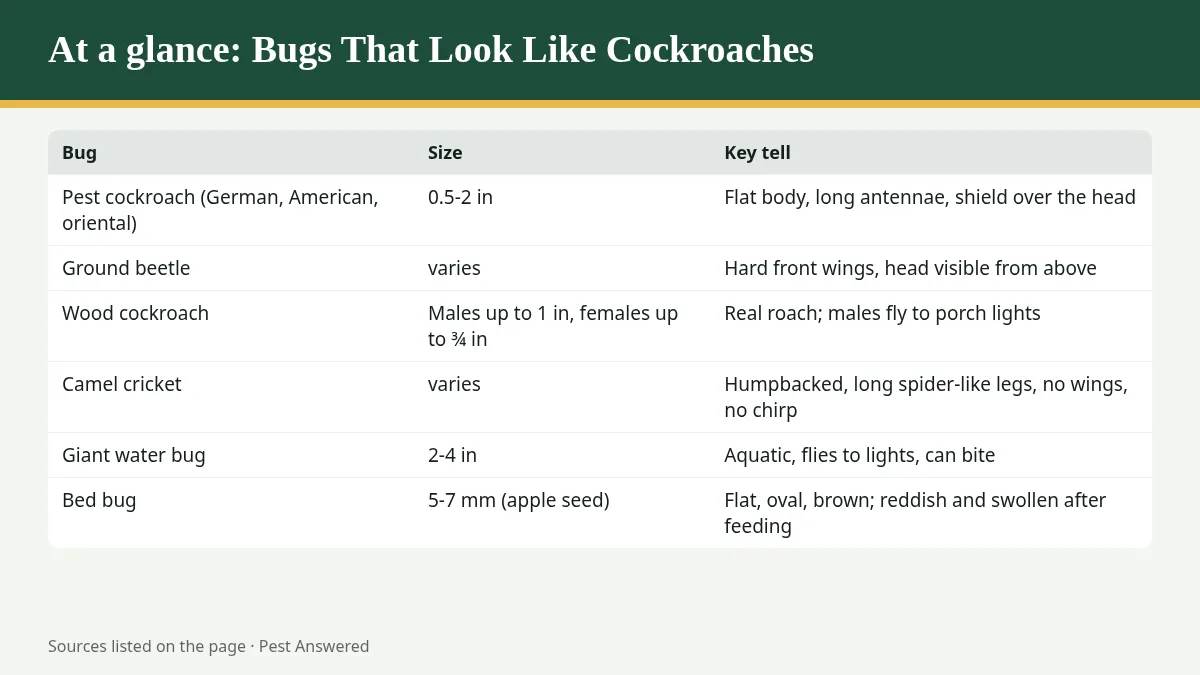
 Bugs That Look Like Cockroaches (and How to Tell Them Apart)
Ground beetles, wood roaches, camel crickets, water bugs and bed bugs get mistaken for cockroaches. Here's how to tell each one apart in under a minute.
-
 Cockroaches
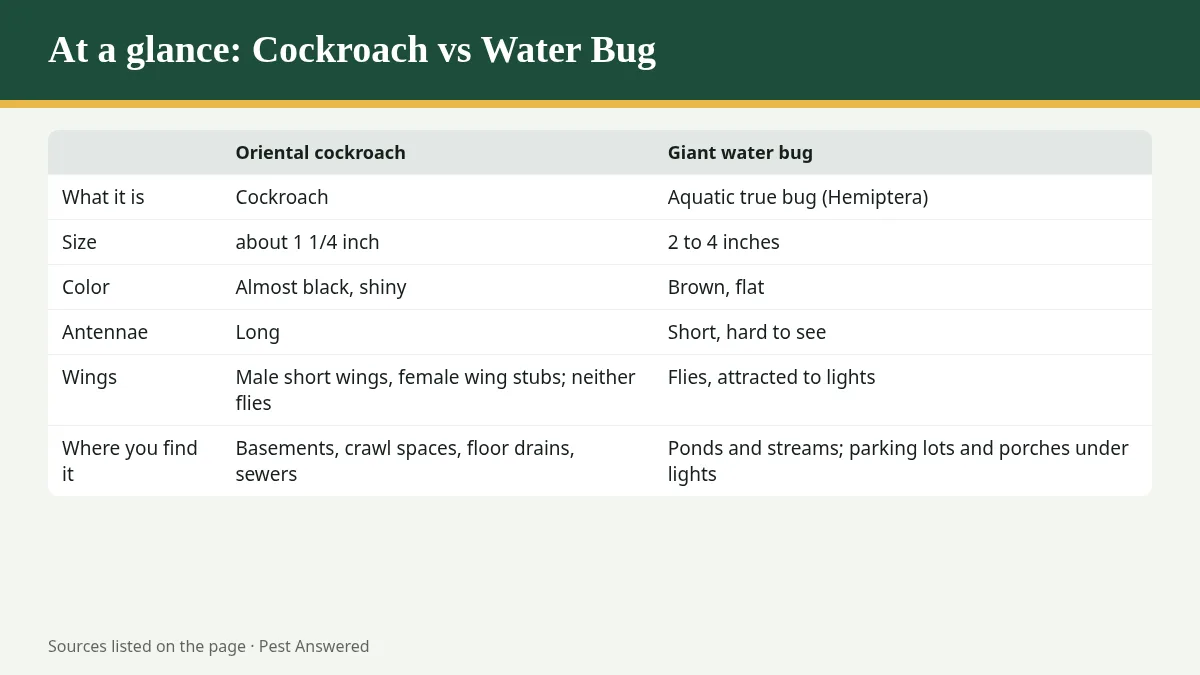
 Cockroach vs Water Bug: Usually the Same Insect, Sometimes Not
Most "water bugs" in homes are oriental or American cockroaches. A true water bug is an aquatic insect that bites and flies to lights. How to tell them apart and what to do.
-
 Cockroaches
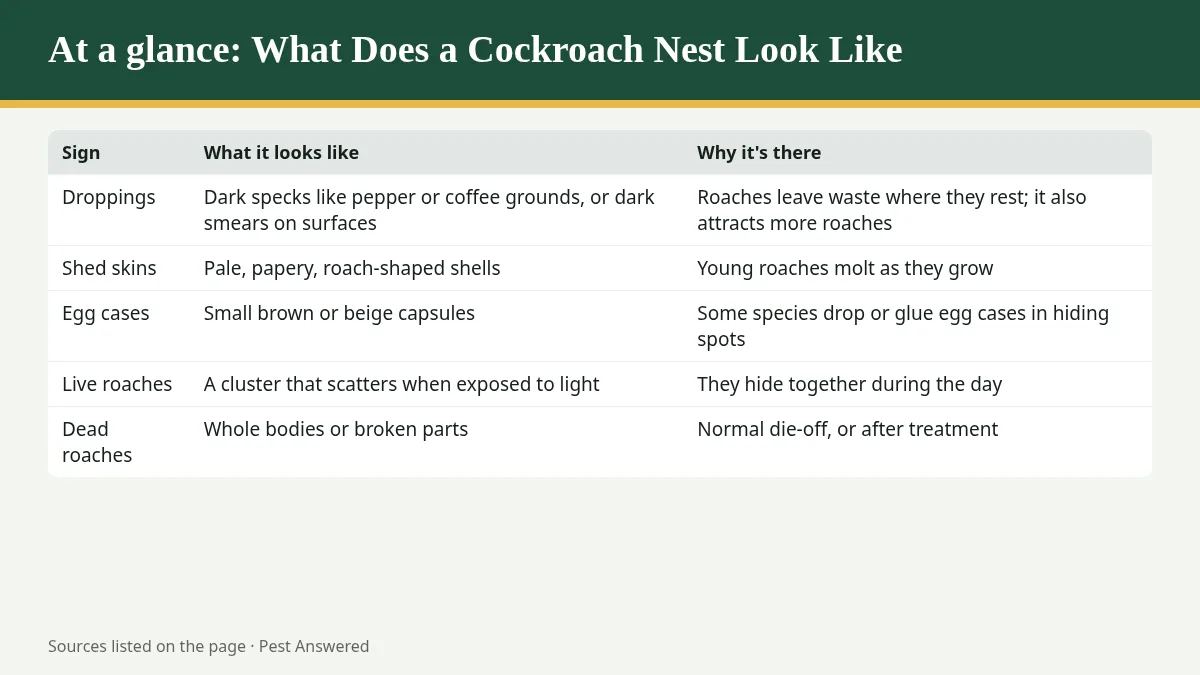
 What Does a Cockroach Nest Look Like? Signs, Egg Cases and Where to Look
A cockroach nest isn't built. It's a crack crowded with roaches, dark droppings, shed skins and egg cases. What each sign looks like and where to look.
-
 Cockroaches
 Why Do Roaches Come Out at Night? (And What a Daytime Roach Means)
Roaches come out at night because they're nocturnal: they hide in dark cracks by day and forage after dark. Here's why, and what seeing one by day means.