What Are Wasp Nests Made Of? Paper, Mud, and How to Tell Them Apart
 ✓ Reviewed by Emanuel Jaramillo
Published · Last reviewed · 6 min read
✓ Reviewed by Emanuel Jaramillo
Published · Last reviewed · 6 min read
Most wasp nests are made of paper. Paper wasps, yellowjackets and hornets chew wood into pulp, mix it with saliva, and spread it into thin layers that dry into a paper-like material (University of Maryland Extension). The exception is mud daubers, which build their nests from mud (Purdue).
The material and shape of a nest tell you which wasp built it, and that tells you how careful to be.
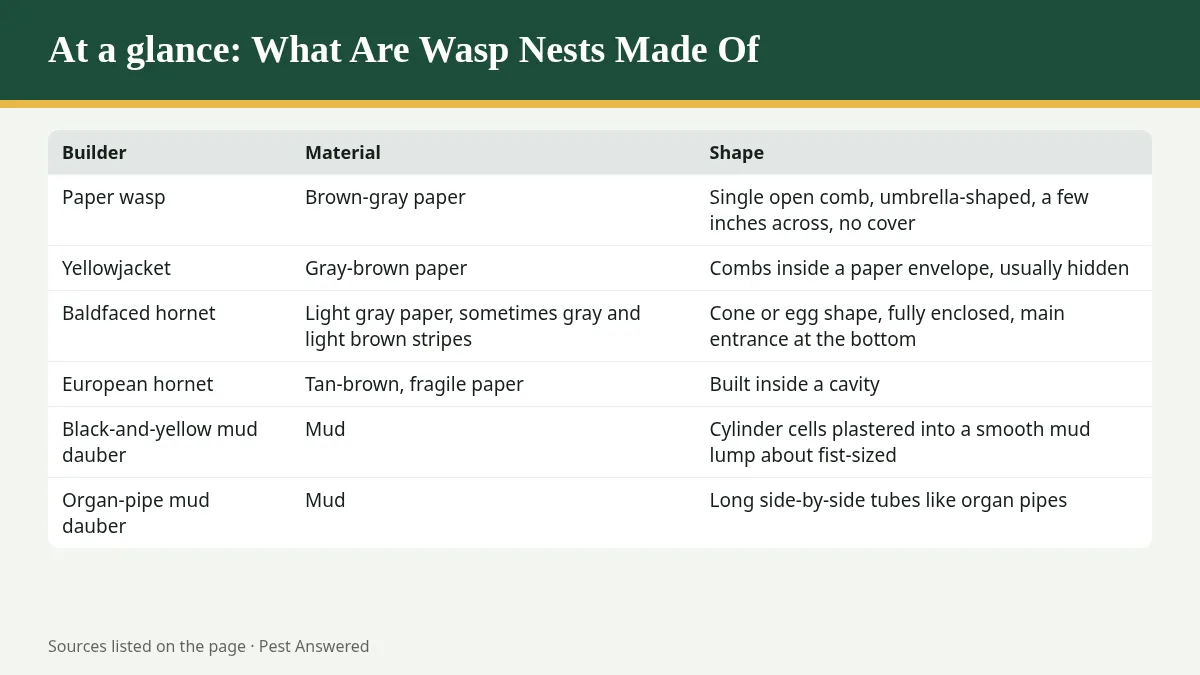 Graphic: summary of this guide, made by our team from the cited sources.
How wasps make paper
University of Maryland Extension describes the process: wasps make "a paper-like material" from "chewed-up wood pulp and saliva." The same material forms the brood cells (the honeycomb-shaped cells the larvae live in) and, for some species, the outer covering called the envelope. Workers enlarge the nest with more comb and paper layers as the colony grows (UMD).
The University of Kentucky gives the same recipe: "finely-chewed wood fragments and salivary secretions" (Univ. of Kentucky).
Where the wood comes from. UMD has a photo of a baldfaced hornet scraping wood pulp for nest-building, and notes that European hornets chew bark off young branches of shrubs such as lilac, viburnum, rhododendron and birch, partly to use the pulp for nests (UMD).
Why some nests are striped. "Pulp from different wood sources can result in paper bands of a different color" (UMD). A nest with swirls of gray and tan was built from more than one source of wood.
Nest types at a glance
| Builder | Material | Shape | Where you'll find it | Colony size (peak) | Source |
|---|---|---|---|---|---|
| Paper wasp | Brown-gray paper | Single open comb, umbrella-shaped, a few inches across, no cover | Eaves, door frames, shrub branches | About 20-75 | UMD |
| Yellowjacket | Gray-brown paper | Combs inside a paper envelope, usually hidden | In the ground (old rodent burrows), wall voids, sheds, dense shrubs | Large nests: thousands of workers | UMD |
| Baldfaced hornet | Light gray paper, sometimes gray and light brown stripes | Cone or egg shape, fully enclosed, main entrance at the bottom | Hanging in trees or on buildings at least 3 ft up | About 100-400 workers | UMD |
| European hornet | Tan-brown, fragile paper | Built inside a cavity | Hollow trees, barns, attics, wall voids | About 200-400 workers; large nests over 1,000 | UMD |
| Black-and-yellow mud dauber | Mud | Cylinder cells plastered into a smooth mud lump about fist-sized | Eaves, overhangs, sheltered walls | Solitary | Purdue |
| Organ-pipe mud dauber | Mud | Long side-by-side tubes like organ pipes | Smooth walls, bridges | Solitary | Purdue |
Paper wasp nests
These are the open, upside-down umbrellas under eaves and porch ceilings. UMD describes a single layer of comb, usually a few inches across, exposed and not covered by an envelope, hanging from a central stalk (UMD). You can see the open cells from below.
The University of Kentucky lists common sites: under eaves, gutters and ledges, in attics, barns and sheds, and behind shutters, inside porch light fixtures, grills and mailboxes (Univ. of Kentucky).
Paper wasps are less defensive than hornets and yellowjackets (UMD). Stings usually happen when someone bumps a hidden nest.
Hornet nests (the "football" or "basketball")
The big gray nest in a tree is almost always a baldfaced hornet nest. Despite the name, UMD notes the baldfaced hornet is actually a type of aerial yellowjacket, not a true hornet (UMD). The University of Kentucky describes the nest as "a large, gray nest resembling a bloated football," attached to a tree, bush or building, often hidden among branches (Univ. of Kentucky).
Inside the paper shell are stacked horizontal combs. UMD says the main entrance is the lowest opening, and a young nest may have a long entrance tube pointing down (UMD). UMD says these nests can be surprisingly easy to miss until winter reveals them.
The European hornet, the only true hornet established in the U.S., builds in hidden cavities. UMD describes its nests as tan-brown and fairly fragile, in hollow trees, barns, attics and wall voids (UMD). Ohio State says it prefers an entry site 6 feet or more above the ground (Ohio State).
Yellowjacket nests
You rarely see a yellowjacket nest, because it's usually hidden. UMD says some species nest in the ground, often in an old rodent or rabbit burrow, while others nest in shrubs, wall voids or sheds. A gray-brown paper envelope covers the combs (UMD). The University of Kentucky adds stone walls, crawlspaces, attics and spaces behind exterior siding (Univ. of Kentucky).
What you'll actually see is a steady stream of wasps going in and out of a hole in the lawn or a gap in siding. Kentucky calls yellowjackets "arguably the most dangerous stinging insects in the United States" because they're unpredictable and usually sting when the nest is disturbed (Univ. of Kentucky). UMD notes that vibrations from a lawn mower or hedge clippers can set off a defensive response (UMD).
Mud dauber nests
Mud daubers are solitary wasps, not colony builders. Purdue describes three common types (Purdue):
- Black-and-yellow mud dauber: builds a series of cylinder-shaped mud cells, then plasters them over into a smooth mud nest about the size of a fist.
- Organ-pipe mud dauber: a black wasp that builds long mud tubes side by side on smooth surfaces such as walls and bridges.
- Blue mud dauber: a metallic blue-black wasp that doesn't build its own nest. It reuses abandoned nests of the black-and-yellow mud dauber.
Each cell is stocked with paralyzed spiders and a single wasp egg. The larva feeds on the spiders (Purdue). Purdue notes that solitary wasps "very rarely sting, and then only if mishandled," and they don't defend their nests the way social wasps do (Purdue). A mud nest on your garage wall is mostly a cleaning job, not a safety problem.
Do wasps reuse nests?
Social wasps don't. UMD says colonies last one year and die off each winter; only a few mated queens survive, and each starts a new nest from scratch in spring (UMD). Ohio State says the same for European hornets (Ohio State).
A paper nest you find in winter is almost certainly empty. The University of Kentucky notes that in cold-winter states, colonies die off once the weather turns cold and the paper carton breaks down over winter (Univ. of Kentucky). UMD recommends removing old nests from inside walls so dead larvae don't attract flies and rodents; nests outdoors in trees can be left to fall apart (UMD).
Mud is different: as noted above, blue mud daubers reuse old black-and-yellow mud dauber nests (Purdue).
Safety: when to leave a nest alone
- Leave active nests alone if they're away from where people walk. UMD advises not mowing under a nest, not hitting a tree or wall that contains one, and not shining a light at the entrance (UMD).
- Skip home remedies. UMD warns that flooding a burrow or burning a nest may not work and raises sting risk. Kentucky says dousing nests with gasoline or a hose is seldom successful and can lead to multiple stings (UMD; Univ. of Kentucky).
- Never seal a nest opening in a wall. Ohio State warns hornets can chew new exit holes through drywall and come out inside the home (Ohio State).
- Treat at night if you must. Kentucky says it's best to treat wasp and hornet nests at night, when most of the insects are in the nest and less active (Univ. of Kentucky). European hornets are the exception because they fly at night. See do wasps come out at night.
- Wait before removing it. After treating a hornet nest, Kentucky says to wait at least 3-4 days before taking it down (Univ. of Kentucky).
- Call a pro for hornet nests out of reach, yellowjackets in walls, or anyone in the household with a sting allergy. Allergic reactions to wasp and hornet stings account for about 225,000 emergency room visits a year in the U.S. (Univ. of Kentucky).
Frequently asked questions
What are wasp nests made of?
Paper wasps, yellowjackets and hornets make paper from chewed wood pulp mixed with saliva. Mud daubers build nests from mud.
Why do some wasp nests have stripes?
University of Maryland Extension says pulp from different wood sources can make paper bands of different colors.
Do wasps reuse old nests?
Social wasp colonies last one year and old nests are not reused. One mud dauber, the blue mud dauber, does use abandoned mud nests of another species.
Is it safe to remove an old wasp nest?
In cold-winter areas, colonies die off once freezing weather arrives. An empty nest in winter is generally safe to knock down. Leave an active nest alone or treat it properly.
Sources
- Social Wasps: Yellowjackets, Hornets, and Paper Wasps, University of Maryland Extension (updated April 17, 2026)
- ENTFACT-620: Controlling Wasps, Hornets, & Yellowjackets, University of Kentucky
- Mud Daubers (E-253), Purdue Extension Entomology
- European Hornet (ENT-0102), Ohio State University Extension
Spotted an error? See our corrections policy or email contact@pestanswered.com.

Pest Answered Editorial Team
Our editors research each guide from the listed sources and check every claim before publishing. Editorial policy
Emanuel Jaramillo
Expert Contributor, Pest Control
Emanuel Jaramillo has 12 years of hands-on pest control experience and is bilingual in English and Spanish. He contributes field tips and reviews our practical guides on pest signs, identification, prevention and…
Related guides
-
 Wasps & Bees
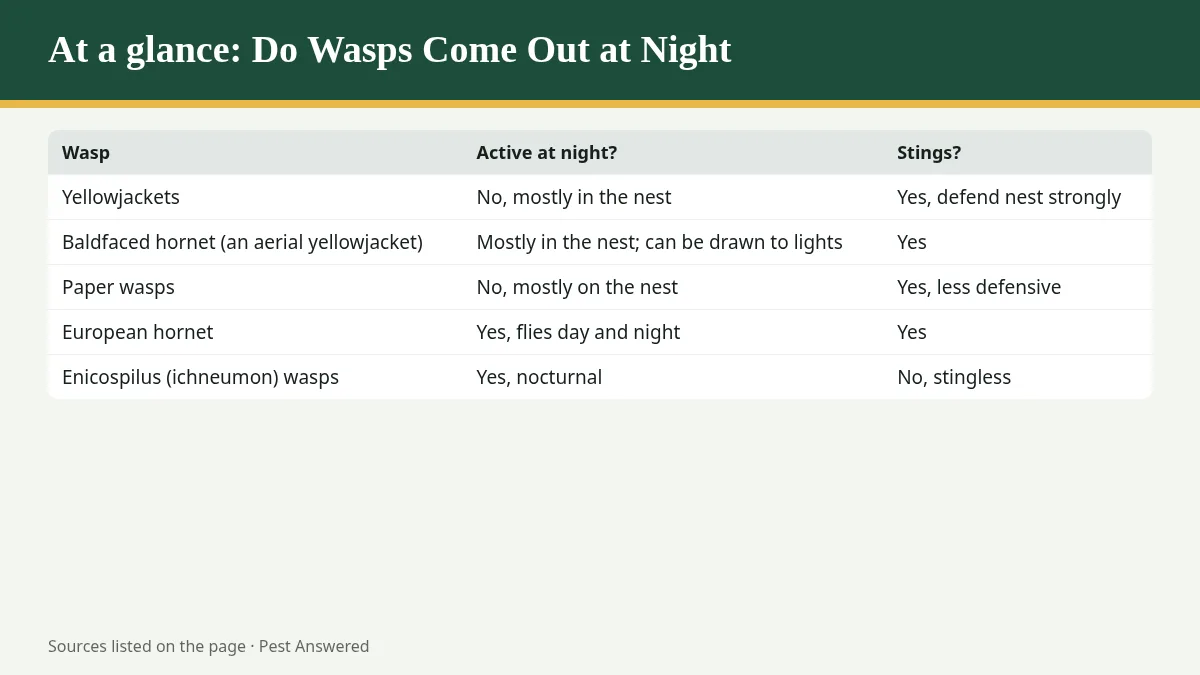
 Do Wasps Come Out at Night? Most Don't. Here Are the Exceptions
Most wasps stay in the nest at night. European hornets and some parasitic wasps do fly after dark and come to porch lights. What it means for you.
-
 Cockroaches
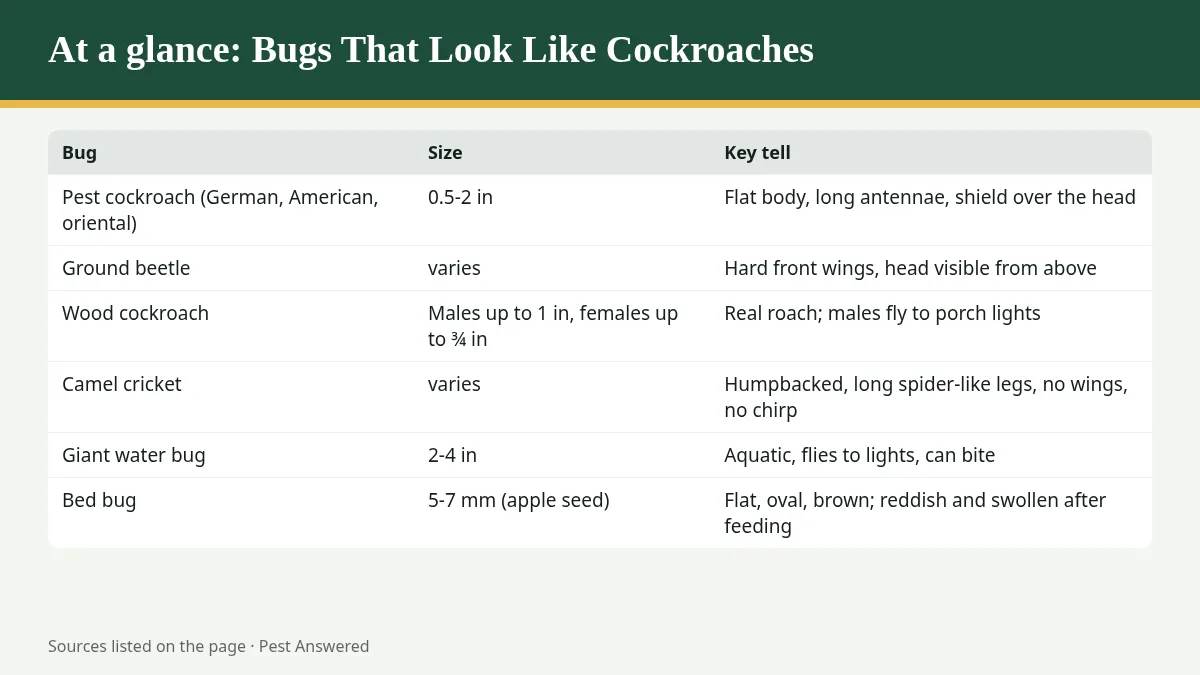
 Bugs That Look Like Cockroaches (and How to Tell Them Apart)
Ground beetles, wood roaches, camel crickets, water bugs and bed bugs get mistaken for cockroaches. Here's how to tell each one apart in under a minute.
-
 Mice & Rats
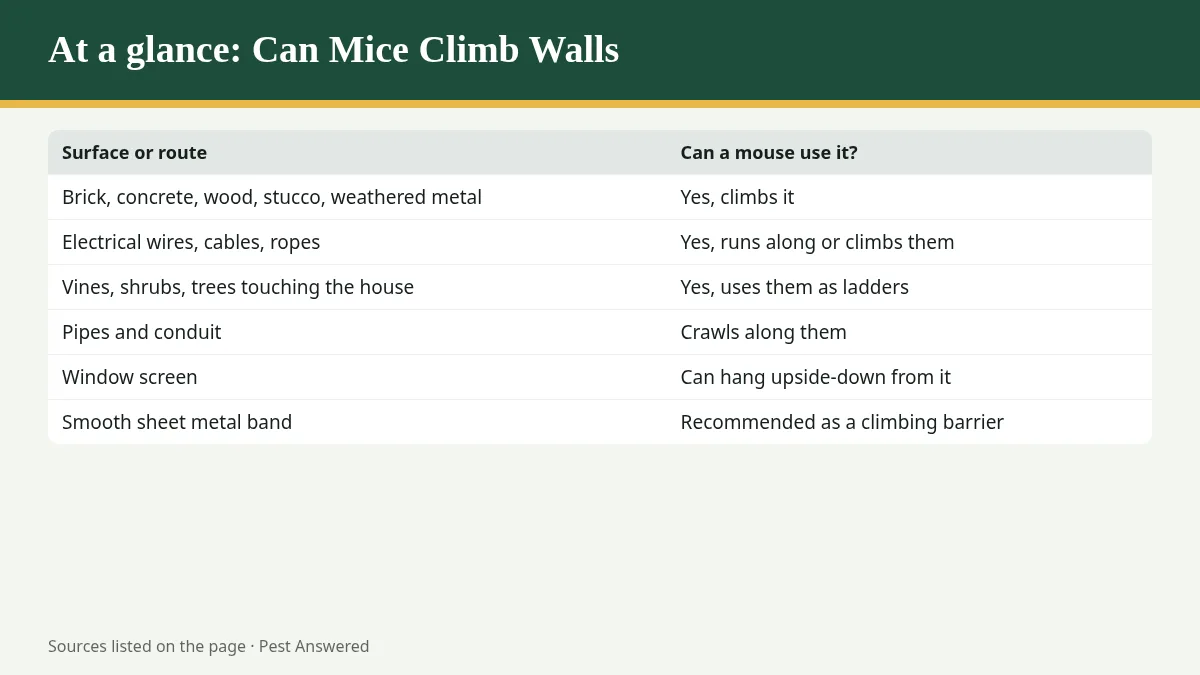
 Can Mice Climb Walls? Yes. Here's What They Can and Can't Climb
Yes, house mice climb any rough wall: brick, wood, concrete, siding. See what they can't grip, how high they jump, and how to block their routes.
-
 Mice & Rats
 Dead Mouse Smell: How Long It Lasts and How to Get Rid of It
A dead mouse smell usually fades once the body dries out, in about a few weeks. How to find the source, clean up safely per CDC, and what not to do.