Why Are There Flying Ants in My House in Winter? What the Timing Tells You
 ✓ Reviewed by Emanuel Jaramillo
Published · Last reviewed · 9 min read
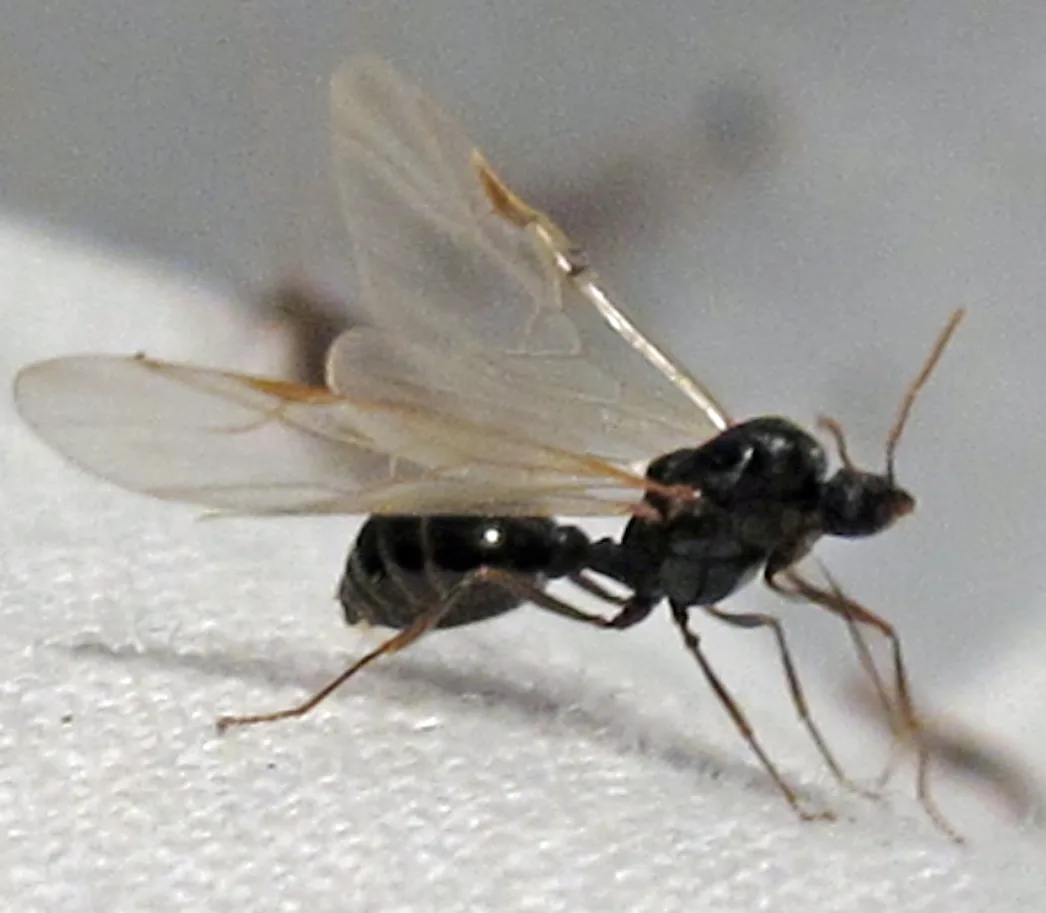
Flying ants in the house in winter almost always mean the colony is living indoors. Ant mating flights are a warm-weather event, so when winged ants turn up in January or February, the warmth that woke them came from your heating system, not the weather. The usual suspects are carpenter ants nesting in a heated wall, pavement ants nesting under a warm slab or along hot water lines, and, now and then, termites.
The timing is the useful part. A summer swarm could have blown in from the yard. A winter swarm is a message from inside the walls, floors or foundation, and it tells you to identify the insect before you vacuum the evidence away.
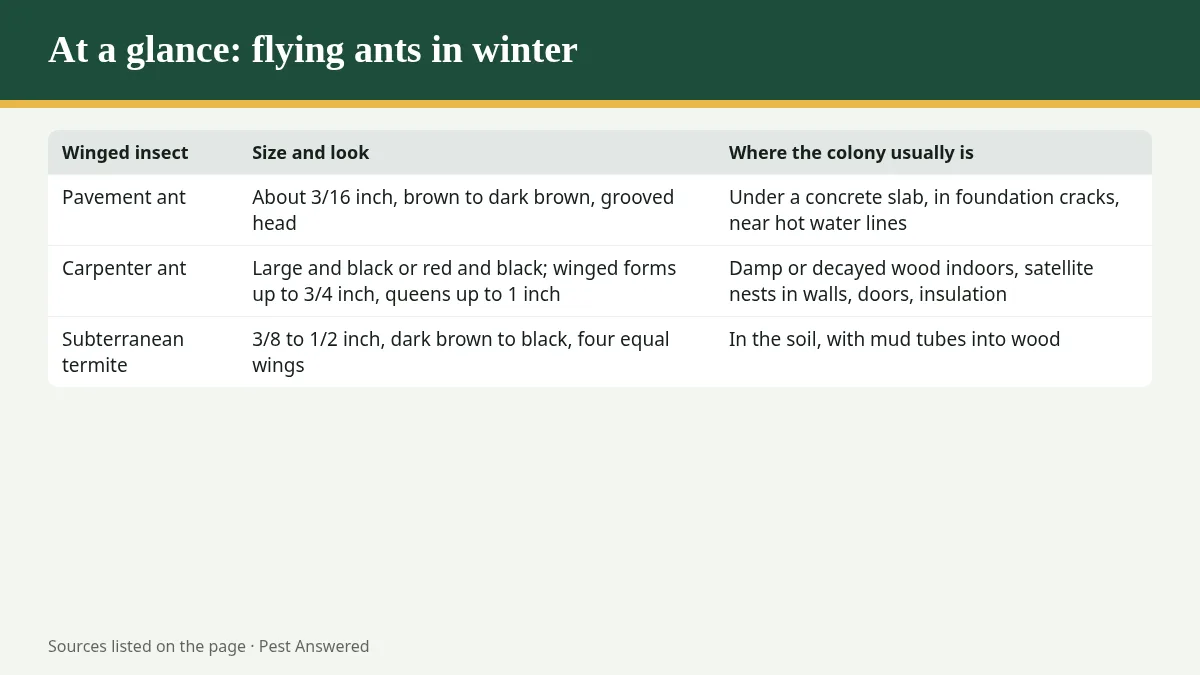 Graphic: summary of this guide, made by our team from the cited sources.
Three winter swarmers and what each one means
| Winged insect | Size and look | Where the colony usually is | How serious |
|---|---|---|---|
| Pavement ant | About 3/16 inch, brown to dark brown, grooved head | Under a concrete slab, in foundation cracks, near hot water lines | Nuisance; no damage to the building |
| Carpenter ant | Large and black or red and black; winged forms up to 3/4 inch, queens up to 1 inch | Damp or decayed wood indoors, satellite nests in walls, doors, insulation | Slow wood damage; find the moisture and the nest |
| Subterranean termite | 3/8 to 1/2 inch, dark brown to black, four equal wings | In the soil, with mud tubes into wood | Likely infestation; get an inspection |
Why winter swarms point inside
Outdoors, the reproductive season is spring and summer. Ohio State's carpenter ant fact sheet says winged males and females emerge from mature colonies usually from March to July, and that carpenter ants are typically inactive during winter unless the nest sits in a heated area of the building. A colony in an unheated porch post is asleep in January. A colony behind the bathroom wall of a heated house can stay on a summer schedule.
The University of Minnesota says this plainly. Its carpenter ant guide states that seeing carpenter ants indoors during winter means there is an inside nest, and that finding them in late winter or early spring means they are coming from a nest in the building. The same guide notes that a nest on a cold, north-facing outside wall may stay dormant until spring, so a quiet winter does not prove the house is clear.
Pavement ants follow the same logic with a different address. UW-Madison Extension says indoor pavement ant colonies nest in wall voids, usually in humid spots near a heat source such as hot water lines, and that while swarmers are usually found in spring, indoor colonies can produce them at any time of year.
How many winged ants did you see?
Numbers matter almost as much as the calendar. UMN draws the line clearly: large numbers of winged ants indoors are a sure sign of a nest inside the home, but one or a few winged queens do not prove one. A newly mated queen can wander in looking for a nest site, and her wings break off once she lands.
In winter that "she flew in" explanation gets much weaker, because there is no outdoor mating flight for her to come from. Still, a single ant is a reason to watch, not to tear into a wall. A cluster at a window, a scattering of shed wings on a sill, or the same kind of winged ant showing up several days in a row is the pattern that points to a colony nearby.
Carpenter ants: the heated-wall nest
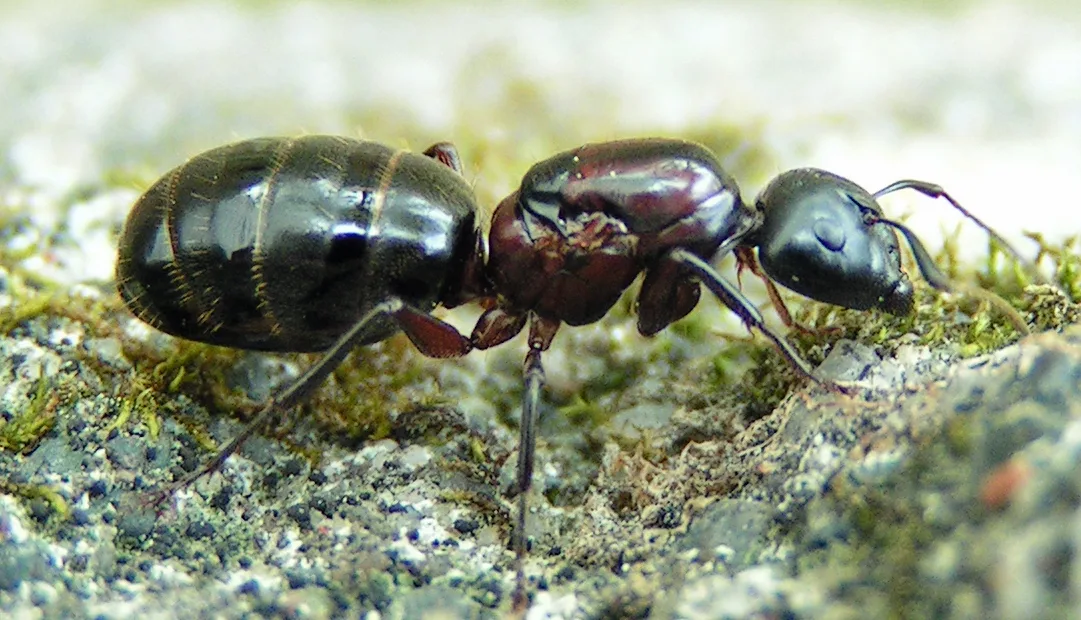
Carpenter ants are the biggest ants most homeowners ever see. Maryland Extension puts workers at 1/4 to 1/2 inch and says the winged reproductives are the largest ants in the state, up to 3/4 inch. Minnesota adds that queens can reach an inch.
They do not eat wood; they carve it out for nesting. That is why moisture is the thread to pull. Ohio State says the parent nest is associated with wood above 15 percent moisture content, usually from rain, leaks or condensation. Minnesota lists the indoor spots where those nests turn up:
- behind bathroom tiles
- around tubs, sinks, showers and dishwashers
- under roofing, in attic beams and under subfloor insulation
- in hollow doors, curtain rods and wall voids
- in foam insulation
Satellite nests, which hold workers, pupae and older larvae, can sit in drier places such as insulation, hollow doors and wall voids. Any nest that sits against a warm interior wall or near a heating run is in the heated area Ohio State describes, which is how a colony stays active through the winter.
Clues to look for:
- Coarse sawdust. Maryland describes carpenter ant frass as looking like pencil shavings and says it means a nest is close by. UNH Extension cautions that sawdust only suggests activity; it does not prove you have found the nest.
- Night activity. Maryland says carpenter ants are most active after dark, and Minnesota says workers in a warmed winter nest go out at night searching for moisture around cabinets, sinks, dishwashers, tubs and toilets.
- Sound. Ohio State says an active colony can make a dry rustling sound, like crinkling cellophane. Minnesota suggests tapping the suspected spot and pressing an ear to the surface.
- Steady sightings. Minnesota counts 20 or more workers seen indoors on a regular basis as a sign of a nest.
The damage side is real but slow. Minnesota says structural wood can be weakened when damage is severe, and that it generally takes years to develop. You have time to find the nest properly; you do not have a reason to ignore it.
Pavement ants: the warm-slab swarm
If the winged ants are small, under a quarter inch, think pavement ants first. Minnesota's pavement ant ID card describes the winged male as about 3/16 inch long, brown to dark brown, with fine grooves on the head and two small spines on the thorax. It says winged pavement ants are found indoors from May through July and also during winter, that they nest in soil under objects including concrete slab construction, and that seeing them indoors indicates a nest in the home.
The reassuring part is on the same card: the nest does not damage the building, and the winged ants are a nuisance. That note about slab construction matters for slab-on-grade houses and finished basements, where the floor above the colony stays warm all winter.
Wisconsin says pavement ant colonies can grow to 3,000 to 4,000 individuals with multiple queens, and that you need to kill the queens to eliminate one. Its advice for a nest you cannot reach is bait, with protein-based or protein and sugar baits working best, used for as long as you see activity. Wisconsin also notes that a barrier treatment around the outside foundation stops ants from coming in but does not eliminate the nest. For timing expectations once bait is out, see our guide on how long ant baits take to work.
Termites: the one to rule out
Winter termite swarms are less common, but they happen. The UC Statewide IPM Program's termite Pest Note says that in buildings with heated basements, termites occasionally fly inside during winter. In colder states the season also starts early: Penn State Extension says swarms of winged termites in Pennsylvania usually emerge between February and June, and that the presence of swarming termites or their wings alone is a sure sign termites are working in a building.
The University of Kentucky's termite FAQ puts it the same way: winged termites found indoors almost always indicate an infestation warranting treatment. Kentucky also says the swarmers themselves cannot damage wood, live only about a day, and can be swept or vacuumed up. The swarm is the symptom; the workers in the soil and the wood are the problem.
Ant or termite: a 30-second check
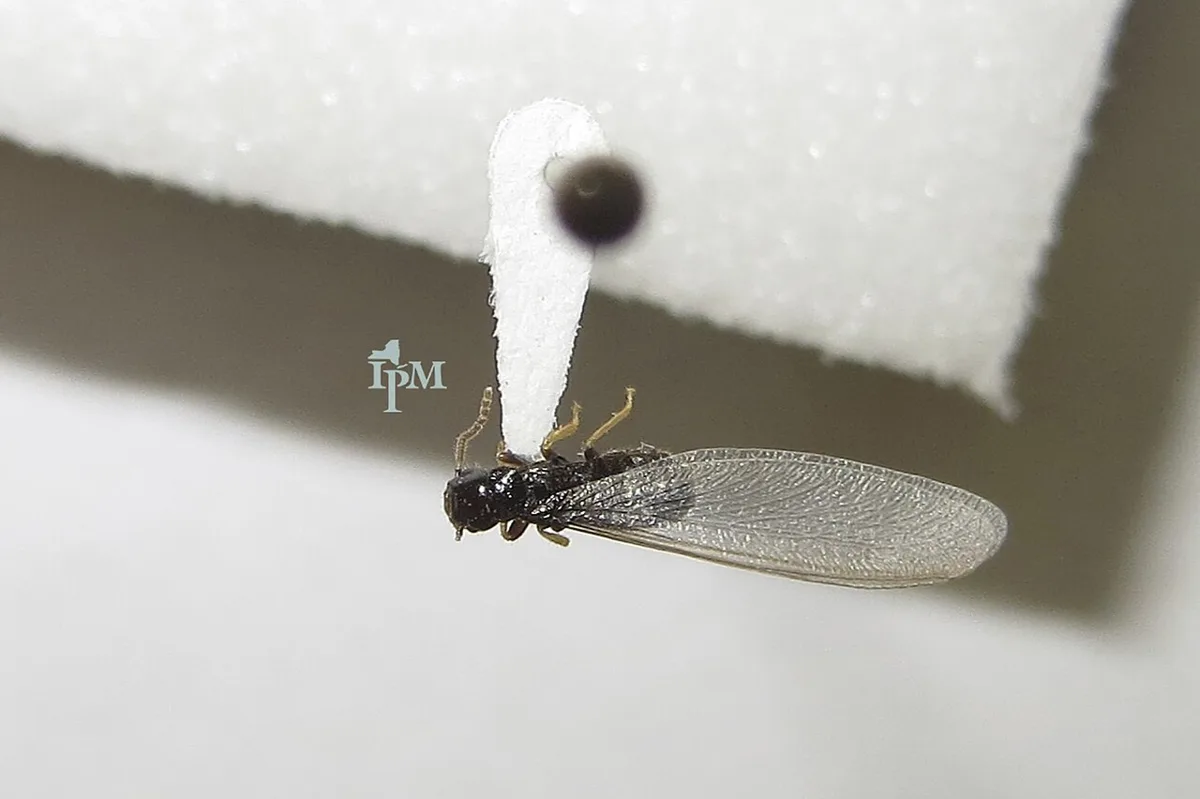
Catch a couple of the winged insects in a clear jar or on tape and look at three things. Kentucky and Penn State agree on the tells:
| Feature | Winged ant | Winged termite |
|---|---|---|
| Waist | Narrow, pinched | Broad, uniform |
| Antennae | Elbowed (bent) | Straight |
| Wings | Front pair longer than back pair; about as long as the body | Four wings of equal length, nearly twice as long as the body |
Ohio State adds one more helpful difference: unlike termites, carpenter ants do not quickly lose their wings after swarming. Penn State says termite wings break off shortly after swarming and that the shed wings are very often the only evidence termites are in a building, so a windowsill of loose, identical wings with few bodies deserves a closer look.
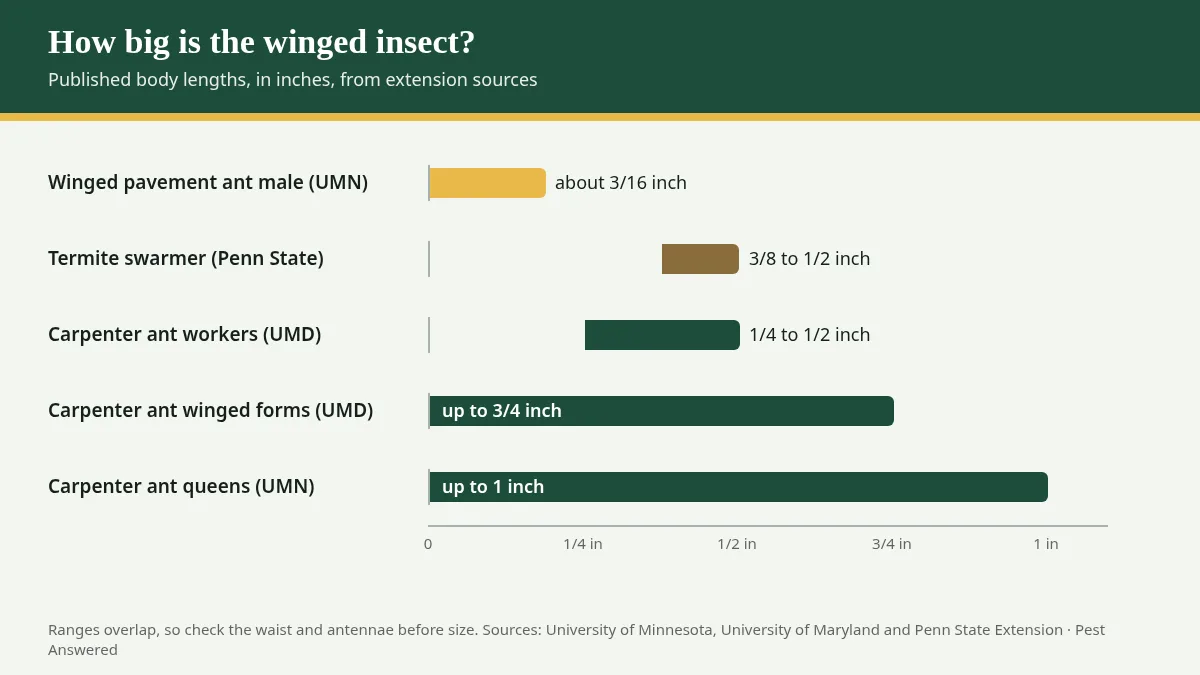 Graphic: made by our team from University of Minnesota, University of Maryland and Penn State Extension figures (linked on this page).
Size alone will not settle it, because a termite swarmer and a small carpenter ant can overlap. Use the waist and the antennae first, then size to sort the ants.
What to do this week
1. Save a sample. Put five or six of the winged insects in a sealed bag or a jar, or stick them to clear tape. An identification takes minutes with a sample and is guesswork without one. Your county extension office can often help.
2. Clean up the rest. Vacuuming is fine. Kentucky says that is all termite swarmers need, and winged ants trapped at a window are not going to found a colony behind the glass.
3. Skip the spray can. Minnesota explains that spraying foraging carpenter ants does not eliminate a nest, because ants carry very little insecticide back, most of the colony is never out foraging, and the nest stays untouched. Wisconsin says the same thing about foundation sprays and pavement ants. A swarm in the living room is the same story: you would be treating the tip of the colony.
4. Trace where they came out. Swarmers head for light after they emerge, so the window is rarely the source. Check the floor and baseboards below the window where you found them, the bathroom and kitchen plumbing walls, the slab edge in a finished basement, and around the water heater and furnace closet.
5. Look for the moisture. For carpenter ants especially, the fix is drying the wood. Minnesota says the best control is to locate and destroy the nest, replace damaged or decayed wood, and eliminate the moisture problem. A slow drip under a tub or sink, a sweating pipe in a wall, or a leaking window frame is the kind of thing that keeps a winter colony going.
6. Match the response to the insect.
- Pavement ants: protein or protein-and-sugar bait along the trail, placed where children and pets cannot reach it and kept out until activity stops. Follow the label.
- Carpenter ants: Minnesota recommends a pest management professional for most indoor nests, because they are hidden in walls, ceilings and subfloors. Tell them when, where and how many ants you saw.
- Termites: book an inspection. Our guide to how long termite treatment takes to work explains what happens after.
If you are seeing plenty of wingless ants as well, our explainer on why there are so many ants in the house covers how colonies decide where to settle.
The short version
Winged ants in winter are not visitors from the yard. They are a colony's reproductive crop, produced early because your heating kept the nest warm. Small brown ones with a grooved head are most likely pavement ants under the slab: annoying, not damaging, and treatable with bait. Large black or red-and-black ones are likely carpenter ants, which means damp wood somewhere and a nest worth finding. Straight antennae, a thick waist and long equal wings mean termites and an inspection. In every case, keep a sample, skip the spray, and look for the warm, damp spot the colony is using.
Frequently asked questions
Can winged ants come in from outside in winter?
Not in any real number when it is cold out. Mating flights happen in warm weather, so Minnesota Extension treats carpenter ants seen indoors in late winter as coming from a nest in the building. The one exception is a worker carried in on firewood, and UMN says those strays cannot start a nest.
Do flying ants in winter mean my house has structural damage?
Not necessarily. Pavement ant swarmers are a nuisance with no damage to the building, according to UMN. Carpenter ants do remove wood, but UMN says the damage usually builds slowly over years. Termites are the case that needs a prompt inspection.
Should I spray the flying ants?
Spraying the swarm only kills the insects you can see. UMN explains that sprays on foraging ants do not reach the nest, and Kentucky says termite swarmers indoors can be removed with a broom or vacuum. Save a few for identification first.
Why do I see them near windows and lights?
Swarmers head for light. Penn State says winged termites that emerge inside buildings swarm about doors and windows, and Kentucky notes they are attracted to light. The window is where they end up, not usually where they came from.
Sources
- Carpenter Ants, University of Minnesota Extension
- Carpenter Ant Queen (What Insect Is This?), University of Minnesota Extension
- Pavement Ant Male (What Insect Is This?), University of Minnesota Extension
- Pavement Ants, University of Wisconsin-Madison Extension
- Carpenter Ants (HYG-2063), Ohio State University Extension
- Carpenter Ants, University of Maryland Extension
- Carpenter Ants Fact Sheet, UNH Extension
- Termites (ENTFACT-604), University of Kentucky Entomology
- Eastern Subterranean Termites, Penn State Extension
- Subterranean and Other Termites (Pest Notes 7415), UC Statewide IPM Program
Spotted an error? See our corrections policy or email contact@pestanswered.com.

Pest Answered Editorial Team
Our editors research each guide from the listed sources and check every claim before publishing. Editorial policy
Emanuel Jaramillo
Expert Contributor, Pest Control
Emanuel Jaramillo has 12 years of hands-on pest control experience and is bilingual in English and Spanish. He contributes field tips and reviews our practical guides on pest signs, identification, prevention and…
Related guides
-
 Ants
Why Are There Ants in My Dishwasher? Food, Water, or a Nest Nearby
Ants in a dishwasher are usually after trapped food and standing water, but a leaking hose can also draw carpenter ants to nest nearby. How to tell which, and what to do.
-
 Ants
Why Are There So Many Ants in My House? What a Big Ant Crowd Really Means
Hundreds of ants usually means one colony found food, water or shelter and recruited its workers by scent trail. Why the numbers jump, which ant you have, and what stops them.
-
 Ants
How Long Do Ant Traps Take to Work? Real Timelines From Extension Experts
Most ant bait stations cut ant numbers in about 5 to 10 days, but some ants take two weeks or more and fire ant baits can take weeks to months. Timelines, why you see more ants first, and fixes.
-
 Ants
Why Are There Ants Only in My Bathroom? What It Usually Means
Ants that show up only in a bathroom are usually after water, warmth or the pipe runs they travel along. How to tell which ant it is, what to check, and when winged ones mean termites.